
 Portugues
Same Game (Simon Tatham's Puzzles)
Saved games stay in this browser only.
About the puzzle
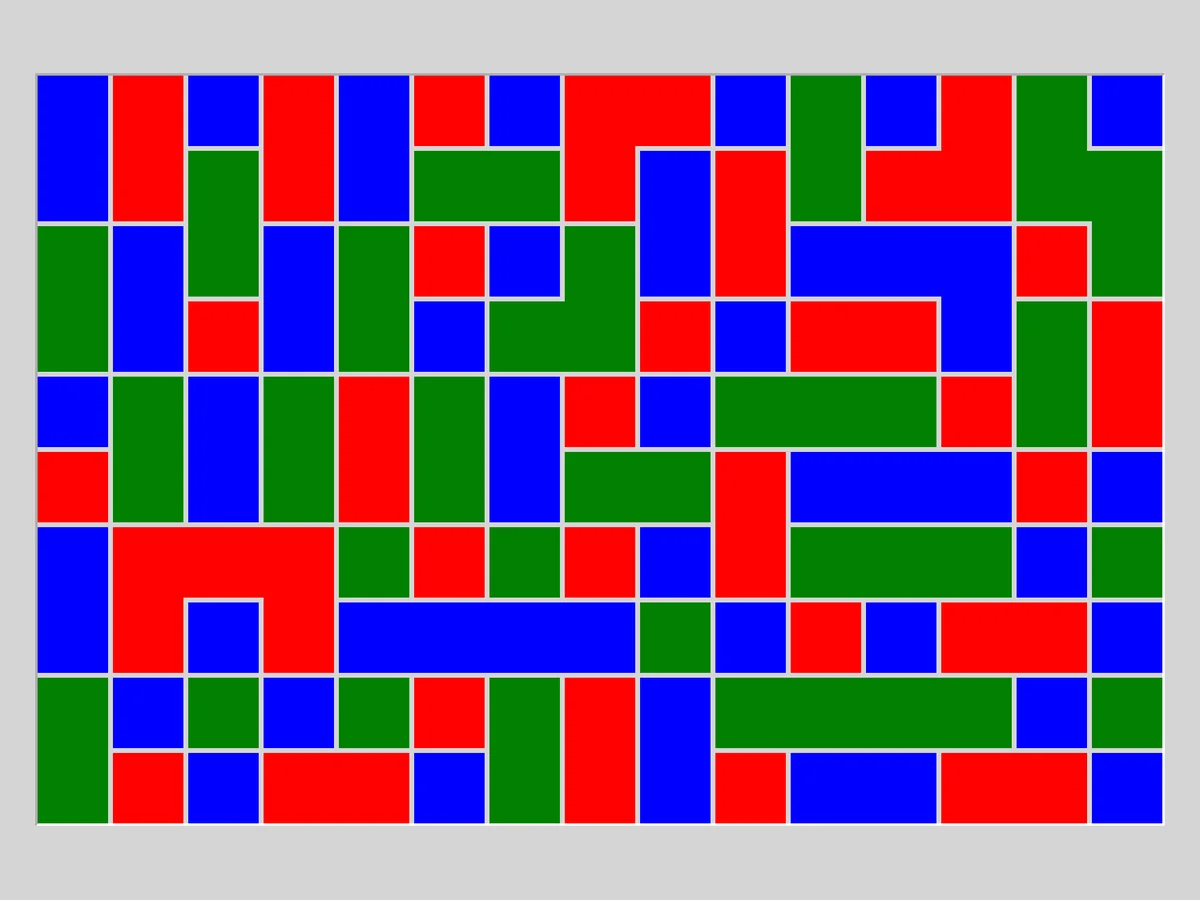
Same Game fills a grid with squares in a few colours. Pick any group of two or more squares of the same colour that touch along their sides, and it disappears. The squares above drop into the gap, and if a whole column empties out, the columns to its right slide over to close it. The aim is to clear the whole grid, and to score as many points as you can along the way.
The game has been around on many computers under names like SameGame and Same GNOME. James Harvey contributed this version to the collection in 2005.
Rules
- A group is two or more squares of the same colour joined edge to edge.
- Removing a group makes the squares above it fall down, and then empty columns are filled from the right.
- With the default scoring, a group of n squares scores (n-2)x(n-2) points: a pair scores nothing, three squares score 1, ten squares score 64.
- You win by clearing the grid. If only single squares are left, with no group to remove, the game is lost.
Controls
| Input | Action |
|---|---|
| Left click a group | select it (the squares are highlighted) |
| Left click the selected group | remove it |
| Right click the selected group | clear the selection |
| Arrow keys | move the cursor |
| Space / Enter | select the group under the cursor, then remove it |
| N / U / R | new game / undo / redo |
The status bar shows your score, and while a group is selected it shows how many points removing it would earn.
How to solve it
Think about the last colour. Clearing the grid means every colour has to be gathered into groups in the end. Decide early which colour you will finish with and avoid breaking up its squares.
Never strand a single square. A square of some colour with no partner left anywhere on the board can never be removed. Before removing a group, check that it does not leave a lone square of a colour with no others to join.
Work from the bottom. Removing a group low down makes everything above it fall, which brings new squares together. Removing groups at the top changes very little.
Let groups grow before you take them. Because of the squared scoring, one group of twelve is worth far more than three groups of four. Clear the other colours from between squares of the same colour so they fall together, then take them as one.
Use the selection preview. Selecting a group shows its score without committing, which is a cheap way to compare options. Undo is there too when a removal turns out badly.
Sizes
The Type menu has 5x5 and 10x5 grids with 3 colours, a 15x10 grid with 3 or 4 colours and a 20x15 grid with 4 colours. Custom sets the width, the height and the number of colours (more colours means smaller groups and a harder game), the scoring system (the alternative (n-1)x(n-1) gives a point for a pair) and whether the grid is guaranteed to be solvable.
Playing here
Click Play to open the puzzle. The menu above the board has New game, Restart, Undo and Redo (this puzzle has no Solve option), the Type menu with the sizes, and the Game menu, where you can type in a game ID or a random seed, download the current game as a file, load a saved file and change the preferences. Your game in progress is kept in this browser and comes back with its whole undo history the next time you open the page.
On a touch screen, tap a group to select it and tap it again to remove it.
Credits and licence
Same Game was written by James Harvey for Simon Tatham's Portable Puzzle Collection, which Simon Tatham maintains with code contributed by several other authors and distributes with its source code under the MIT licence. This page runs a WebAssembly build made by FredyGames from the author's official source snapshot, with no changes to the puzzle; the source and the build script are hosted with the game, and the licence text is linked from this page.