
 Portugues
Signpost (Simon Tatham's Puzzles)
Saved games stay in this browser only.
About the puzzle
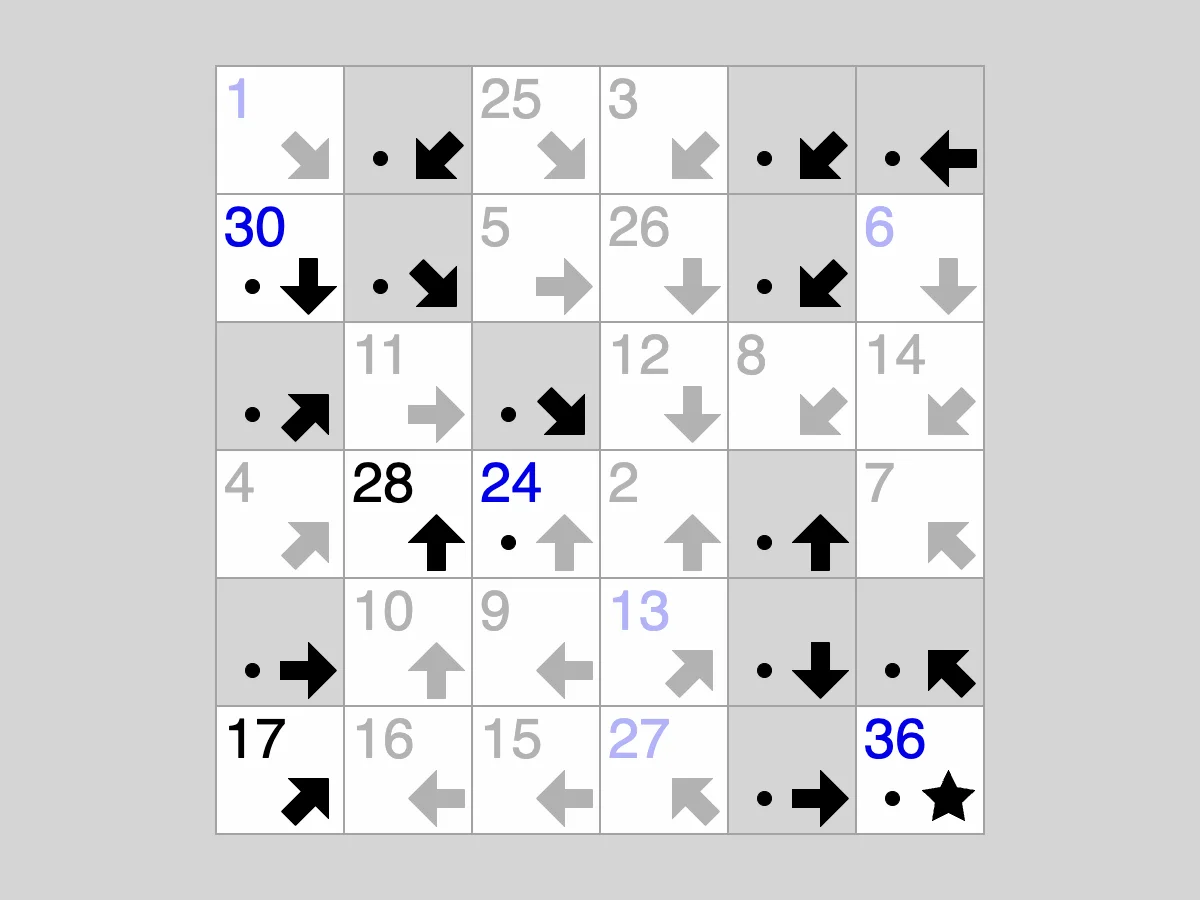
In Signpost every square of the grid carries an arrow, pointing in one of eight directions, and a few squares carry numbers. The squares form a single path that visits each of them once, numbered from 1 up to the size of the grid, and each square's arrow points the way to the next one. The next square can be any distance away, as long as it lies somewhere along the arrow. You have to find the order.
Credit for the idea goes to the puzzle site of Angela and Otto Janko, where it is called Pfeilpfad (arrow path). James Harvey wrote this version for Simon Tatham's collection.
Rules
- Number every square so that the numbers run from 1 to the total number of squares, each used once.
- The arrow in each square points towards the square with the next number: in the same row, column or diagonal, in that direction, at any distance.
- The last square has no arrow; it shows a star instead.
- The first and last numbers are always shown, and some puzzles show a few numbers in between.
Controls
| Input | Action |
|---|---|
| Left-drag from a square to another | link it to its successor |
| Right-drag from a square to another | link it to its predecessor |
| Left-drag a square off the grid | remove its links |
| Right-drag a square off the grid | break up its whole chain |
| Arrow keys | move the cursor |
| Enter, move, Enter | link the first square to the second |
| Space, move, Space | link backwards (show the squares that point at this one) |
| N / U / R | new game / undo / redo |
Clicking a square shows where it can legally link. A square's arrow turns grey once it has a successor, and a square that still needs a predecessor has a small dot in its corner, so you are always joining a black arrow to a dot. When two unnumbered squares are joined, they get temporary labels such as a and a+1, and the whole chain takes a real number as soon as it touches a numbered square.
How to solve it
Only one target. Some arrows point at just one square that is still free to be a successor, for example an arrow pointing at the edge from right next to it. Link those straight away.
Only one arrow points here. Look at it the other way round: a square that needs a predecessor, but which only one unlinked arrow points at, must come right after that square.
Follow the numbers. If 7 is shown and 9 is shown, 8 must be a square that 7's arrow points at and whose own arrow points at 9. Often only one square fits both.
Build chains, then join them. Chains labelled with letters float freely until they touch a number. When a chain has a fixed length, it has to fit exactly into a gap in the numbering, which rules out many places.
Watch the ends. Only a square whose arrow points at the star can come just before it, and square 2 must lie along the arrow of square 1. These short lists are often the first deductions on the board.
Sizes
The Type menu has 4x4, 5x5, 6x6 and 7x7 grids. In the normal puzzles the path starts in the top left corner and ends in the bottom right; the "free ends" types put the start and the end anywhere. Custom sets the width, height and whether the ends go in the corners, and Preferences change the victory effect.
Playing here
Click Play to open the puzzle. The menu above the board has New game, Restart, Undo, Redo and Solve (which you can undo to keep going on your own), the Type menu with the sizes, and the Game menu, where you can type in a game ID or a random seed, download the current game as a file, load a saved file and change the preferences. Your game in progress is kept in this browser and comes back with its whole undo history the next time you open the page.
On a touch screen, drag from a square to the next one with your finger; turn on the Mark button above the board to drag backwards, from a square to the one before it.
Credits and licence
Signpost was written by James Harvey for Simon Tatham's Portable Puzzle Collection, which Simon Tatham maintains with code contributed by several other authors and distributes with its source code under the MIT licence. This page runs a WebAssembly build made by FredyGames from the author's official source snapshot, with no changes to the puzzle; the source and the build script are hosted with the game, and the licence text is linked from this page.