
 Portugues
Solo (Simon Tatham's Puzzles)
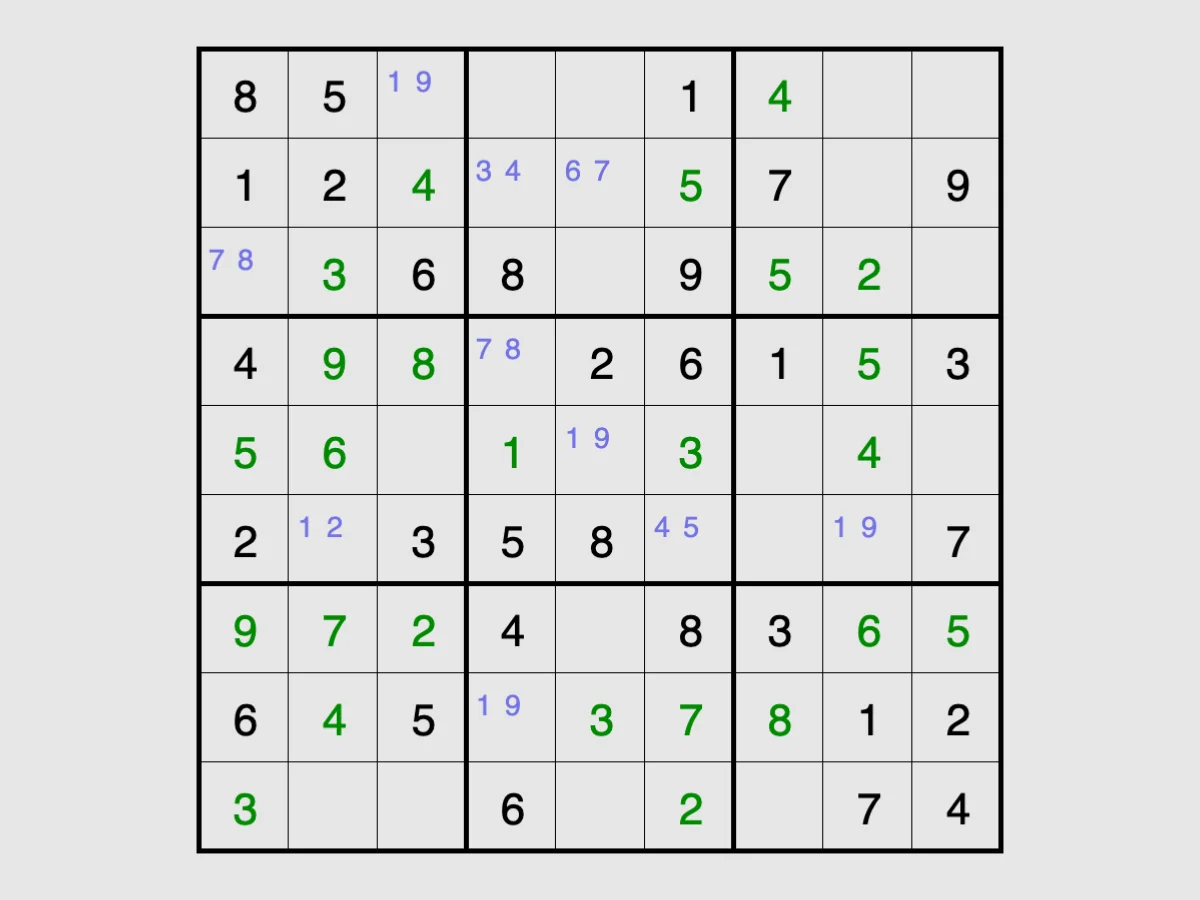
Saved games stay in this browser only.
About the puzzle
Solo is Simon Tatham's version of the number-placement puzzle that newspapers made famous as sudoku. The classic grid is 9 by 9, divided into nine blocks of 3 by 3. Some squares already hold digits; you fill in the rest so that no digit repeats in any row, column or block.
What makes Solo worth playing is its generator. Every puzzle is made on the spot, has a single solution, and is graded by the kind of reasoning it needs. On the easiest levels there is always a square where only one digit fits; on the harder ones you have to reason about where a digit can go in a whole row or block; at the Unreasonable level you will eventually need to try a guess and backtrack. Solo also plays several popular variants (described below).
Rules
- Every row contains each digit exactly once.
- Every column contains each digit exactly once.
- Every block contains each digit exactly once.
- In X mode, the two main diagonals also contain each digit once.
- In killer mode there are no starting digits: cages outlined in colour show the sum of their squares, and no digit repeats inside a cage.
The digits run from 1 to the size of the grid. Grids larger than 9 use letters after 9 (a 12x12 grid uses 1 to 9 and then a, b and c).
Controls
| Input | Action |
|---|---|
| Left click, then a digit | write the digit in the square |
| Left click, then Space or 0 | clear the square |
| Right click, then digits | add or remove pencil marks |
| Arrow keys | move the cursor |
| Enter | switch the cursor between digits and pencil marks |
| N / U / R | new game / undo / redo |
Pencil marks are small notes that the game ignores: use them to keep a list of candidates, or anything else that helps you.
How to solve it
Scan for singles. Pick a digit and look at one block: if every other square in it is blocked by that digit in a crossing row or column, the digit goes in the last free square. Sweep all nine digits through all nine blocks before anything fancier.
Check what is missing. In a row, column or block with only two or three empty squares, list the missing digits and see which square each one can reach.
Use pencil marks on harder levels. From Intermediate up, you will need the candidates. A pair of squares in the same row that can only hold the same two digits (a "naked pair") removes those digits from the rest of that row.
Block and line interactions. If, inside a block, a digit can only go in one row, then it cannot go anywhere else in that row outside the block. This one idea solves a surprising number of Advanced puzzles.
Killer arithmetic. In killer mode, remember that each full row, column and block adds up to 45. Comparing that with the cage sums tells you the value of squares that stick out of a group of cages.
Difficulty and variants
The Type menu covers 2x2 and 2x3 grids for beginners, the classic 3x3 at Trivial, Basic, Intermediate, Advanced, Extreme and Unreasonable, X versions (diagonals), killer, jigsaw (irregular blocks) and the larger 3x4 and 4x4 grids. Custom lets you combine any block shape with X, jigsaw or killer, choose the symmetry of the starting digits and the difficulty. Hard grids can take a few seconds to generate.
Playing here
Click Play to open the puzzle. The menu above the board has New game, Restart, Undo, Redo and Solve (which you can undo to keep going on your own), the Type menu with the levels and variants, and the Game menu, where you can type in a game ID (to play a sudoku from a newspaper, for instance) or a random seed, download the current game as a file, load a saved file and change the preferences. Your game in progress is kept in this browser and comes back with its whole undo history the next time you open the page.
On a touch screen, tap a square and use the number keys that appear below the board; turn on the Mark button to enter pencil marks instead.
Credits and licence
Solo is part of Simon Tatham's Portable Puzzle Collection, written by Simon Tatham with code contributed by several other authors, and distributed with its source code under the MIT licence. This page runs a WebAssembly build made by FredyGames from the author's official source snapshot, with no changes to the puzzle; the source and the build script are hosted with the game, and the licence text is linked from this page.