
 Portugues
Unequal (Simon Tatham's Puzzles)
Saved games stay in this browser only.
About the puzzle
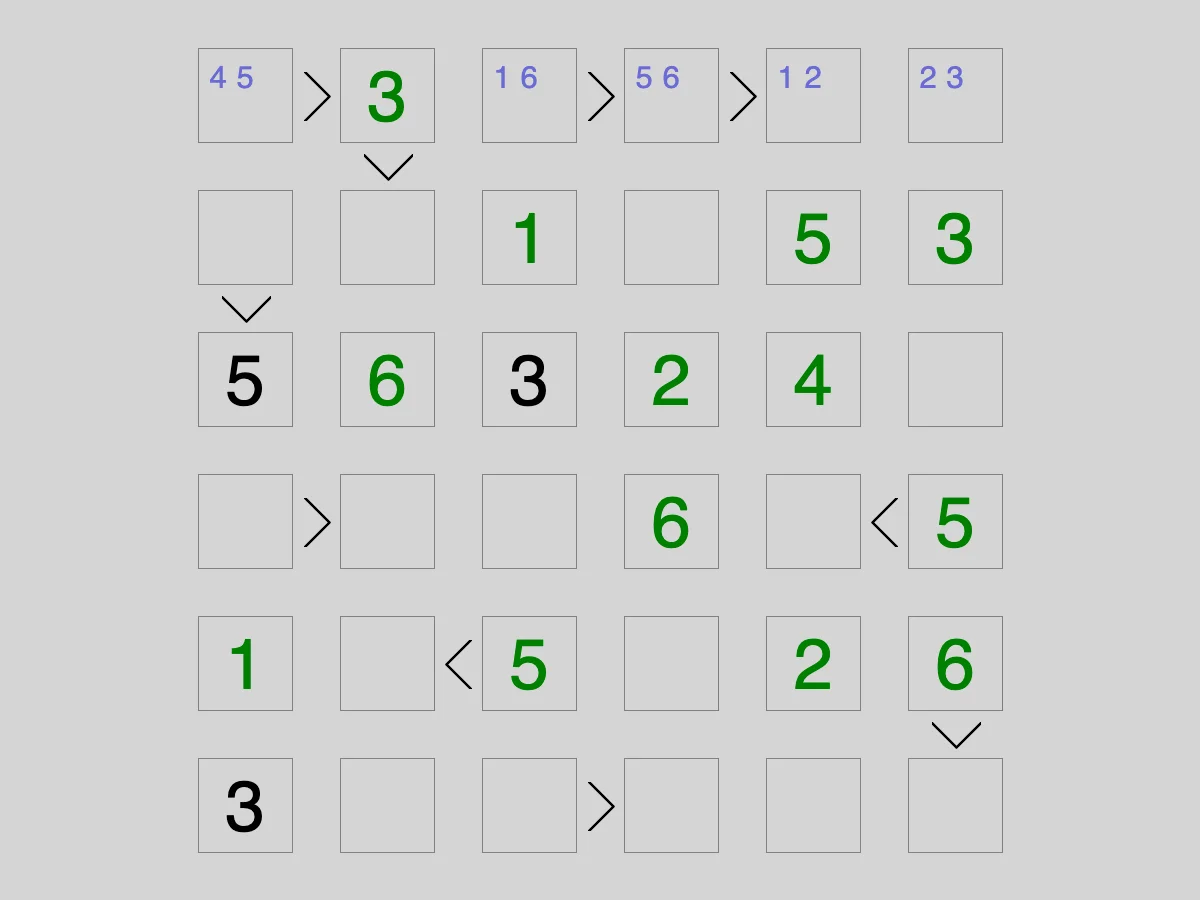
Unequal is a Latin square with a twist. Fill a square grid with numbers so that each row and each column holds every number from 1 to the size of the grid once, as in a sudoku without boxes. Between some pairs of neighbouring squares there are greater-than signs, and those inequalities, together with a few given numbers, are the only clues you get.
In this form the puzzle is also known as Futoshiki, the name under which it ran in a British newspaper when it was added to the collection. James Harvey wrote it for Simon Tatham's collection, and gave it a second mode, Adjacent, with a different kind of clue.
Rules
- Each row contains every number from 1 to N exactly once.
- Each column contains every number from 1 to N exactly once.
- Every clue sign between two squares must be satisfied.
In Unequal mode the clues are greater-than signs, pointing at the smaller number, and not every true inequality is shown. In Adjacent mode the clues are bars between squares whose numbers are consecutive (one higher or one lower), and every such pair is marked, so two neighbours without a bar are never consecutive.
Controls
| Input | Action |
|---|---|
| Left click, then a digit | fill in the square |
| Left click, then Space or 0 | clear the square |
| Right click, then digits | add or remove pencil marks |
| M | fill every empty square with all possible pencil marks |
| H | the same, then remove the candidates that are obviously impossible |
| Left click on a clue | grey it out as done (click again to restore) |
| Arrow keys | move the cursor |
| Enter | switch the cursor between numbers and pencil marks |
| Ctrl/Shift+arrow | grey out the clue in that direction |
| N / U / R | new game / undo / redo |
The game marks a number that repeats in a row or column and a clue that the numbers next to it break.
How to solve it
Ends of a chain. A square that is greater than a neighbour can never be 1, and a square that is smaller can never be N. In a chain such as a > b > c, the first square is at least 3 and the last at most N - 2.
Use the Latin square. If a number has only one possible square left in a row or column, it goes there; if a square has only one candidate, that is its number. Press H to get a grid of pencil marks to work from.
Inequalities squeeze candidates. When a square can only be 2 or 3 and the square below it is smaller, the one below is at most 2. Push these limits back and forth along the signs until nothing changes.
Pairs and sets. If two squares in a row can only hold the same two numbers, those numbers are used up and can be removed from the rest of the row. The same works with three squares and three numbers.
Adjacent mode. Here the missing bars matter as much as the bars: a square next to a 3 without a bar can't be 2 or 4. Large numbers and small numbers tend to alternate where bars are absent.
Sizes and difficulty
The Type menu has Unequal grids from 4x4 to 7x7 at Easy, Tricky and Extreme (not every size at every level), and Adjacent grids of 5x5, 6x6 and 7x7. Custom adds a Trivial level, with no signs at all, and a Recursive level that needs backtracking, and lets you pick other sizes; above 9x9 the game also uses letters, which need a keyboard.
Playing here
Click Play to open the puzzle. The menu above the board has New game, Restart, Undo, Redo and Solve (which you can undo to keep going on your own), the Type menu with the sizes, and the Game menu, where you can type in a game ID or a random seed, download the current game as a file, load a saved file and change the preferences. Your game in progress is kept in this browser and comes back with its whole undo history the next time you open the page.
On a touch screen, tap a square and use the number keys that appear below the board; turn on the Mark button to enter pencil marks instead.
Credits and licence
Unequal was written by James Harvey for Simon Tatham's Portable Puzzle Collection, which Simon Tatham maintains with code contributed by several other authors and distributes with its source code under the MIT licence. This page runs a WebAssembly build made by FredyGames from the author's official source snapshot, with no changes to the puzzle; the source and the build script are hosted with the game, and the licence text is linked from this page.