
 Portugues
SpacePi
Saved games stay in this browser only.
About the game
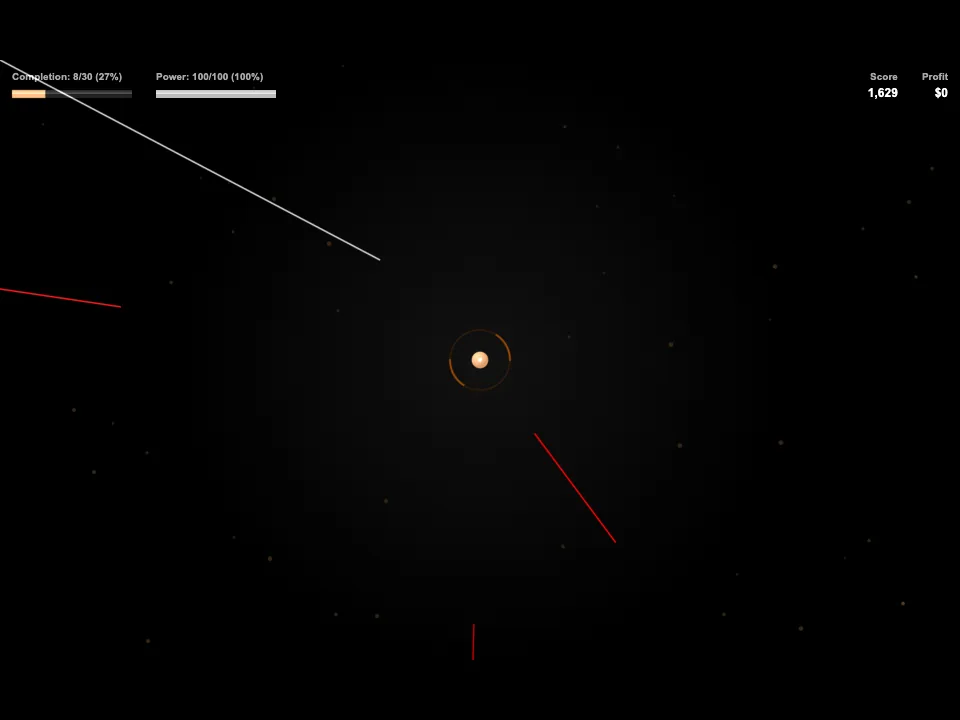
In SpacePi you protect a small green base floating in empty space. Enemy lines shoot in from the edges of the screen towards it, and your only weapon is the mouse: click, drag and release to draw a defensive line of your own. Any enemy line that touches one of yours is destroyed, and any that gets through hurts the base.
Drawing costs power, shown in the bar at the top, and power refills slowly, so you cannot simply wall off the whole screen. Meanwhile the base keeps growing, and the level is won when it reaches its target radius. Destroyed enemies drop coins that you collect by drawing through them, and coloured power-ups that slow the enemies, give unlimited power for a while, speed up the base or scatter extra coins.
Between levels you spend the coins on upgrades: more power and faster regeneration, a tougher and faster-growing base, a coin magnet, better coins and longer-lasting power-ups. There are thirteen bases to defend, each harder than the last. The score works like golf: lower is better, and you earn a better one by finishing faster, drawing fewer and shorter lines, and taking less damage.
Jack Rugile made SpacePi for the first js13kGames competition, in 2012, where the whole game had to fit in a zip of 13 kilobytes.
Playing it here
This is the version kept on the js13kGames site. Click Play and then Play Game to reach the upgrades and level screen, and pick a level. The game was designed for a 960 by 600 page, and here it is scaled to fit the frame. Your progress, coins and upgrades are saved in this browser at the end of every level and after each purchase; Reset Game Data on the main menu erases them. The game has no sound. The links on the title screen only open, in a new tab, if you click them.
Controls
| Input | Action |
|---|---|
| Click and drag | draw a defensive line |
| Release the button | place the line |
| Space | pause or resume the level |
| Mouse | menus, upgrades, level choice |
A few things worth knowing
Short lines are cheap. A short line in exactly the right spot uses much less power than a long barrier, and it is better for the score too.
Intercept early. A line drawn across an enemy's path near the edge gives you time to react if you miss, while one drawn right next to the base does not.
Draw through the coins. Coins only count when one of your lines touches them, and the magnet upgrade pulls them closer.
Upgrade power first. Power capacity and regeneration decide how much you can draw, and the later bases throw many lines at once.
Credits and licence
SpacePi was created by Jack Rugile, who wrote the code and designed everything in it. It is released under the MIT licence, published in his repository on GitHub. The licence text is linked from this page.