
 Portugues
Tangomon
Saved games stay in this browser only.
About the game
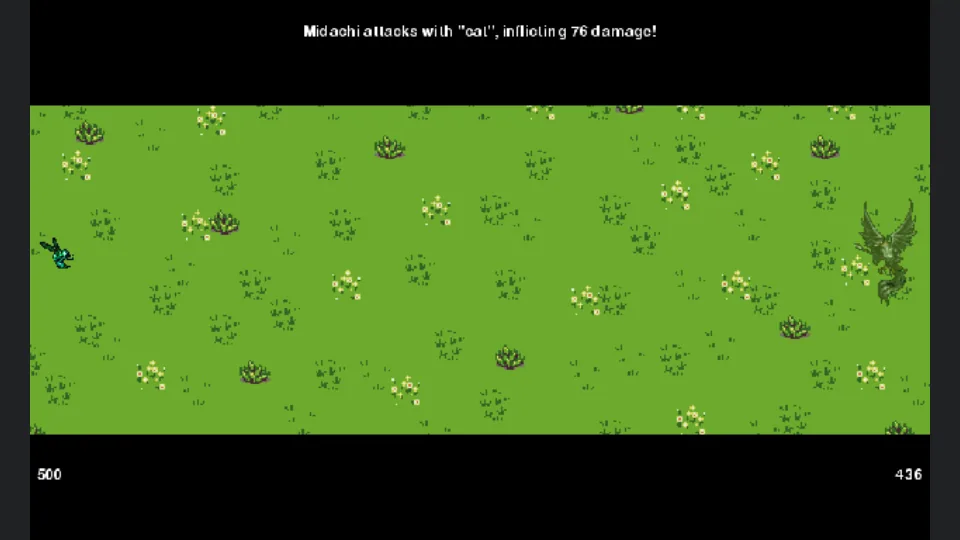
Tangomon is a monster-battling game in which you attack by remembering things. You collect tangomon, small creatures from nine zones, and fight them with tangojis: flashcards that you write yourself. A tangoji is a word with a clue, and the clue can be anything you want to learn: a vocabulary word in another language and its meaning, a formula, a name, a date.
In a battle, the game shows you the clue of one of your tangojis and a text box. Type the matching word and press Enter to hit the enemy: the better you remember it (and the faster you answer), the harder you hit. Get it wrong and you are hurt. Every time you use a tangoji it gets a little weaker, so the game keeps asking you to add new ones, and the ones you got wrong come back until you know them. Win a battle and you may recruit the tangomon, and the further to the right the zone, the stronger the creatures in it.
It is a learning game and a monster game in equal parts, and it works for anything you can write as a clue and an answer.
Playing it here
The first time you click Play the page downloads the Python runtime and the pygame library (about 23 MB) and the game (about 2 MB), which takes a few seconds; after that a "click to start" message appears, and one more click opens the title screen. The download is kept by your browser, so every other pygame game on the site opens faster. Nothing is loaded from other sites. Your saves and options are kept in this browser only, in five save slots.
Pick "New Game" and a slot. The game asks for your name and then for three tangojis (a word, a clue and, if you want, some extra information) before it lets you start: write down three things you really want to learn. The menus and the game are in English and use a simple built-in font, so letters with accents or other alphabets may not show up; plain letters and numbers work best.
Controls
| Key | Action |
|---|---|
| Left / Right | choose a zone on the zone screen |
| Enter | start a battle in the chosen zone; confirm in menus and dialogs |
| Escape, Space, Tab or Backspace | open the menu on the zone screen; go back in menus |
| Up / Down | move in menus |
| Keyboard | in a battle, type your answer and press Enter; also type your name, words and clues |
| Escape | in a battle, ask to run away (you lose the tangomon you were using) |
Tips
Write clues you can answer. A clue that you can not answer from memory is a way to lose a battle; short and clear works best.
Add tangojis often. Used tangojis lose power, so a bigger set of tangojis hits harder and also teaches you more.
Be careful when you leave a battle. Running away costs you the tangomon you were using, and the game asks you to confirm.
Frequently asked questions
Does it save my progress? Yes, in the browser, in five slots. Clearing the site data erases them, and so does your list of tangojis.
Do I need to write the tangojis myself? Yes: the game has no word lists of its own, and that is the idea.
Does it work on a phone? It needs a keyboard, so it is meant for a computer.
Is it free? Yes. The game is free software: the code is under the GNU GPL, and the sprites, sounds and music under Creative Commons and other free licences.
Credits and licence
Tangomon was made by onpon4. The code is released under the GNU General Public License, version 3 or later. The monster sprites are by Stephen "Redshrike" Challener, Blarumyrran, LordNeo, Sharm, 5hiroi, hc and others (CC BY 3.0 and CC0), the music by SketchyLogic (CC BY 3.0), and the sounds by the author, NenadSimic (CC BY 3.0) and MatzeB of SuperTux (GPL 3+); all of them are named, with their licences, in the credits screen of the game and in the licence file. The game runs on the Pygame SGE and xsge_gui (LGPL-3.0-or-later). The version served here has some changes so it can run in a browser (the dialogs can no longer wait inside loops, the Quit, Fullscreen and Select Font entries are gone and the saves live in the browser); the changes, the full source and every licence text are linked from the Licenses page. The game also runs on pygame-ce (LGPL-2.1) and CPython, whose licences and source are linked there too.