
 Portugues
Tessel
Saved games stay in this browser only.
About the game
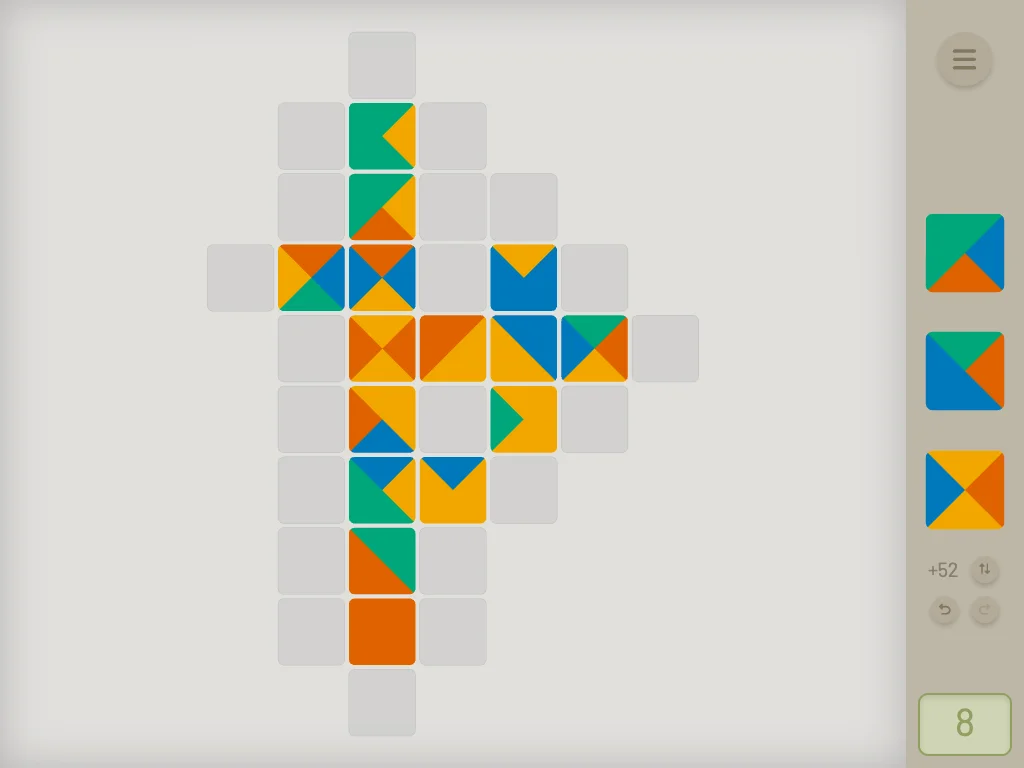
Tessel is a quiet puzzle about laying tiles. Each tile is split into coloured sections, and the board starts with a single tile in the middle. You get three tiles at a time on the side of the screen: drag one onto an empty spot next to the others, turning it so its colours match the tiles it touches. When the sections of one colour close into a shape with no open edges, the shape scores, and the bigger it is the more points it brings. The game ends when the tiles run out.
It begins with squares and triangles, but the same idea works on many other tilings, and the game offers nine: square, triangle, rhombus, Cairo pentagons, hexagons, deltoidal trihexagonal kites, snub square, and two aperiodic tilings, Penrose rhombs and Ammann-Beenker, that never repeat. A custom game lets you pick the tiling, the number of colours, how the tiles are coloured and the rules: touching tiles can be required to have different colours instead of the same, and points can come from closed areas, single tiles, convex shapes, full vertices or holes. There is also a paint mode for colouring a tiling freely, statistics of your games and a dark mode.
Gijs van Tulder released Tessel in 2025 as free software, playable in the browser and also as an app for Android and iOS. The game is translated into more than a dozen languages, Brazilian Portuguese included.
Playing it here
Click Play and choose a tiling on the main menu; the "How to play?" page in the settings explains the rules with pictures. Your games in progress, settings and statistics are saved in this browser. On the Portuguese pages of this site the game starts in Brazilian Portuguese; the language can be changed in the settings.
This version was built by us from the author's source code, with small changes for this site: it does not install itself as an offline app, does not jump to the site's home page, and opens links to other sites in a new tab. The game itself is unchanged. It adapts to the shape of the screen and works well on phones and tablets as well as with a mouse.
Controls
| Input | Action |
|---|---|
| Drag a tile from the stack | place it on the board |
| Click or tap a tile | rotate it |
| Undo and redo buttons | take back or repeat a move |
| Swap button | exchange the tiles on offer |
| More tiles button | add tiles to the game |
| Menu button | settings, restart, back to the main menu |
The settings can show the outline of every empty spot, highlight where the current tile fits, rotate tiles automatically and snap them into place.
A few things worth knowing
Close shapes early. A shape only scores once it is closed, and an open edge in a crowded corner can become impossible to finish.
Use the hints when learning. The setting that highlights valid positions shows at once where a tile can go, which helps a lot on the unusual tilings.
Big shapes pay more. Growing one colour region over several tiles is worth more than closing many small ones.
Try the aperiodic boards. Penrose and Ammann-Beenker look chaotic at first, but their tiles fit together in surprisingly regular patterns.
Credits and licence
Tessel was created by Gijs van Tulder; the translations were contributed by players through Weblate. It is free software under the GNU General Public License, version 3 or later. The interface uses icons from Font Awesome Free (CC BY 4.0), the Barlow and Inter fonts (SIL Open Font License) and several JavaScript libraries under MIT and similar licences. The licence texts and the complete source code of this build are linked from this page.