
 Portugues
The Ninth Vigil
Saved games stay in this browser only.
About the game
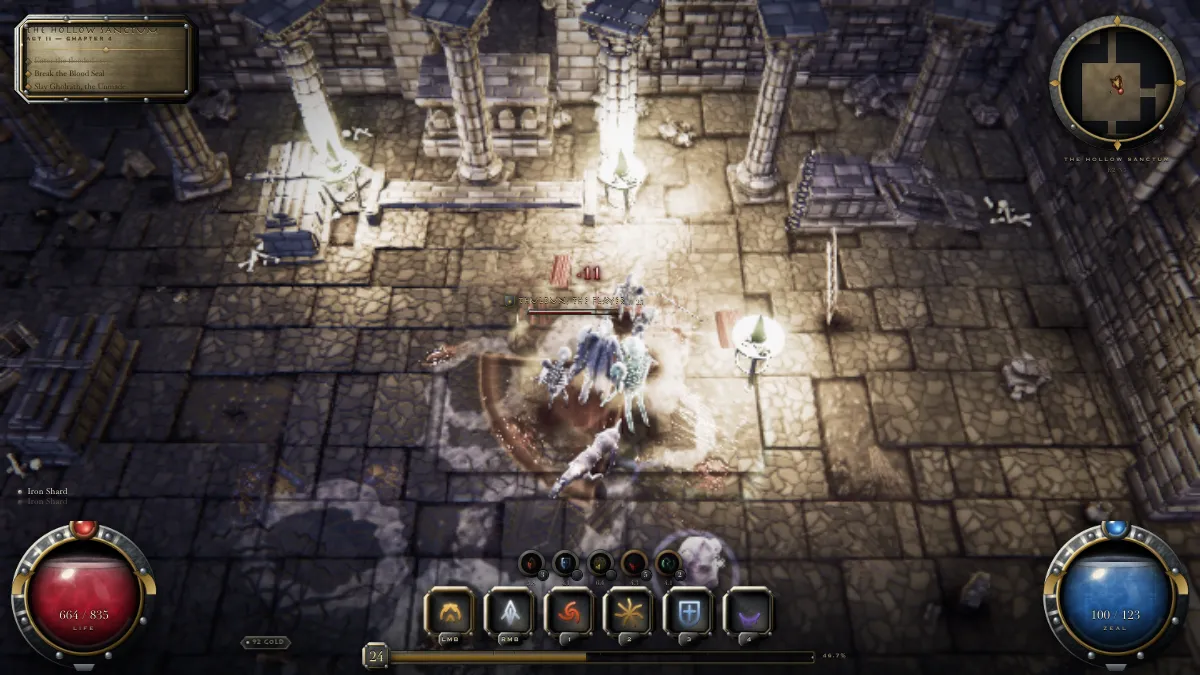
The Ninth Vigil is a dark action RPG seen from above at an angle, in the tradition of loot-driven dungeon crawlers. You play a knight in layered plate with a cloak and a sword, in the broken halls of the Hollow Sanctum, a crypt of pillars, vaults, chains and bones lit by torches and by shafts of light that fall through the ceiling. Skeletons come in packs, the pack members take turns to strike rather than all at once, and the fights ask you to move, dodge and choose the right ability.
The hero has ten abilities, from a three-hit sword combo and a whirlwind to a leap that breaks the floor, a shockwave, a storm glaive, a lance of void energy, a dash called Shadow Step and a war cry. Enemies drop loot with named, flavoured legendary items, and the game has a character sheet with a skill tree, an inventory, damage types and resistances, a minimap and a quest tracker in a gothic frame.
What makes it unusual is how it was made. The README says that every line of code was written by AI agents, working against a written contract and a rubric, and that no art exists in the project at all: no images, no models, no fonts and no audio files. The stone, wood and metal textures, the knight and his cloak, the skeletons, the animations, the sound effects and the music are all generated by code when the page loads. It is a technical demonstration as much as a game, and some visual rough edges are listed by the author.
Playing it here
Click Play and be patient: the game builds its whole world and compiles a large set of graphics programs when it starts, which took about 45 seconds on a recent laptop, and longer on a modest computer. A loading screen shows the progress. After that it runs smoothly on a decent graphics card, and it is a heavy game for old machines or phones. The game starts in the crypt in the middle of a fight, so you can try the controls at once. Nothing is saved between visits.
Controls
| Input | Action |
|---|---|
| left click on the floor, or W A S D | move |
| left mouse button | attack (a three-hit combo) |
| right mouse button | whirlwind |
| 1, 2, 3, 4 | leap, fissure, storm glaive, void lance |
| Q (or 5) | war cry |
| Space | dash (Shadow Step) |
| E | heavy attack |
| I / C | inventory / character sheet |
Tips
Keep moving. The skeletons strike in turns, so a short dash out of a swing and back in is safer than trading blows.
Use the whirlwind when surrounded and the leap or the fissure to break up a pack before it closes in.
Watch the Zeal orb. The big abilities cost Zeal, the blue orb in the corner, so do not spend it all at once.
FAQ
Is it a finished game? It is more a showcase of what can be built by code alone: there is a crypt, a fight and a hero with many abilities, and the author keeps a list of open visual issues.
Why does it take so long to load? Every texture, model and sound is generated when the page loads, and the graphics card has to compile many programs before the first frame.
Was it really made by AI? Yes: the author states that agents wrote all the code, and the repository documents the process.
Credits and licence
The Ninth Vigil was made by iamlukethedev with AI agents writing the code, and is released under the MIT licence. The scene is drawn with the three.js library (MIT). In this version we added a security policy that blocks any network request outside the page; the licence texts and the source are linked from this page.