
 Portugues
Tiles Collector
Saved games stay in this browser only.
About the game
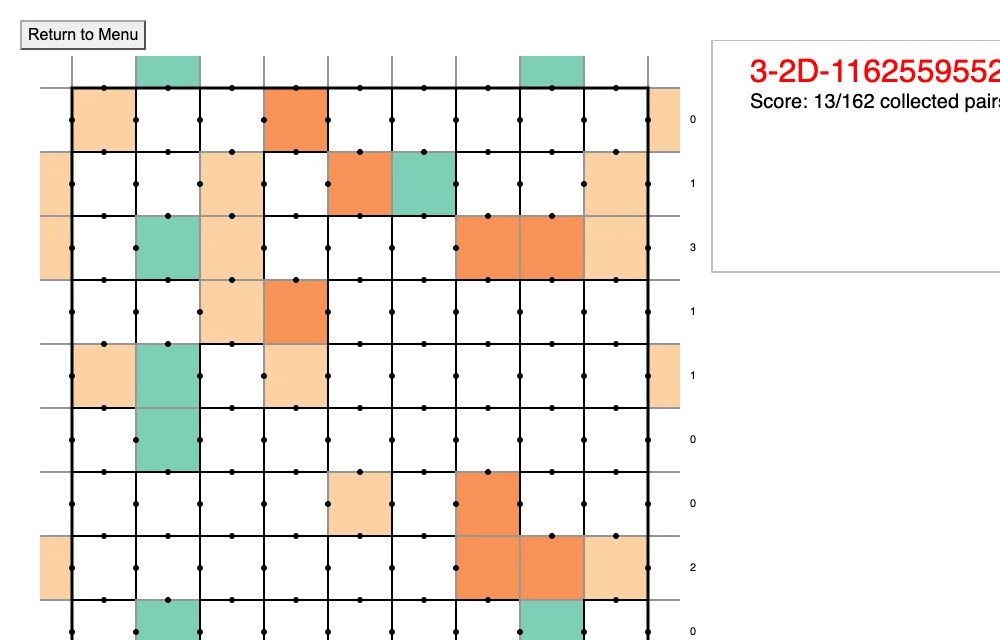
Tiles Collector asks a question that looks simple: if you fill a row or a grid with tiles of two, three or four colours, how many different pairs of neighbouring colours can you make appear? Orange next to yellow is one pair, and so is yellow next to orange; with two colours there are four possible pairs. The game keeps a count of the pairs you have collected so far and shows them as small dominoes, and a row or a column that repeats a pair gets a dot to say so. Rows and columns are counted as if they wrapped around, so that the last tile is also next to the first.
It starts with a tutorial of seven short levels that teaches how to place a tile, how pairs are counted, and how to go from a single row (a "frieze") to a full grid in two dimensions. After that there are three Daily Challenges, with a new board for each day, in a row of four colours, a grid of three colours and a grid of four colours, and a Sandbox where you choose the number of colours and whether you want a row or a grid. The 2x2 squares of four colours are a mathematical puzzle that the author says is still open, and a goal he would have liked to put in the game.
Dimitri Masson made Tiles Collector in 48 hours for Ludum Dare 58, in 2025, with the p5.js library. It is silent by design and has no images apart from the small pictures in the tutorial.
Playing it here
Click Play, then click anywhere to leave the title screen. The game is drawn for a window about 760 pixels tall (about 960 when the window is narrow), so in a smaller frame scroll down inside the game with the mouse wheel, or use a bigger window. Choose a tutorial level to learn, or go straight to a daily board. To place a tile, press on a square and keep the mouse button down: a wheel of colours opens around it, and you pick one by moving the pointer towards it, then let go. Tiles that are drawn in the board from the start cannot be changed. Esc takes you back to the menu. In the Daily Challenges, press Submit Score when you are done: the scores are saved on a local list in this browser, since the online ranking of the original is not part of this copy.
Controls
| Input | Action |
|---|---|
| press on a square, move toward a colour, release | set the colour of that tile |
| Esc | back to the menu |
| Return to Menu button | back to the menu |
| Submit Score button (daily boards) | end the board and save your score |
A few things worth knowing
Think of the board as a ring. The first tile touches the last one, and the top row touches the bottom row, so a pair that looks lost at the edge may still count.
Look at the dominoes on the right. The pairs you already have are shown there. Fill the missing ones one at a time instead of trying to guess the whole board.
A dot means a repeat. When the black dot between two tiles shows up, that pair was already collected, so one of the two tiles can be changed to a pair you still need.
Credits and licence
Tiles Collector was made by Dimitri Masson and is released under the MIT licence. It uses p5.js 2.0.5 (LGPL-2.1, the Processing Foundation and contributors), served unchanged with its source code next to the game, and Bootstrap 5.3.8 (MIT) for the menu. The changes made for this site are: the daily ranking is kept in your browser instead of an online service, the Google font that was loaded is gone, the Settings section of the menu (which called code that this version of the game does not have) is removed, and a rule blocks any request to other sites. The patch, the build script and the licence texts are linked from this page.