
 Portugues
Venience World
Saved games stay in this browser only.
About the game
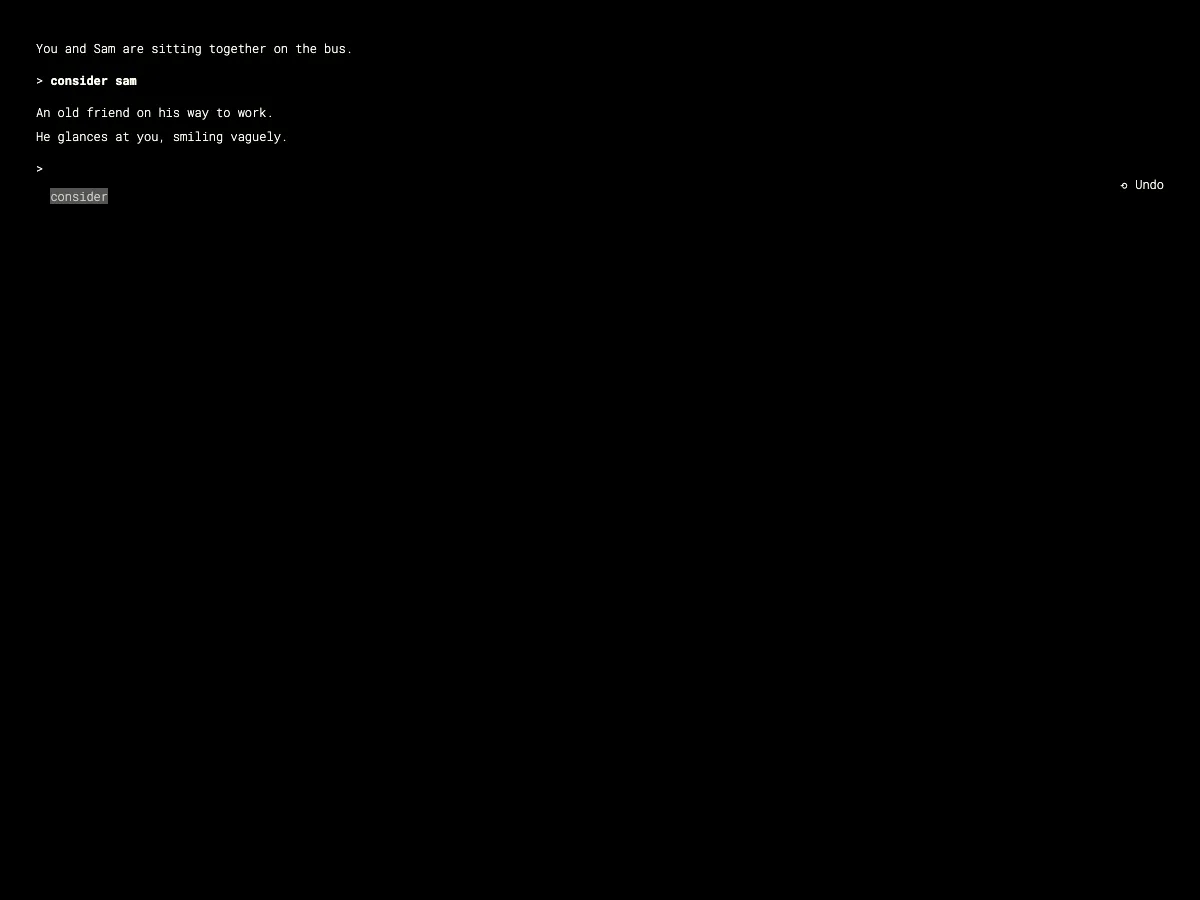
You and Sam are sitting together on the bus. Sam is an old friend, on his way to work, smiling vaguely. That is all the game gives you at the start, and the rest is up to what you notice. Venience World is a text adventure in which most of the action is thinking: the commands it offers are about considering and interpreting what is in front of you, and each new thought opens others.
The novelty is the interface. Instead of guessing what the game understands, you see it. Type a letter, or just press Enter, and the game lists the words that could come next, in the form of a sentence you assemble one piece at a time. It works as autocomplete, but also as a map of what you are allowed to do. The author calls the game a work of interactive fiction under active development and describes this version as a playable demo of the interface, some of the mechanics and some of the themes of the finished game. The title is a play on "supervenience", the philosophical idea that one level of description depends on another, and the game is about trying to understand what is going on.
Daniel Spitz showed the demo at the Spring Thing 2018 festival. The build served here is his update from 2019.
Playing it here
Click Play now, then click inside the black screen once so that the keyboard goes to the game. Press Enter to accept the highlighted suggestion and keep pressing it, or type your own. The arrow keys move among the suggestions. A full playthrough takes about 10 to 30 minutes, according to the author. The game has no save: leave the page open if you need to stop. It is in English.
A few things worth knowing
It needs a keyboard. The author says it works in Chrome and Firefox on a computer; it does not work well on Safari or on phones, where the keyboard does not come up.
You never have to replay. The author designed the game so that everything can be seen in a single playthrough.
It is unfinished. This is a demo, and parts of it will feel abrupt.
Credits and licence
Written by Daniel Spitz and released under the MIT licence. It is made with TypeScript and React. The Roboto Mono font (SIL OFL 1.1) is served from this site instead of Google Fonts. The licence texts are linked from this page.