
 Portugues
Interactive fiction 59 games
Stories you play by typing: read the scene, type what you want to do and see what happens.
No games match this filter.
-
Text adventures
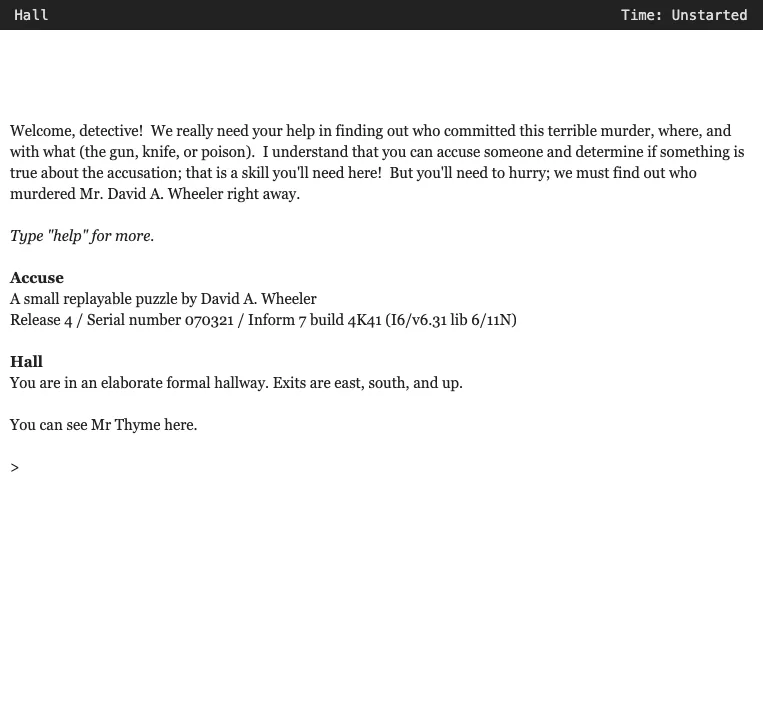
Accuse
Someone has been murdered in a large house, and you must work out who did it, with which weapon and in which room, by making accusations that only tell you whether any part of them is right. A small deduction puzzle by David A. Wheeler that shuffles the solution every time.
-
Text adventures
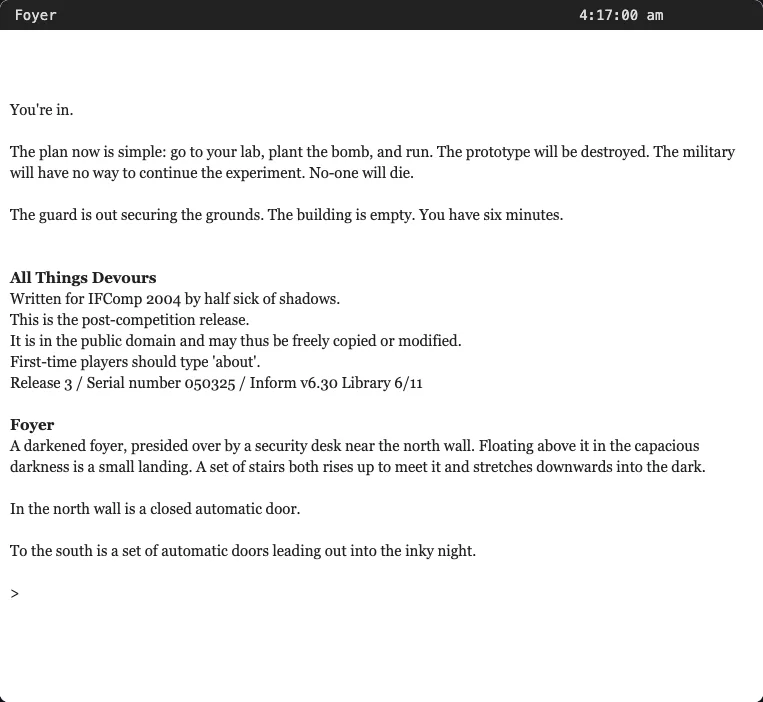
All Things Devours
It is 4:17 in the morning, you have broken into a research lab to plant a bomb, and a guard is just outside. A tight puzzle about time, in which every minute matters.
-
Text adventures
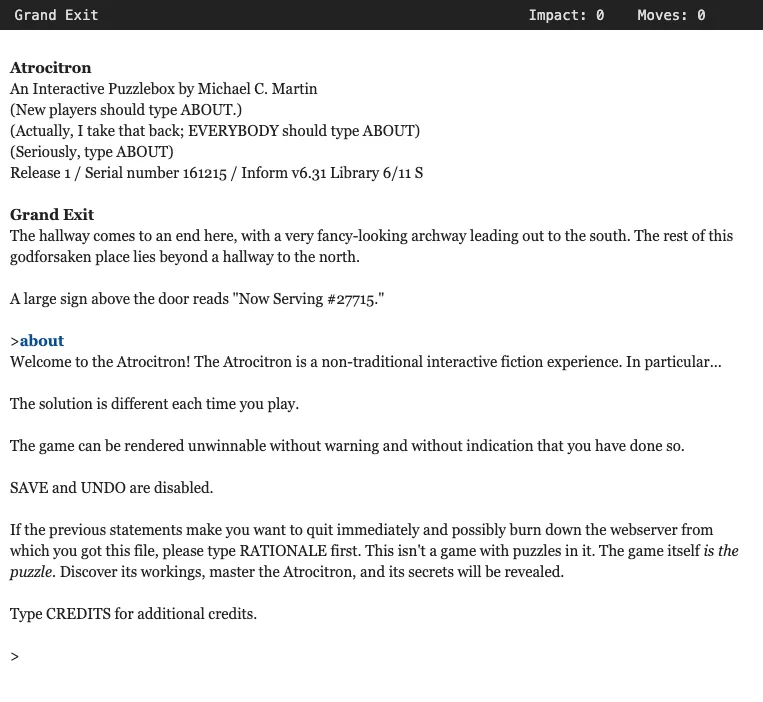
Atrocitron
A sprawling building of odd rooms and stranger objects, a solution that changes every game, and no save or undo. The fifth Annoyotron, a deliberately unfair puzzle box by Michael C. Martin that you are invited to take apart rather than simply solve.
-
Text adventures
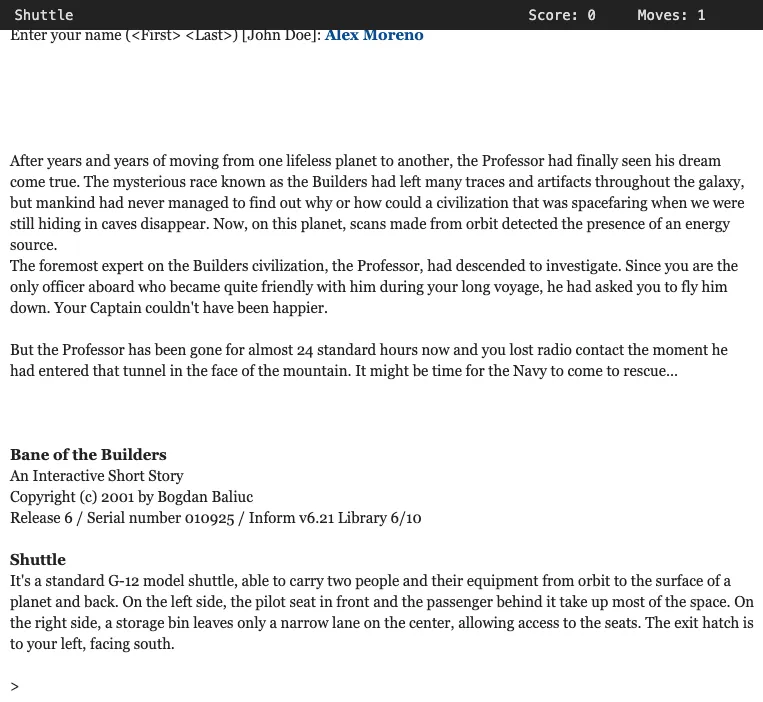
Bane of the Builders
A space navy officer flies a shuttle down to a dead planet to find the Professor, who vanished into a tunnel left by the Builders, an alien race that disappeared long ago. A science-fiction adventure from IFComp 2001, by Bogdan Baliuc.
-
Text adventures
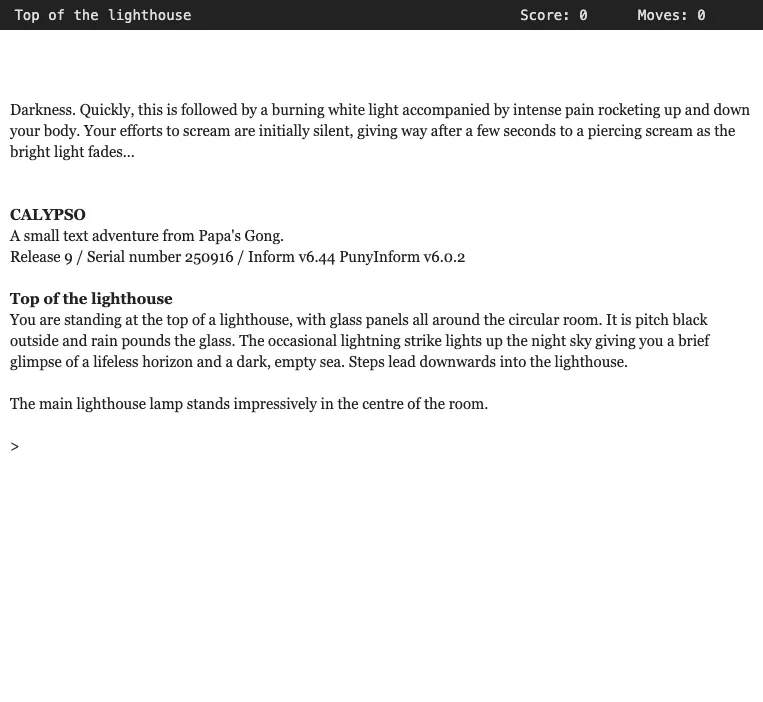
Calypso
You come to at the top of a storm-lashed lighthouse with no memory of who you are, a dead sea outside the glass and a deserted island waiting below. A compact, old-fashioned mystery adventure by Dave Footitt.
-
Text adventures
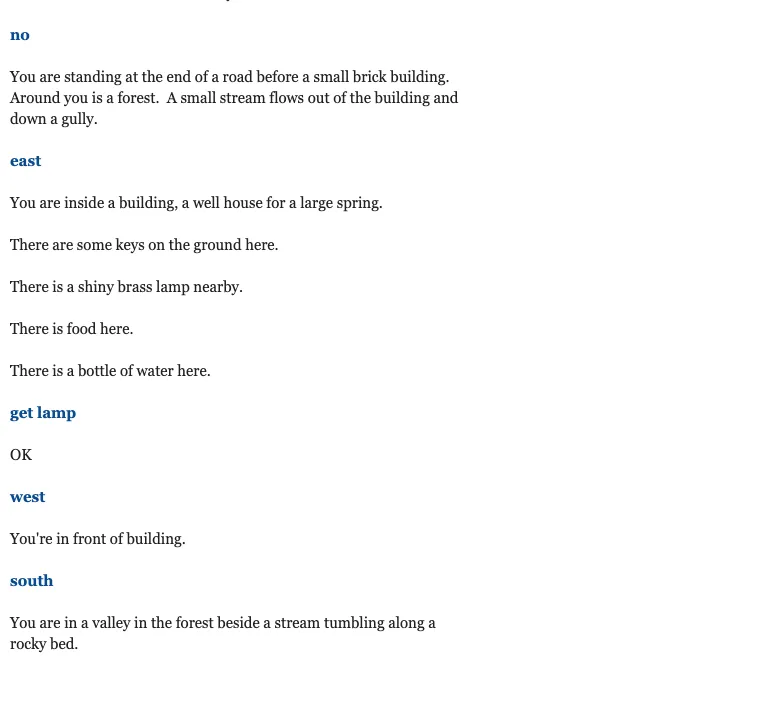
Colossal Cave Adventure
The first text adventure: a road, a small brick building, a stream disappearing into the rock and a cave full of treasure, mazes and magic words. Crowther and Woods' Adventure 2.5, the original 430-point version, in its Open Adventure form.
-
Text adventures
Counterfeit Monkey
A smuggler on the run on an island where words are tools, armed with a device that removes letters from things and turns them into something else. Emily Short's celebrated wordplay adventure.
-
Text adventures
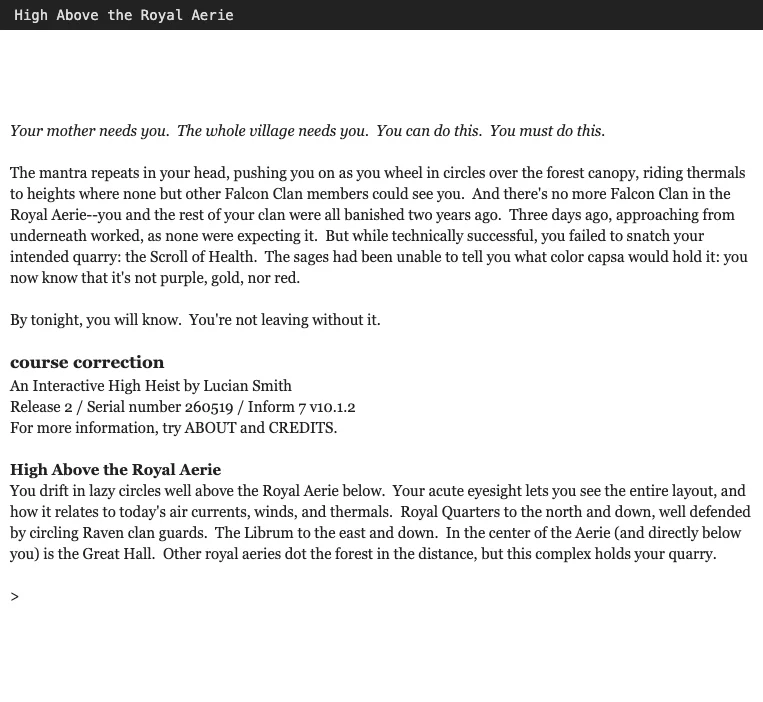
course correction
Banished from the Royal Aerie two years ago, a falcon flies back alone to steal the one scroll that can save her village. A short fantasy heist told in text, with bird clans, magic scrolls and many ways in, by Lucian Smith.
-
Text adventures
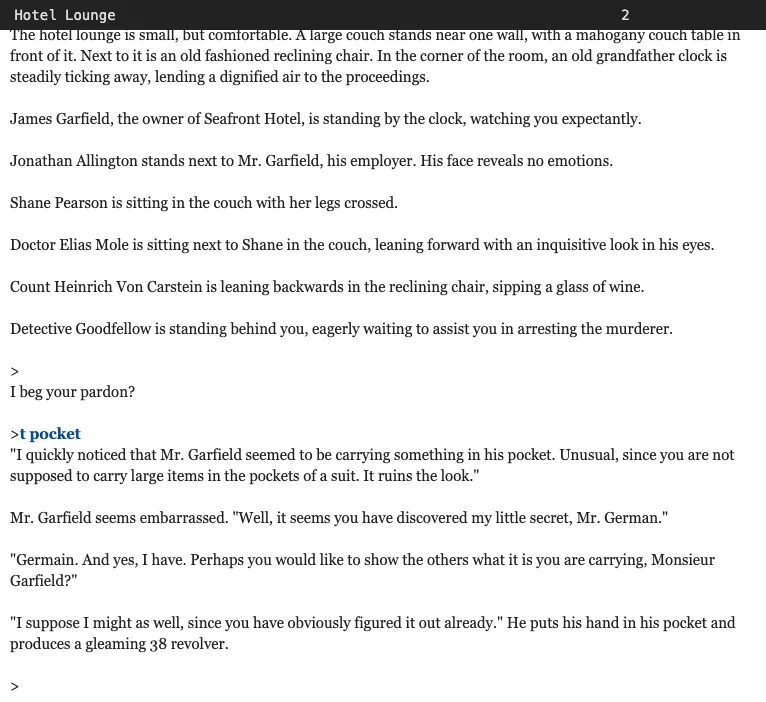
Death off the Cuff
A famous detective gathers the suspects in a hotel lounge to name the killer, with one small problem: he has no idea who did it. A comic murder mystery told entirely through bluffing and conversation, by Simon Christiansen.
-
Text adventures
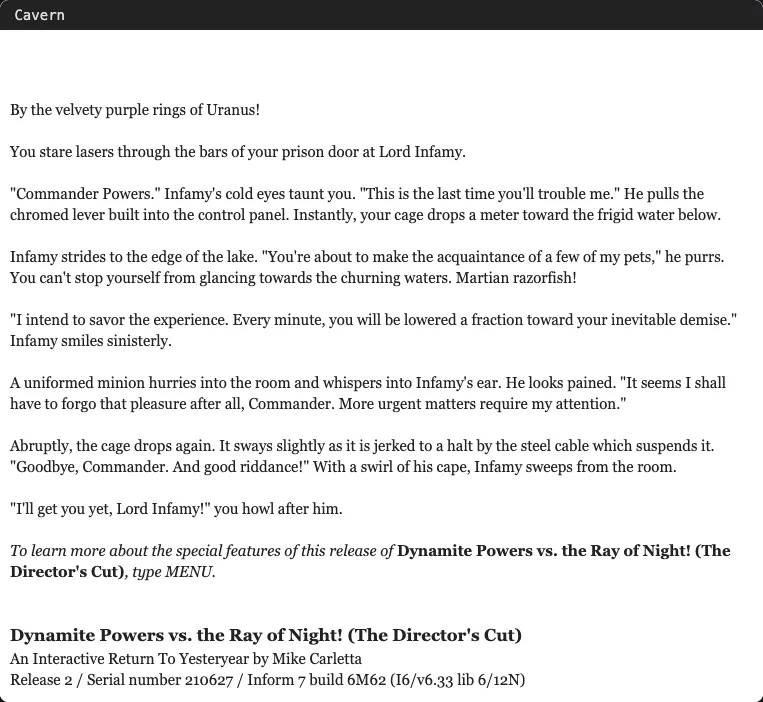
Dynamite Powers vs. the Ray of Night
Commander Dynamite Powers dangles in a cage over a lake of Martian razorfish while Lord Infamy readies his superweapon. A pulp space-serial text adventure by Mike Carletta.
-
Text adventures
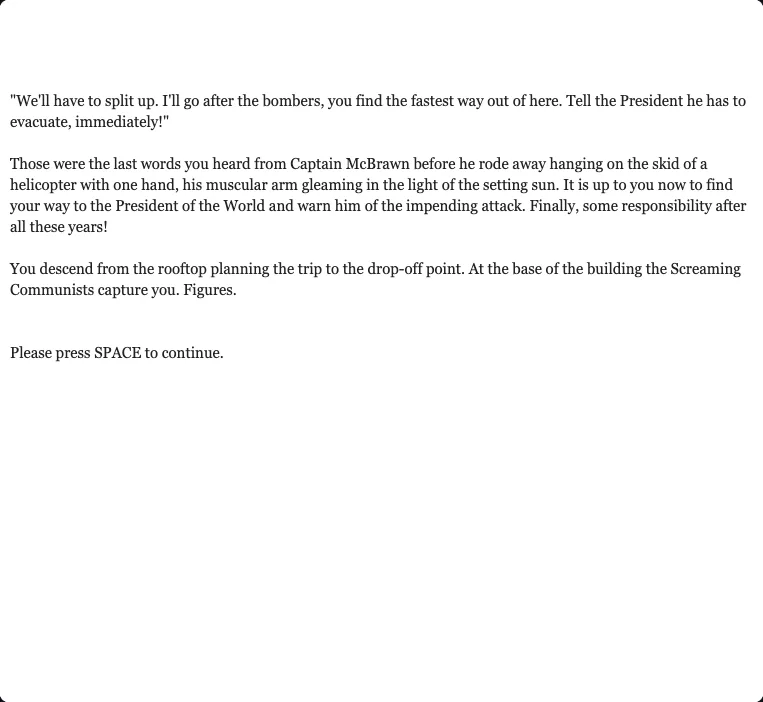
Escapade!
Captured by the Screaming Communists and locked in a cell, the sidekick of a square-jawed hero has to get out. Then do it again, and again. A one-room comedy with eleven ways out.
-
Text adventures
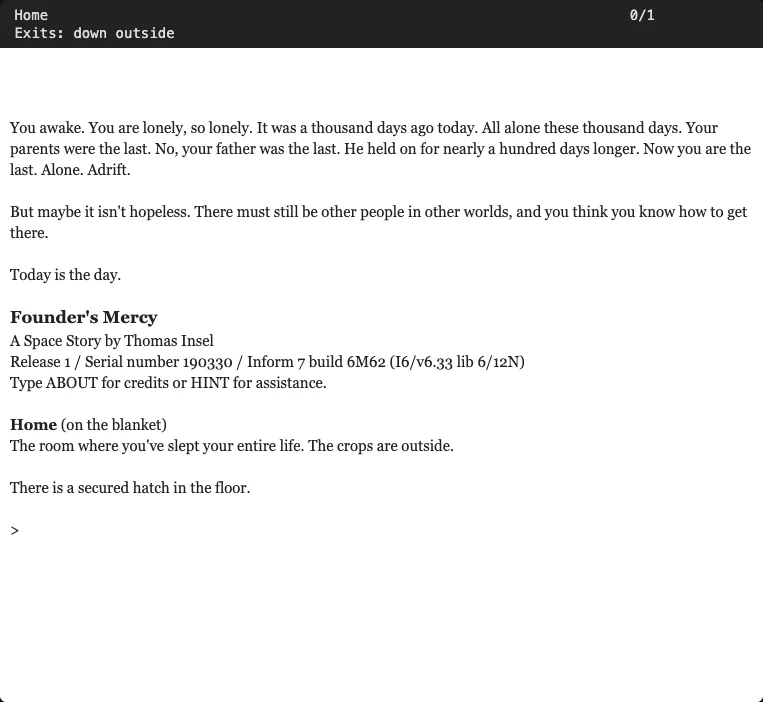
Founder's Mercy
The last person aboard a dying space colony wakes up alone and decides that today is the day to leave. A quiet, puzzle-driven science fiction text adventure by Thomas Insel.
-
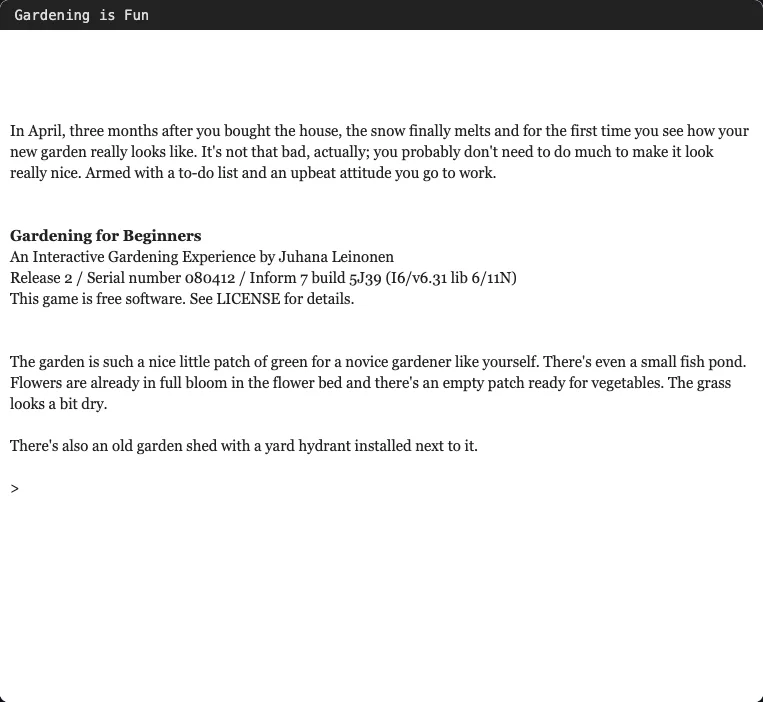
Text adventures
Gardening for Beginners
The snow has melted, you have a new garden and a short to-do list. What could possibly go wrong? A one-room comedy about chores that keep multiplying, by Juhana Leinonen.
-
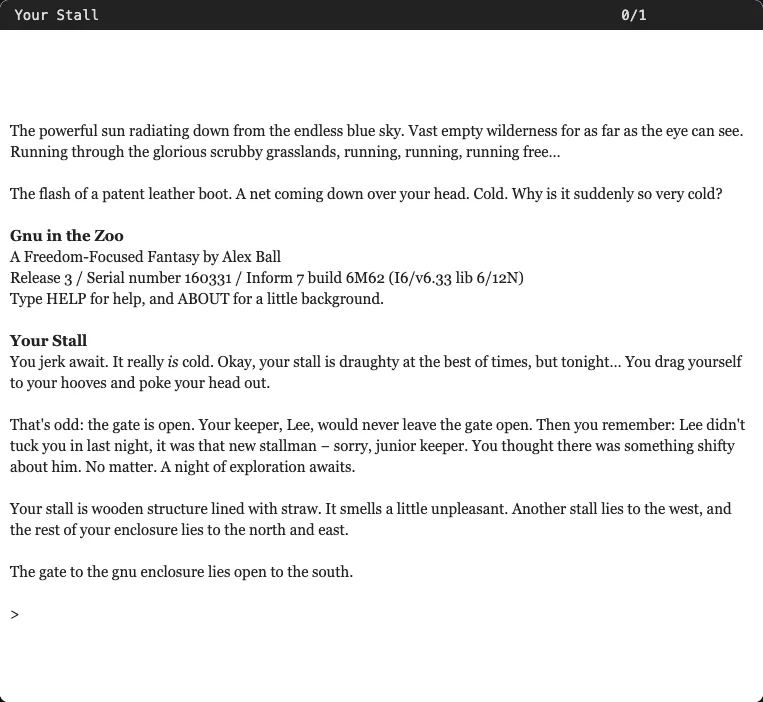
Text adventures
Gnu in the Zoo
A gnu wakes up on a cold night to find the gate of its enclosure open. Escaping the zoo takes help, and only other gnus understand you. A short, punny animal comedy with a soft spot for free software.
-
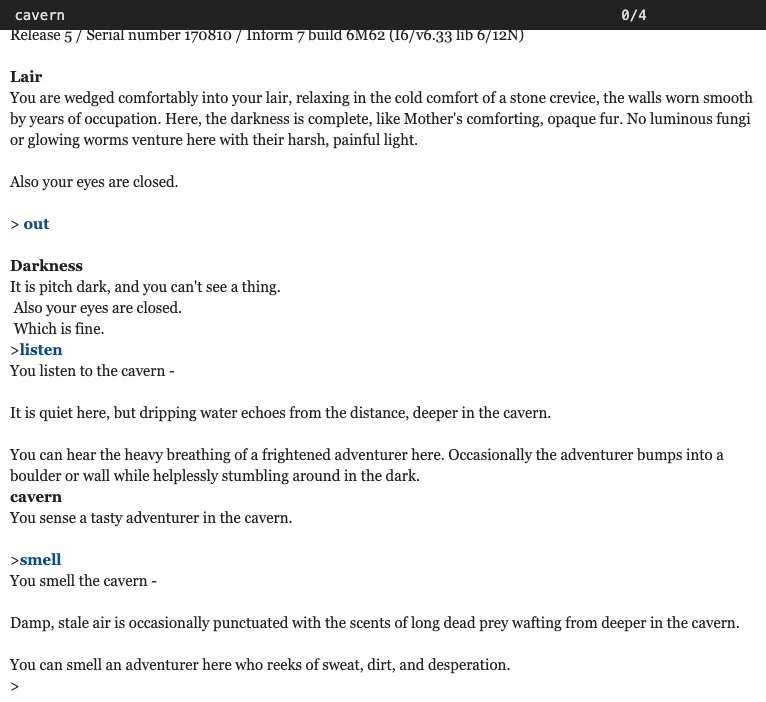
Text adventures
Grue
You are the monster in the dark. A lost adventurer stumbles through your cave and you are very hungry. A funny, atmospheric text adventure told from the grue's point of view, by Charles Mangin.
-
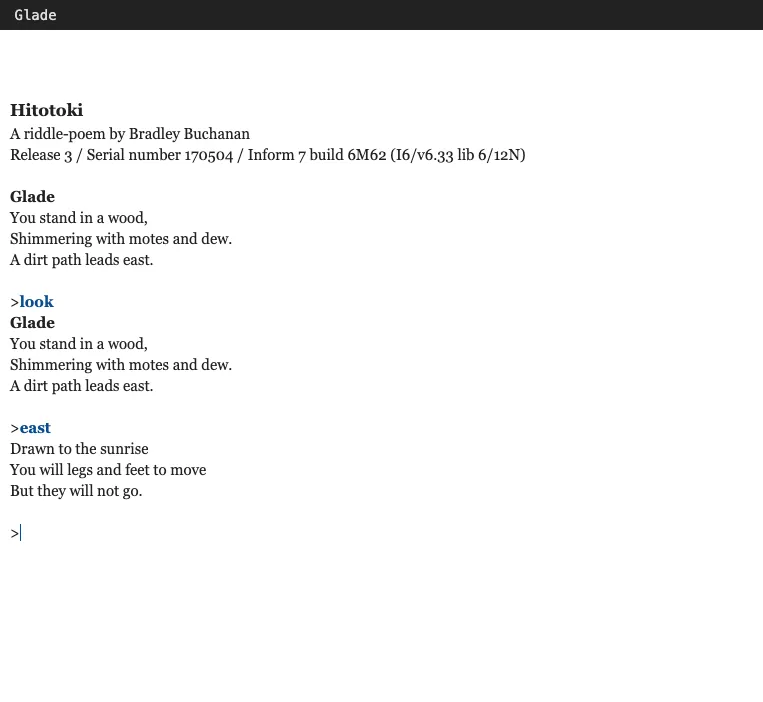
Text adventures
Hitotoki
A riddle-poem in a single frozen moment: a glade at dawn where nothing moves and every reply comes as a haiku. Look closely enough and you may find a way to let the moment pass. A tiny, quiet puzzle by Bradley Buchanan.
-
TIC-80
Humanity's Helper
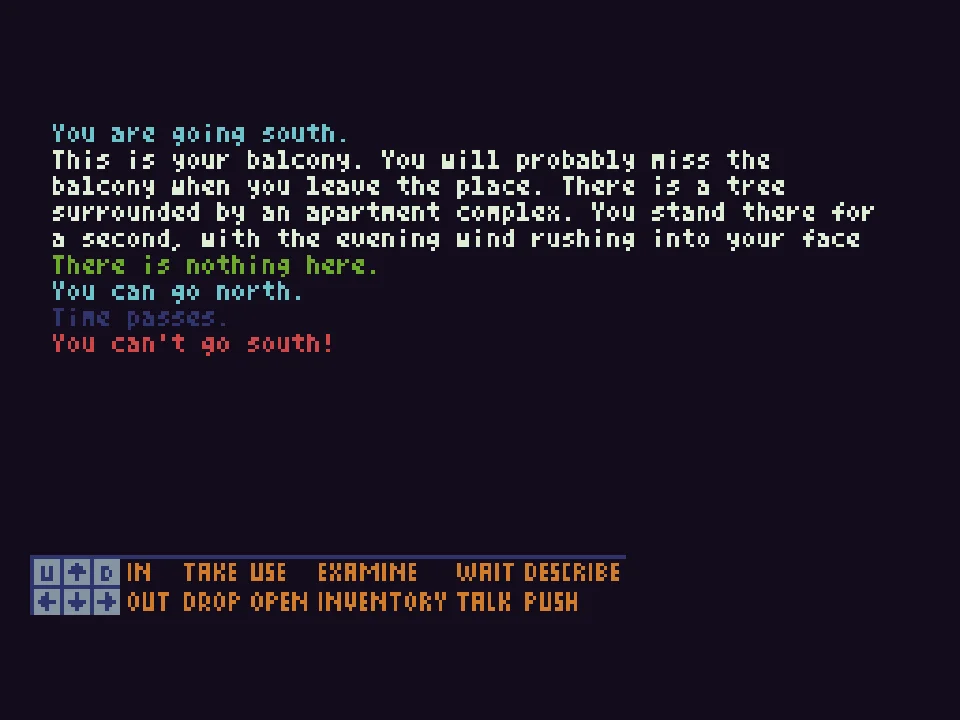
A silly point-and-click text adventure: you want to change the world, so you start by helping everyone in your block, and the right gift for each person is not always the obvious one. A short comedy for the TIC-80 by ronynn.
-
Text adventures
Jason and Medea
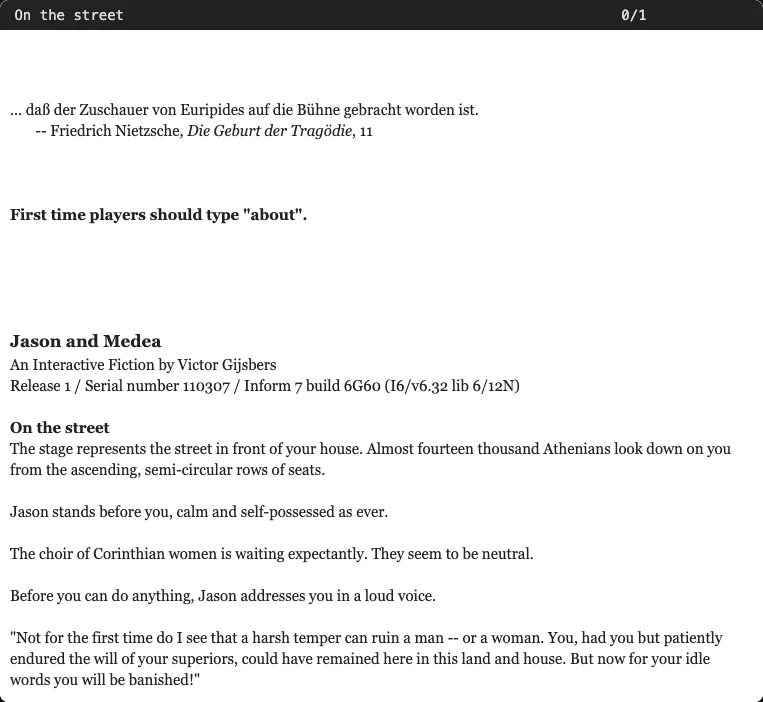
You are Medea, abandoned by Jason for a princess and about to be banished, and he has come to justify himself in front of the women of Corinth. A short Greek tragedy in which an argument is fought like a duel.
-
Browser games
Kitty and the Sea
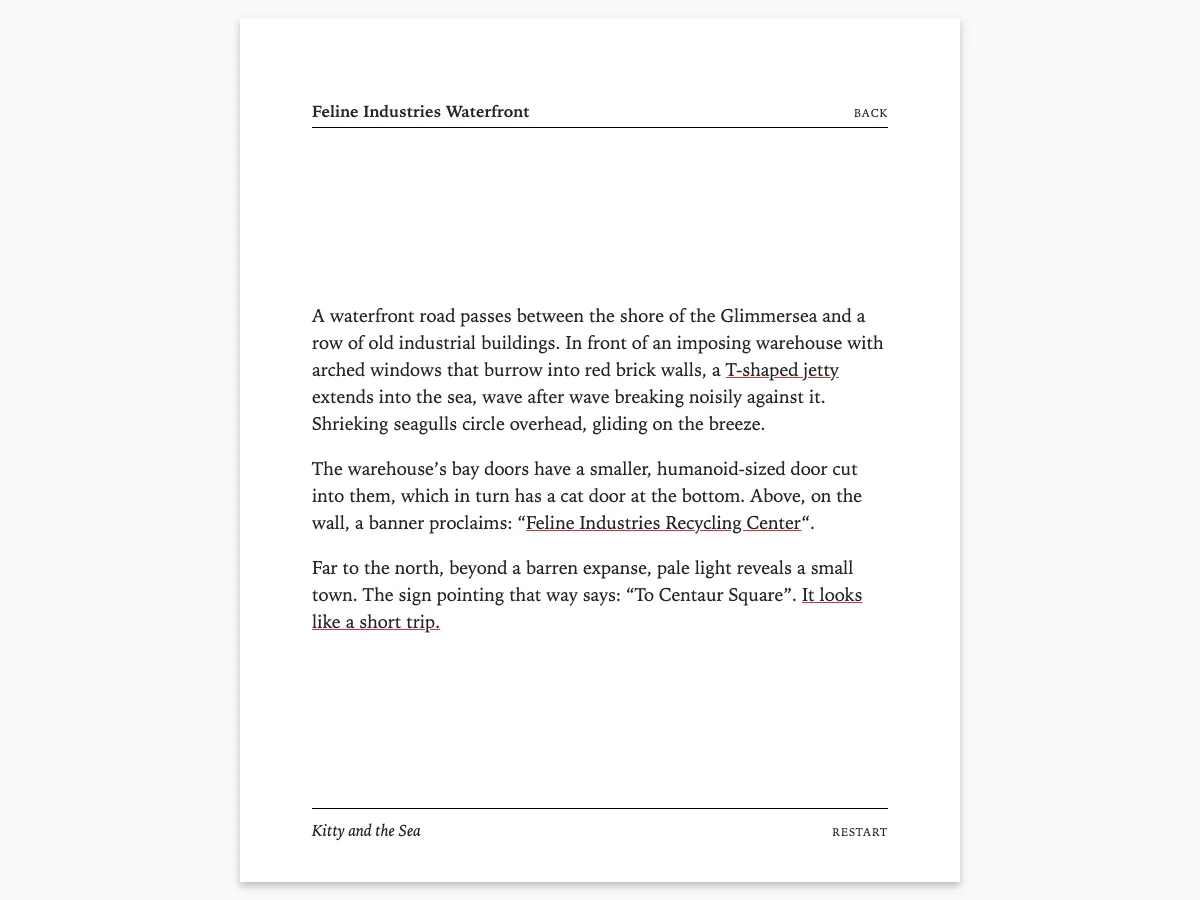
A short walking story in a steampunk seaside town where you follow the paw prints of a cat past a recycling plant and a lighthouse. Quiet, odd and a little sad. By Felix Pleșoianu.
-
Text adventures
Last Day of Summer
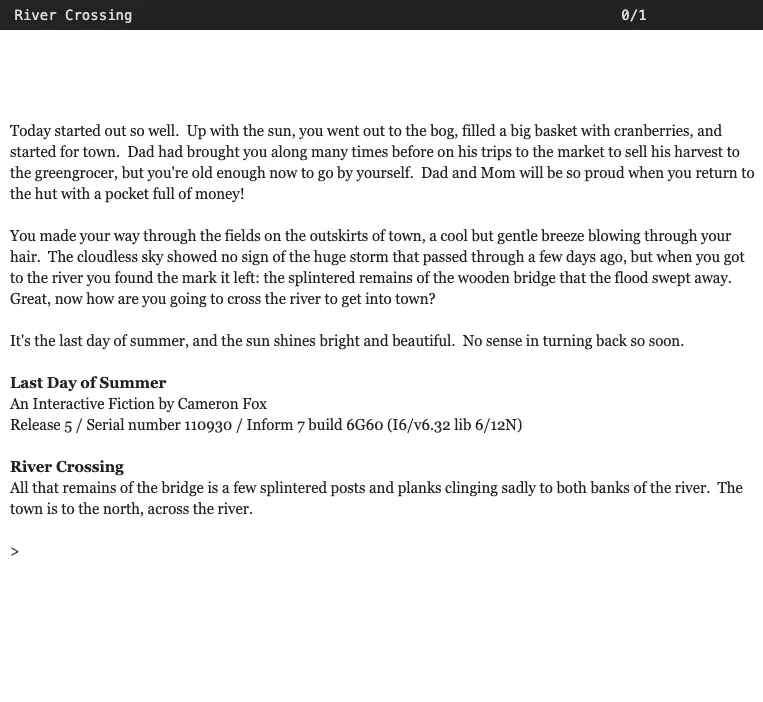
A farm boy sets off alone to sell his family's cranberries at the market, only to find the bridge into town washed away by a storm. A gentle, sunny puzzle story from IFComp 2011, by Doug Orleans.
-
Browser games
Left Undetected
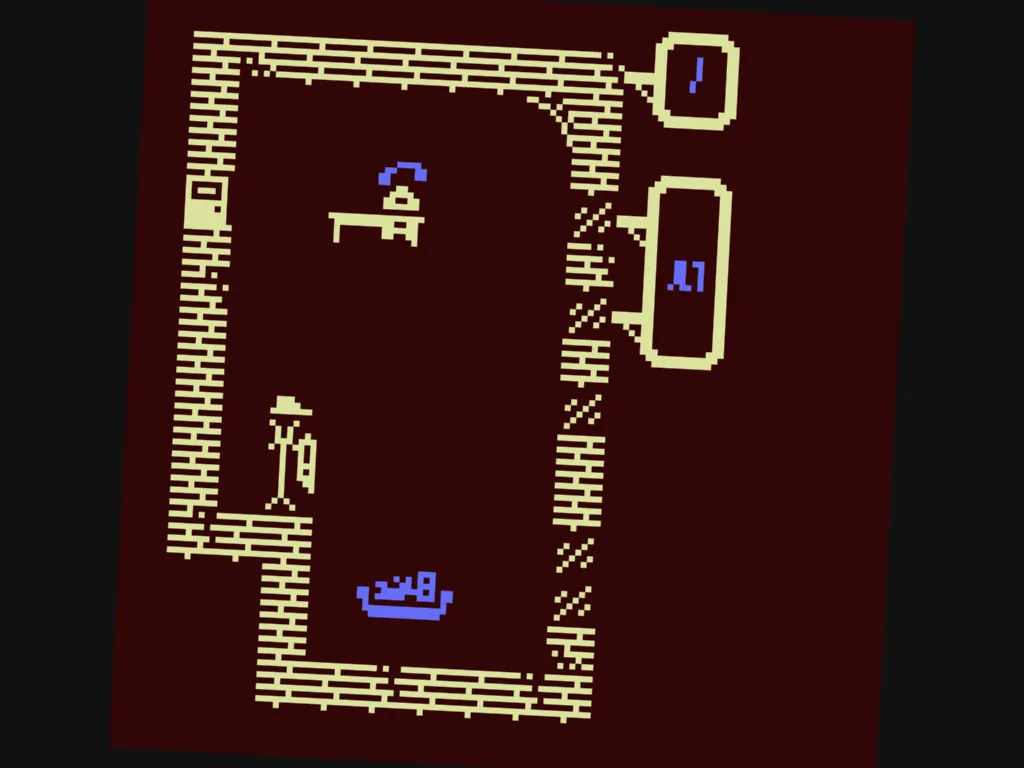
A very short story in pixel art about a private detective who is tired of detecting: one day, four phone calls, and a decision. Made in Bitsy for Global Game Jam 2018.
-
Text adventures
Logic Puzzle Sampler
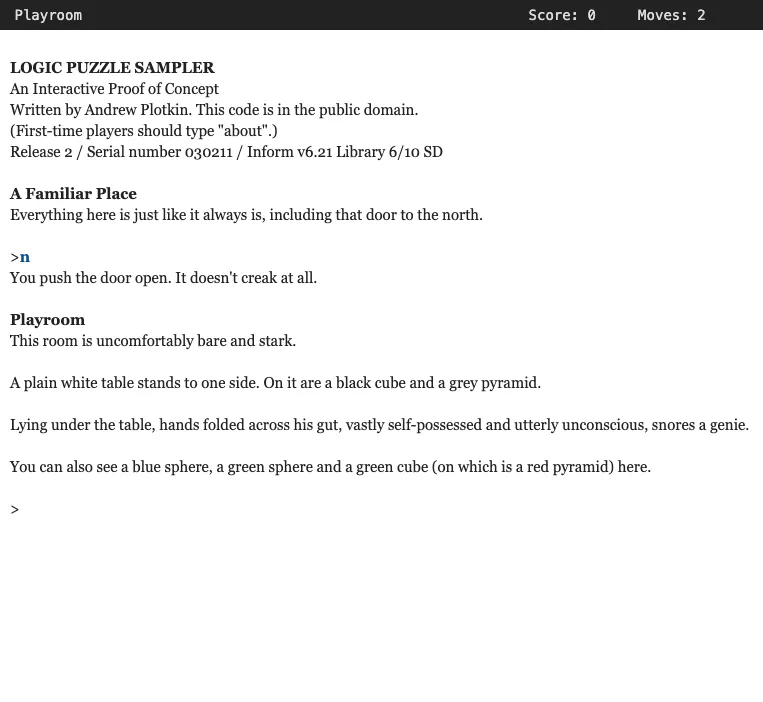
A sleepy genie, a table of coloured blocks and pieces of paper that turn green when what is written on them is true, red when it is false and grey when it is a paradox. A small logic toy about truth and self-reference, by Andrew Plotkin.
-
Text adventures
Midnight at Al's
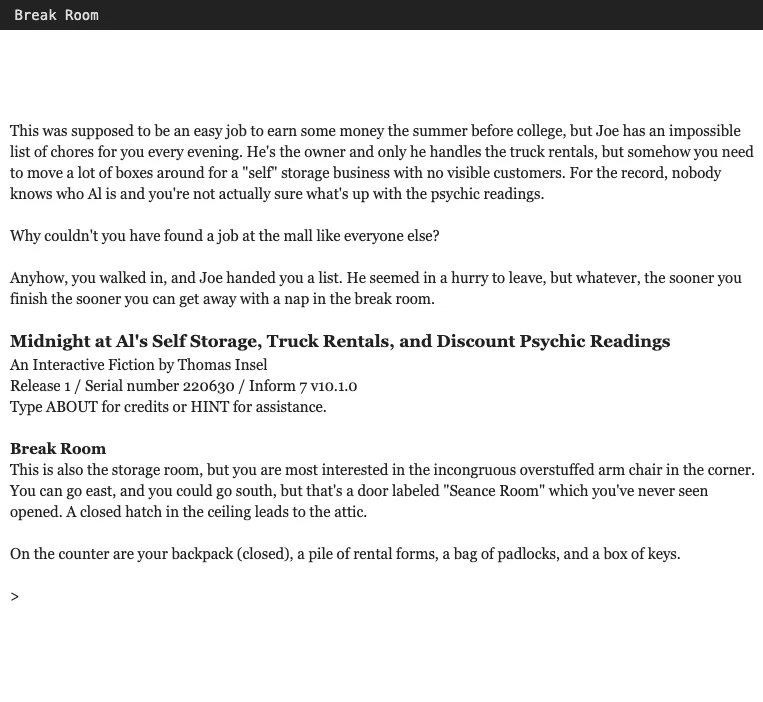
A summer job at a self-storage place, a list of three boxes to move before morning and a door marked Seance Room that nobody ever opens. A short, gently strange night-shift puzzle game by Thomas Insel.
-
Text adventures
My Name is Jack Mills
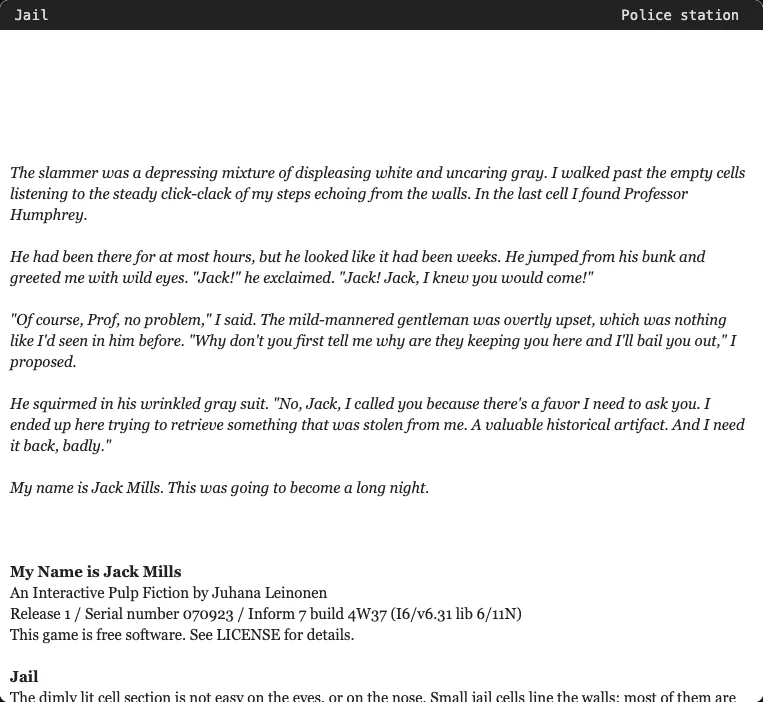
An old friend is in jail and swears his stolen artifact must be recovered at any cost. Hotels, nightclubs, a car chase and a late-night auction in a pulp detective story by Juhana Leinonen.
-
Browser games
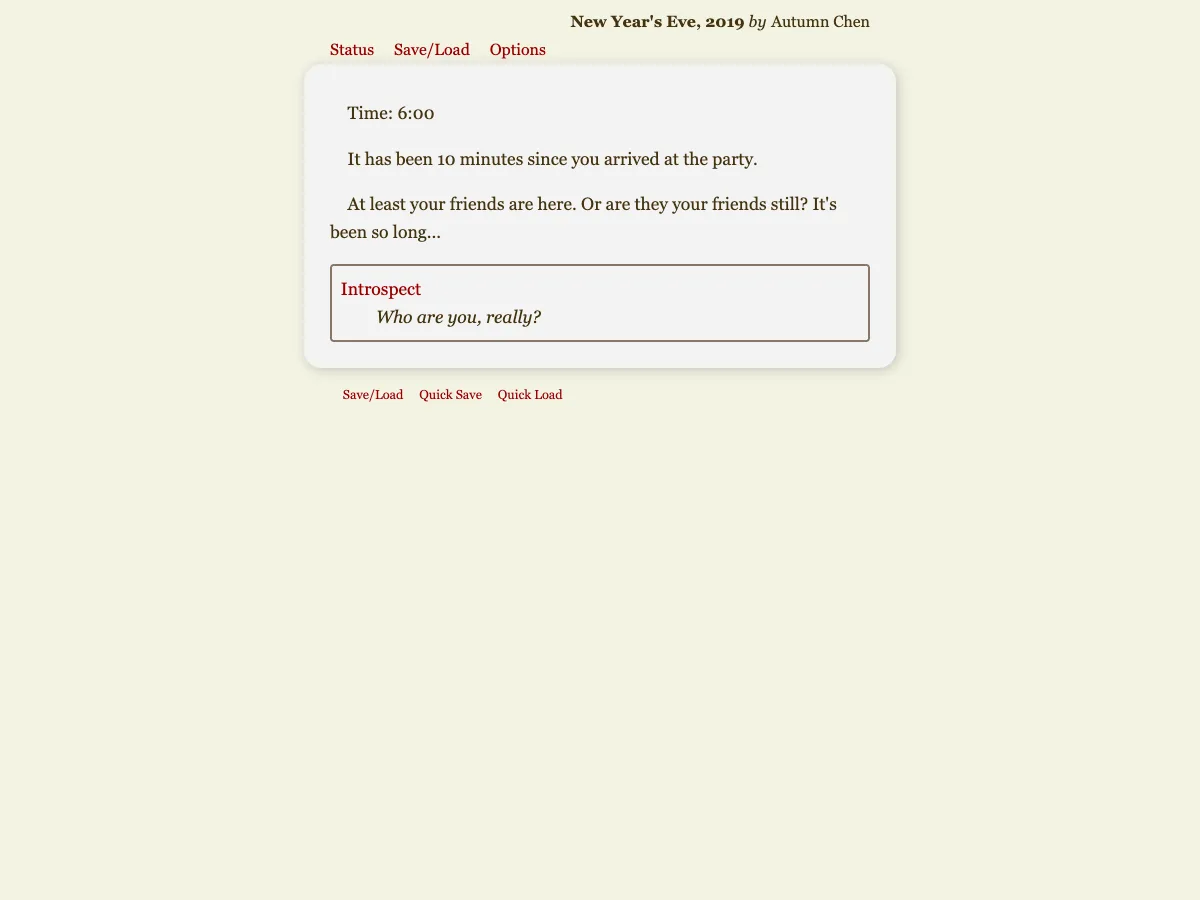
New Year's Eve, 2019
An evening at a New Year's Eve party with your family and old friends, and the question of who you have become since the last time you were all together. A text story and a sequel to Pageant, by Autumn Chen.
-
Browser games
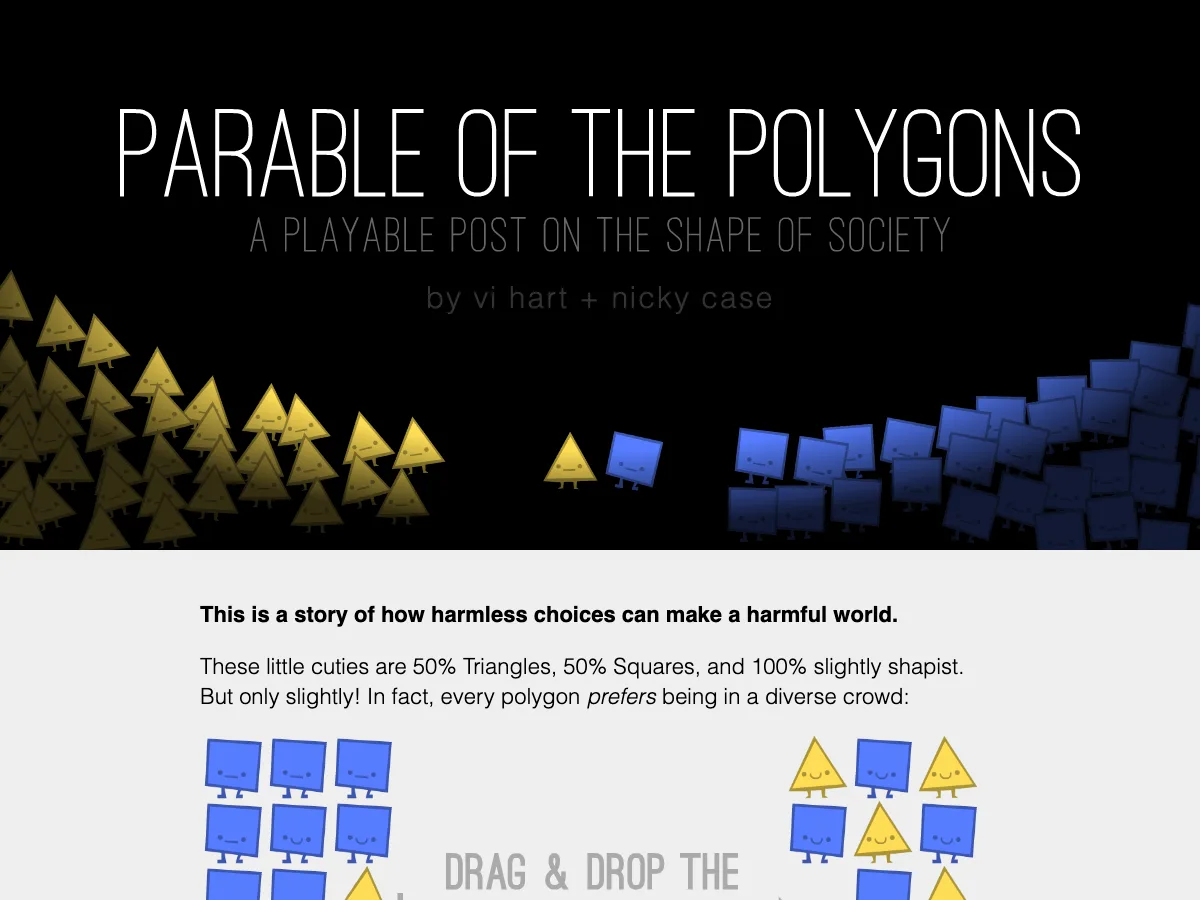
Parable of the Polygons
A playable post about how mild preferences add up to segregated neighbourhoods. Move triangles and squares around, then change the rules and watch what happens. By Vi Hart and Nicky Case.
-
Text adventures
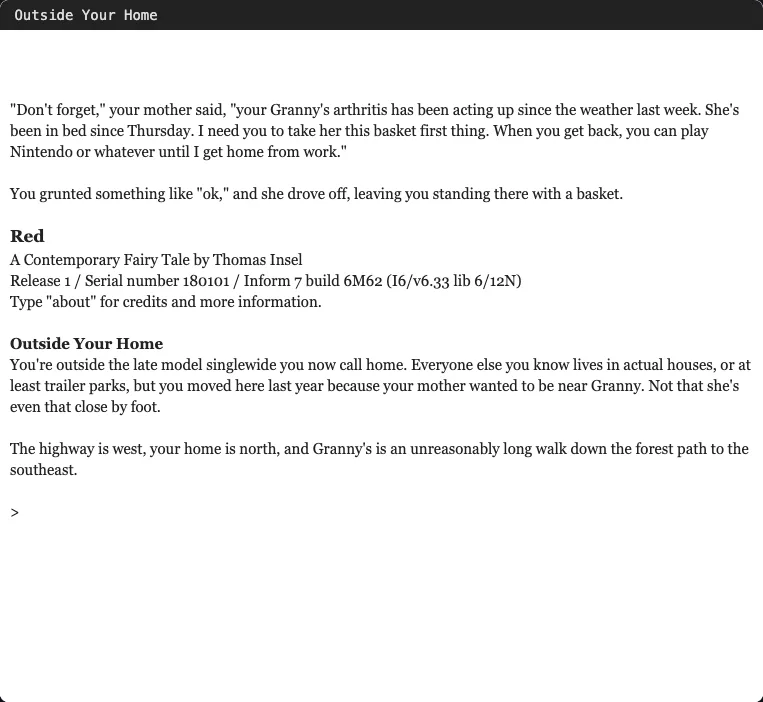
Red
A basket of cake and wine, a sick grandmother and a suspiciously handsome hunter in the woods. Little Red Riding Hood retold as a short modern text adventure by Thomas Insel.
-
Text adventures
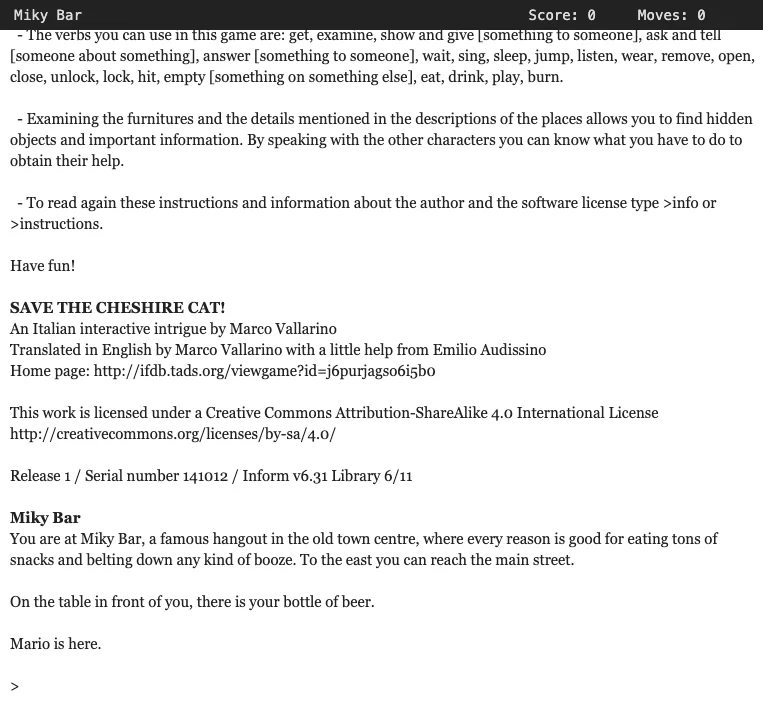
Save the Cheshire Cat!
The mascot of a gaming club has vanished in the middle of a book fair, and you have one afternoon in an Italian old town to find a cat that meows non-stop and is not house-trained. A short comic text adventure by Marco Vallarino.
-
Text adventures
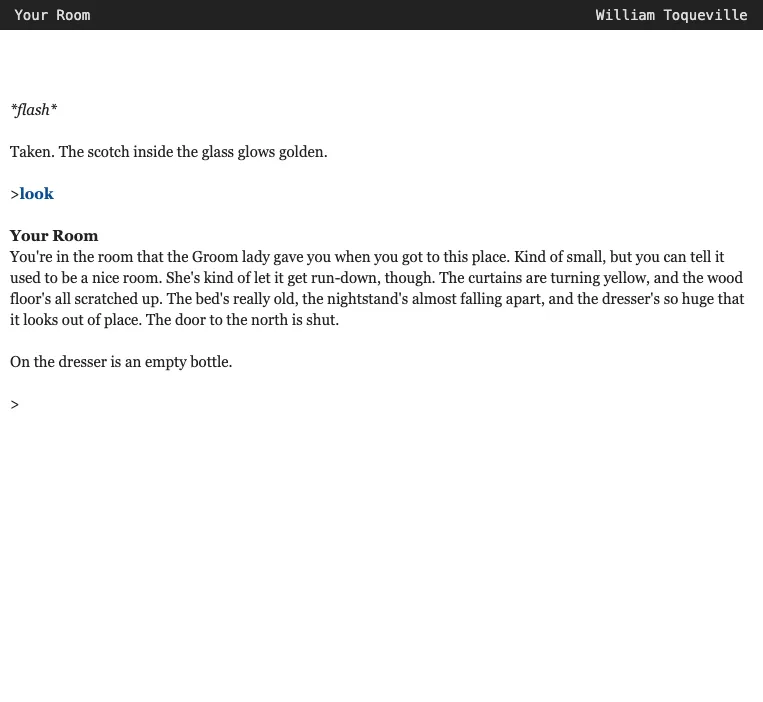
Snatches
Something is hunting the guests of a run-down bed and breakfast high in the mountains, one by one, as the sun goes down. A short horror story told through the eyes of several of them in turn, from IFComp 2005, by Gregory Weir.
-
Text adventures
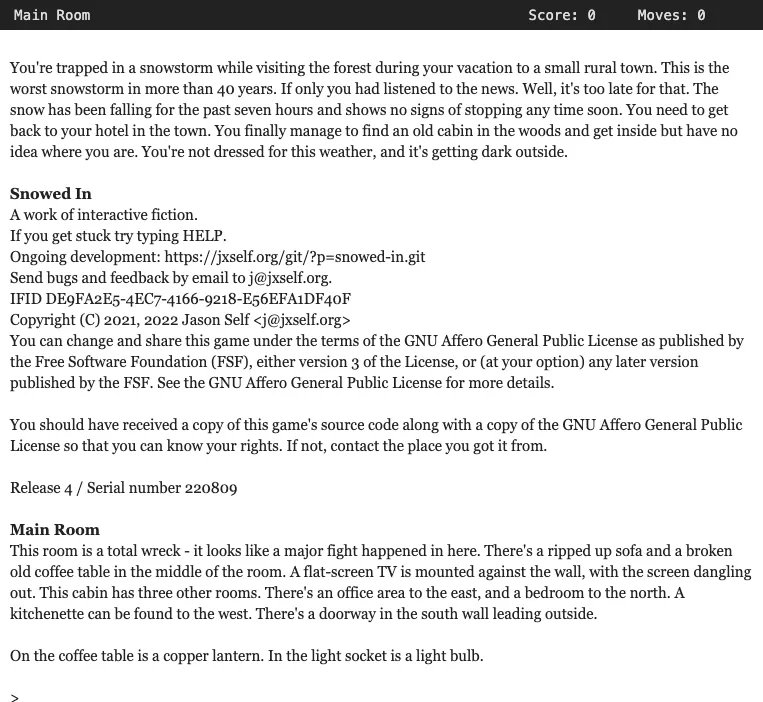
Snowed In
Caught by the worst blizzard in forty years while on holiday, you take shelter in a wrecked cabin in the woods with night falling, no idea where you are and the wrong clothes for the weather. A short survival adventure by Jason Self.
-
Browser games
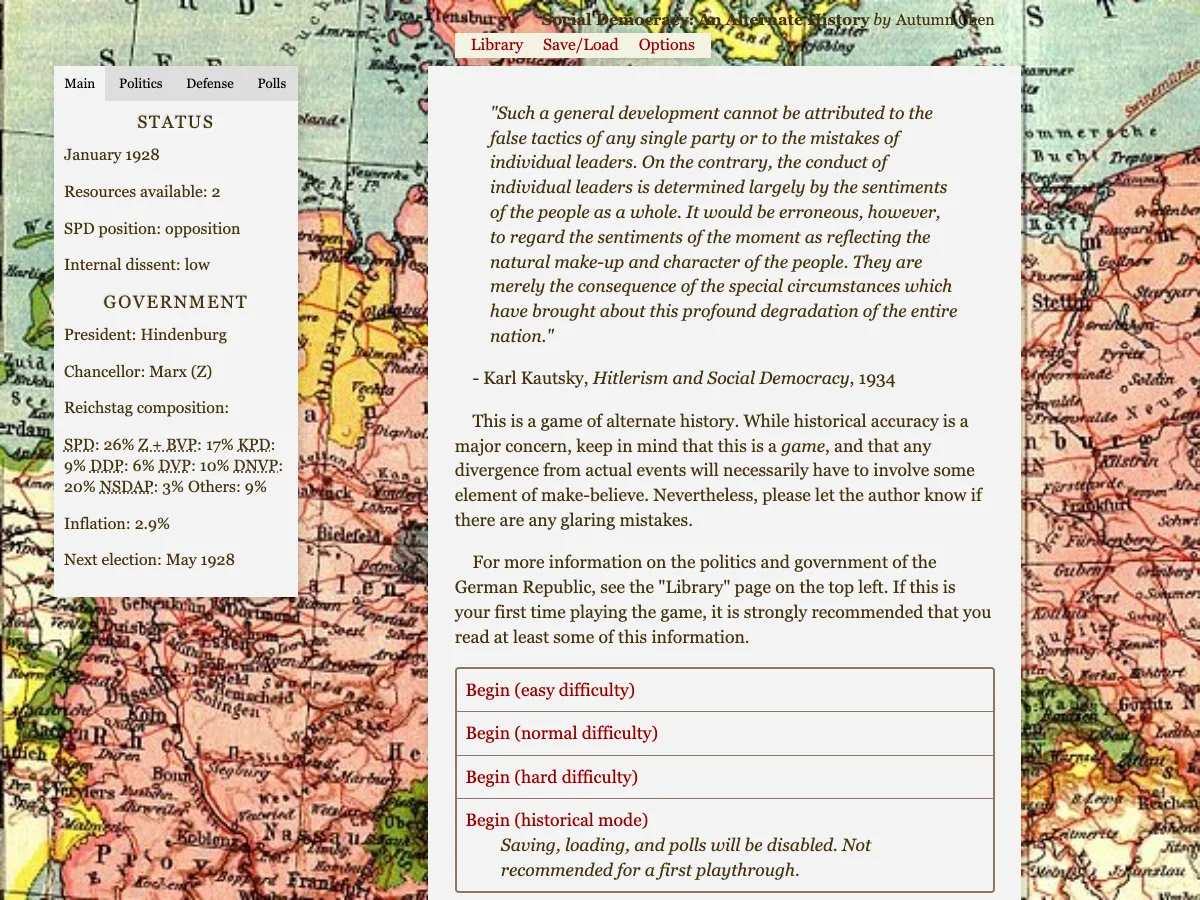
Social Democracy: An Alternate History
Lead the German Social Democrats through the last years of the Weimar Republic. Spend your limited actions on policy and alliances while the economy, the Reichstag and the streets pull the country apart. An alternate-history strategy story by Autumn Chen.
-
Text adventures
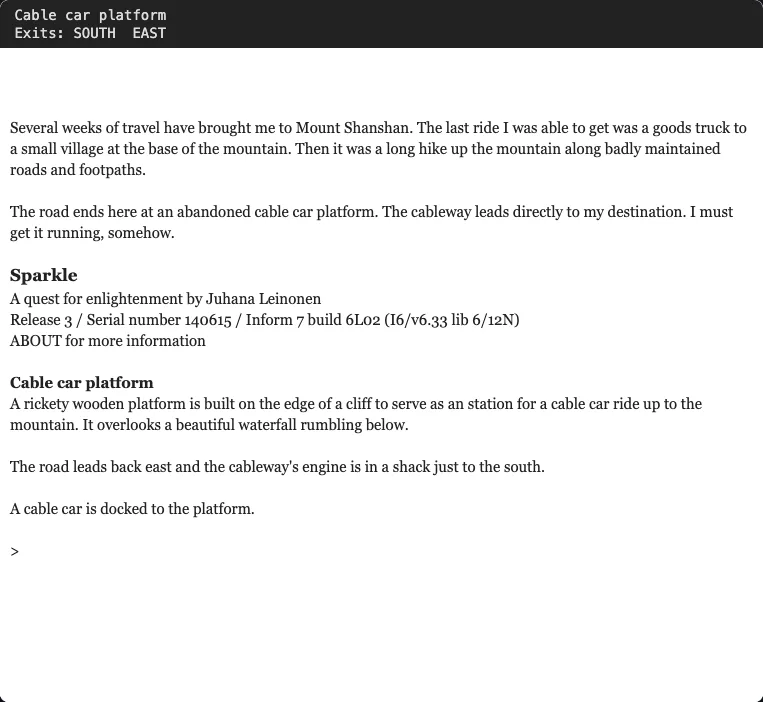
Sparkle
Your search for the Pattern ends at an abandoned cable car on Mount Shanshan. Meditate to learn which things are secretly the same, then turn one into the other. A short puzzle adventure by Juhana Leinonen.
-
Text adventures
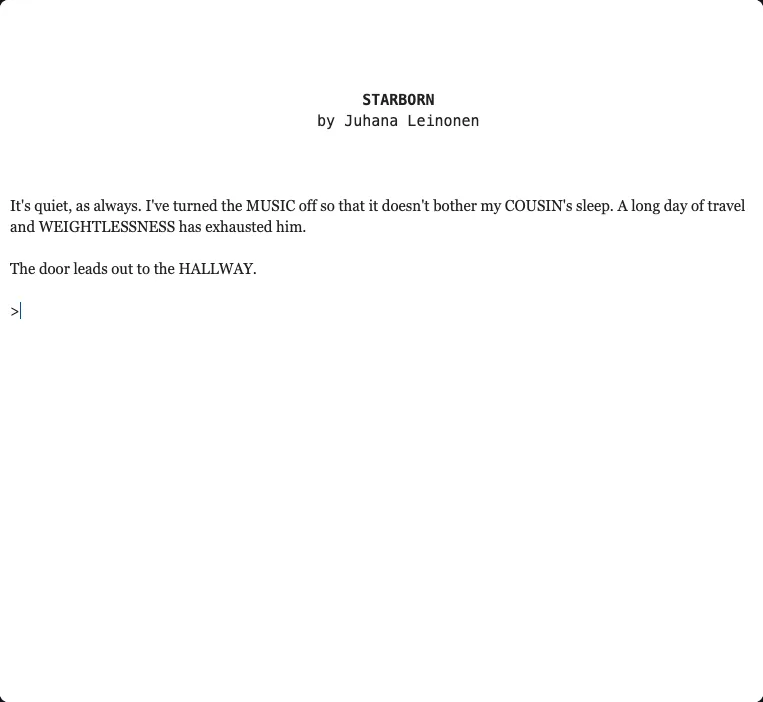
Starborn
Born on a starship far from home, you are finally in orbit around the Earth, and you are told you can never go down. A short science fiction story played with single keywords, by Juhana Leinonen.
-
Text adventures
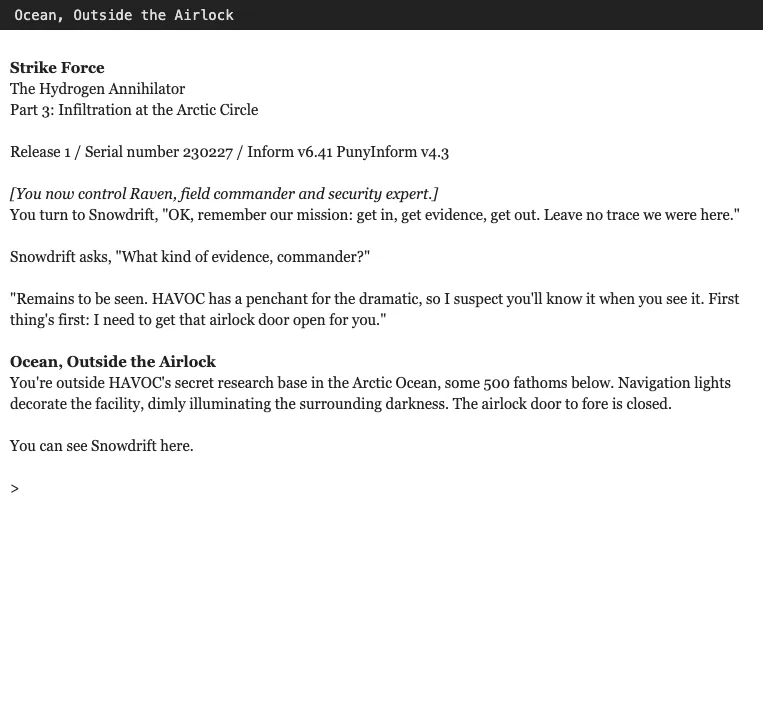
Strike Force
Two agents of an elite team slip into an enemy research station on the floor of the Arctic Ocean to find out what its masters are planning. A tongue-in-cheek spy caper in the style of an 80s Saturday morning cartoon, by Christopher Drum.
-
Browser games
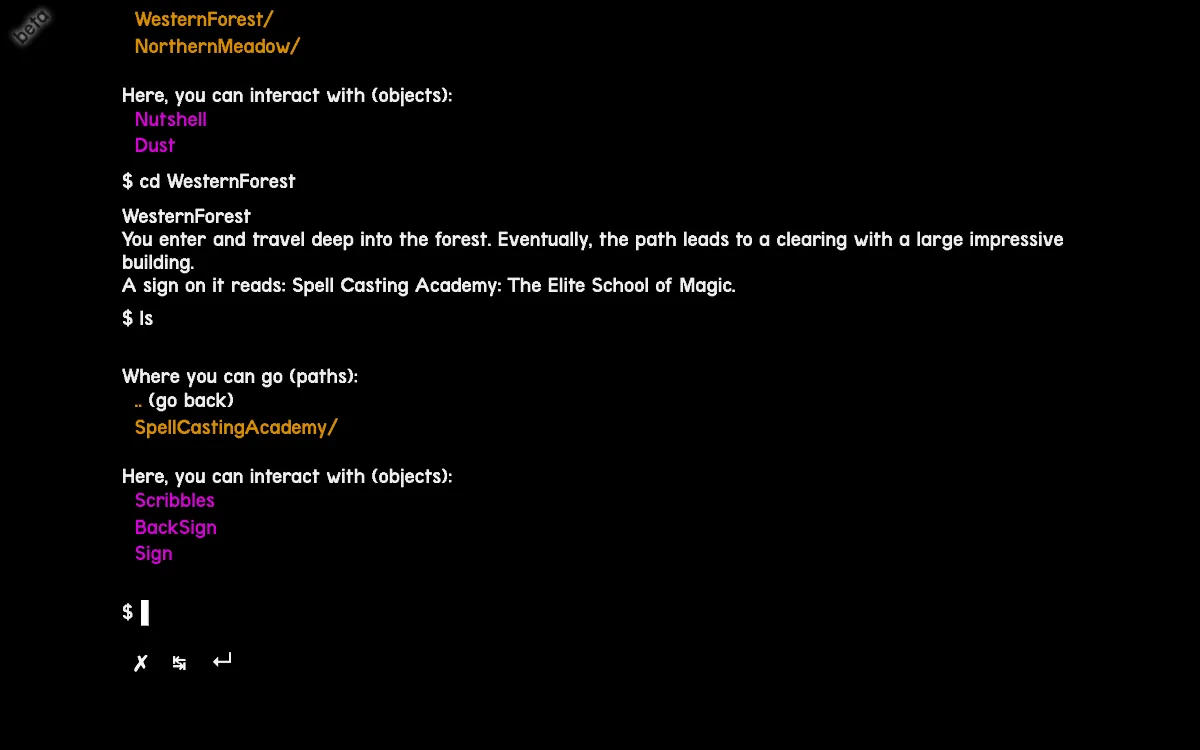
Terminus
A text adventure played with real command line commands: explore a fantasy land with ls, cd and cat, solve puzzles by moving, copying and deleting things, and learn the Unix shell without noticing. A rewrite of an MIT class game, by luffah.
-
Text adventures
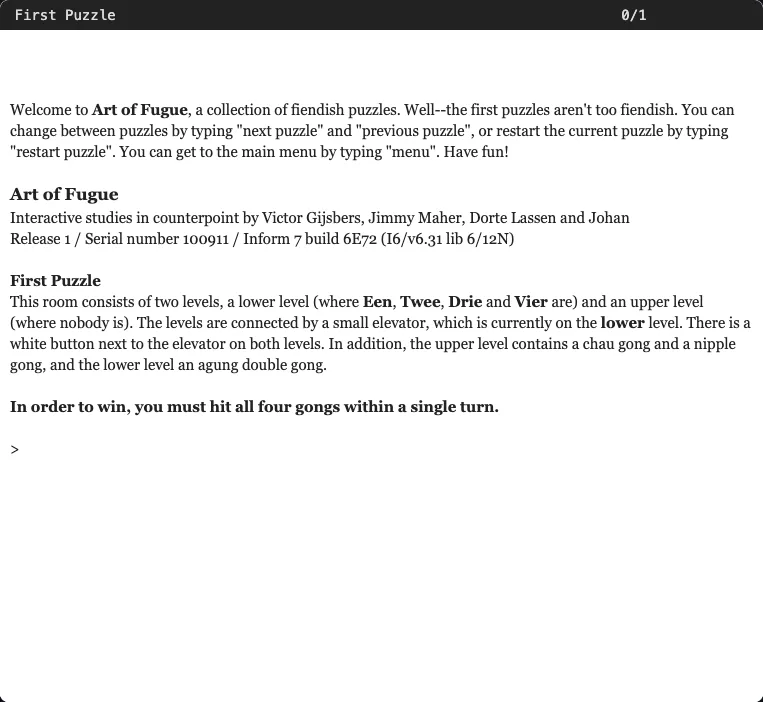
The Art of Fugue
Every command you type is carried out four times, by four characters, one turn apart, like voices entering a fugue. Eight logic puzzles where you plan for the people behind you, not just the one in front.
-
Text adventures
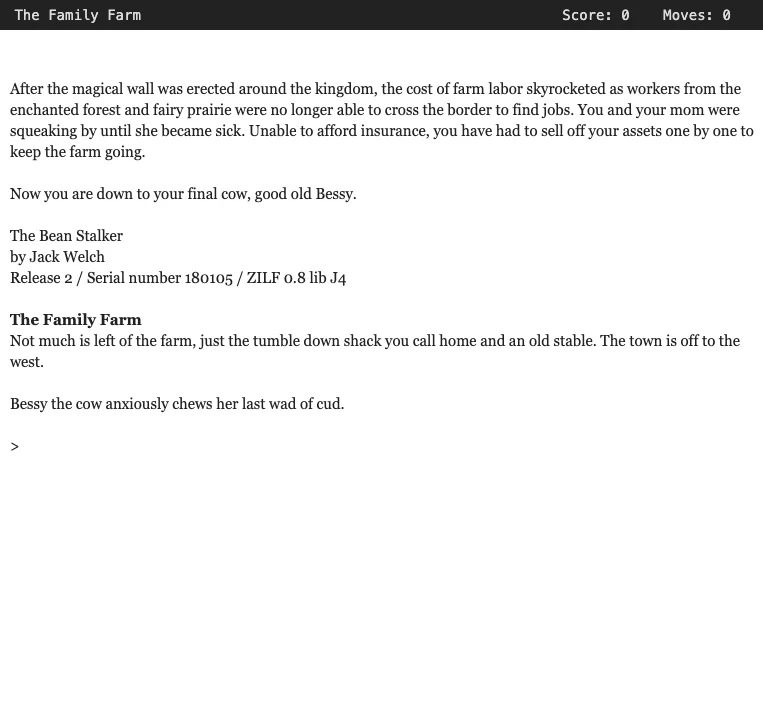
The Bean Stalker
The farm is broke, your mother is sick and good old Bessy is the last cow you have. Jack and the Beanstalk retold as a short, cheeky fairy-tale text adventure, written in the old Infocom language ZIL by Jack Welch.
-
Browser games
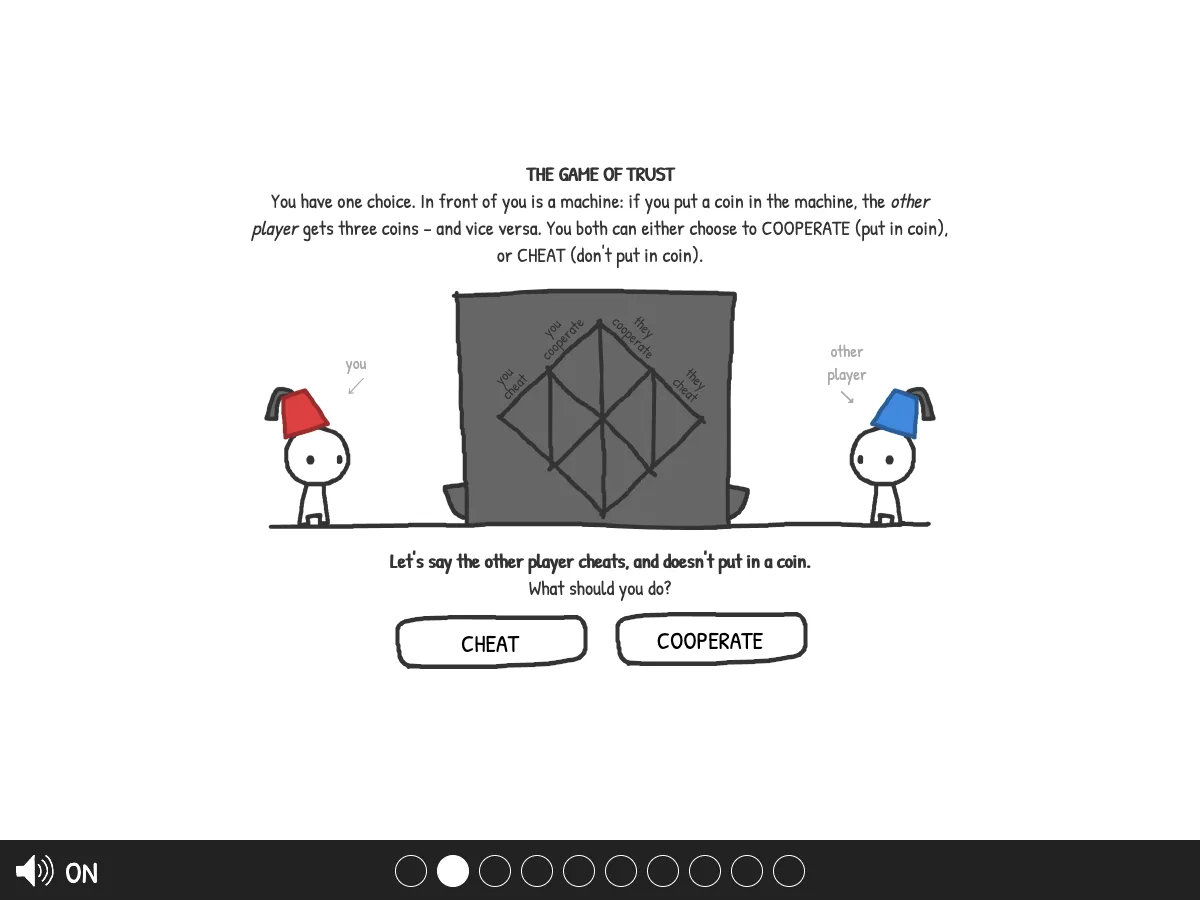
The Evolution of Trust
An interactive guide to the prisoner's dilemma and the game theory of trust: put a coin in the machine or keep it, play against characters with simple strategies, run a tournament and watch what survives. By Nicky Case.
-
Text adventures
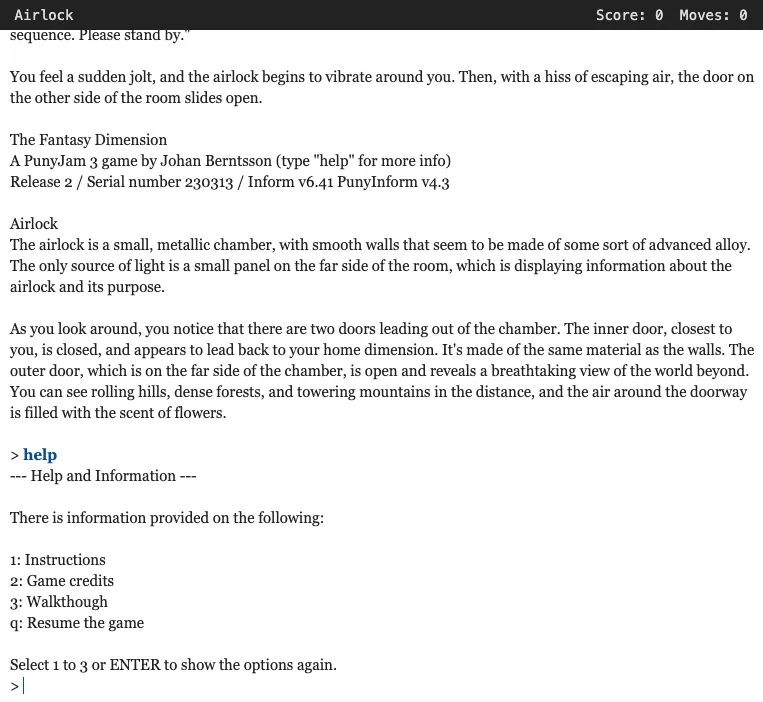
The Fantasy Dimension
One moment you are at your desk, the next you are in a humming airlock that offers to send you to any dimension you name, and you pick a fantasy world. A short classic-style fantasy adventure written for PunyJam 3 by Johan Berntsson.
-
Text adventures
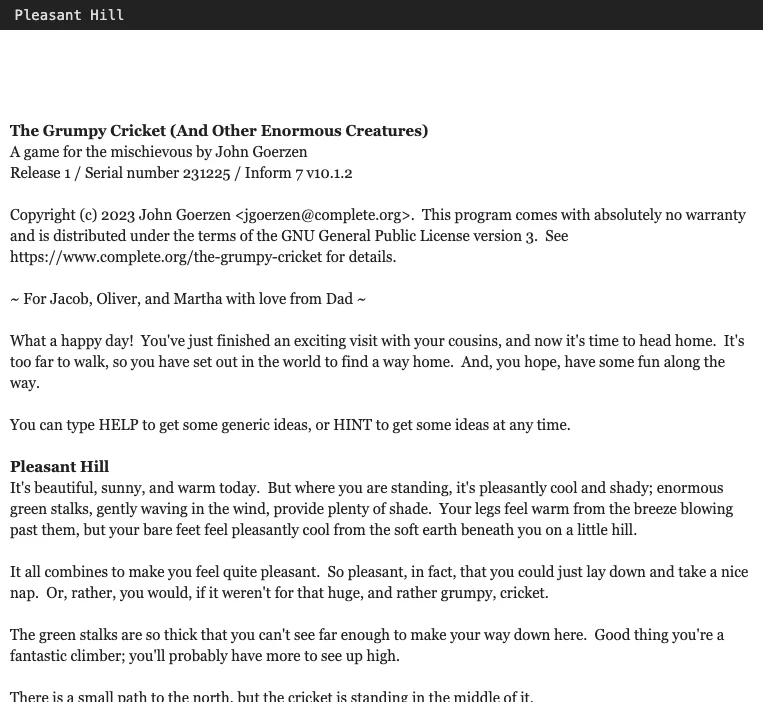
The Grumpy Cricket (And Other Enormous Creatures)
A happy day out is over and you have to find your way home, but you are very small, everything around you is enormous, and a huge grumpy cricket is blocking the path. A gentle, funny first text adventure written for children.
-
Text adventures
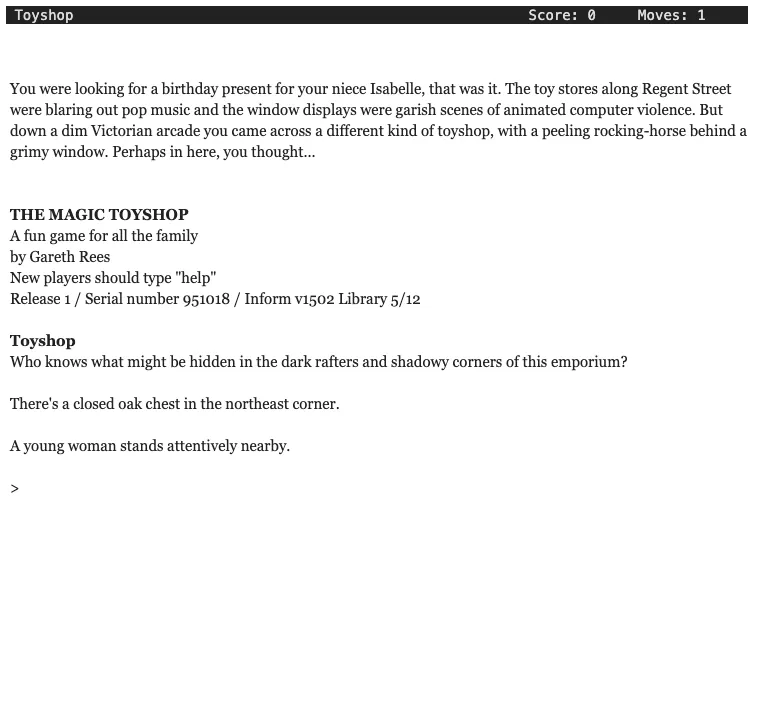
The Magic Toyshop
You only wanted a birthday present for your niece, but the girl minding an old Victorian toyshop has a chest full of games and gadgets and wants to see you solve each one. A playful one-room puzzle box by Gareth Rees.
-
Text adventures
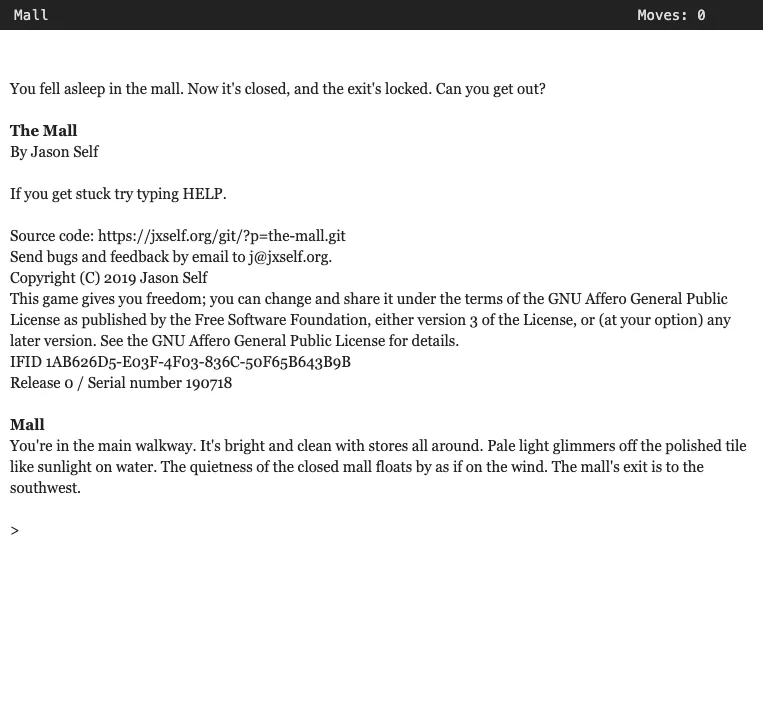
The Mall
You fell asleep in the mall and woke up after closing time, with the lights on, the shops empty and the exit locked. A small, quiet escape game set in a deserted shopping mall, by Jason Self.
-
Text adventures
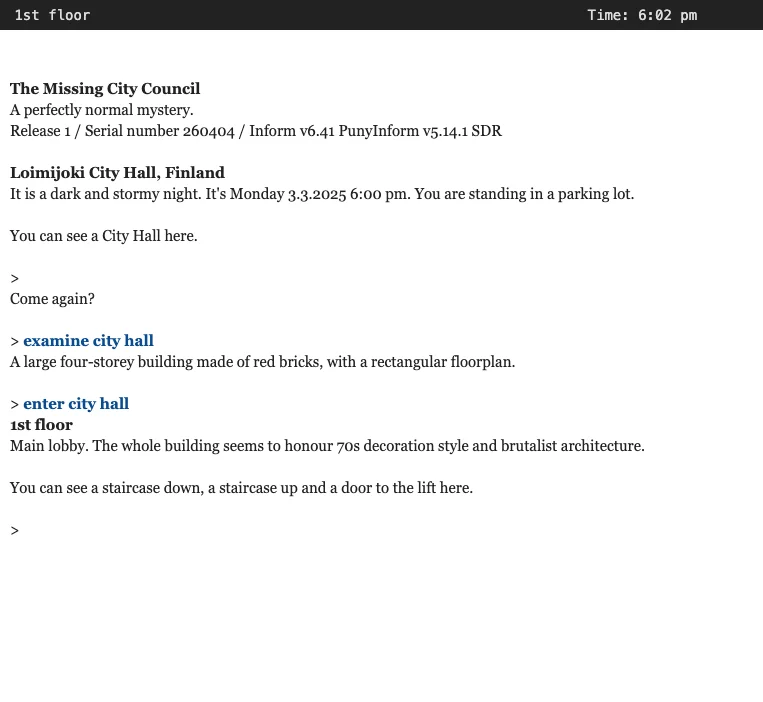
The Missing City Council
You arrive at a small Finnish town hall at six o'clock sharp for the council meeting about your property, and nobody is there. A short, absurd mystery set over four floors and a basement, by Ville Sundell.
-
Text adventures
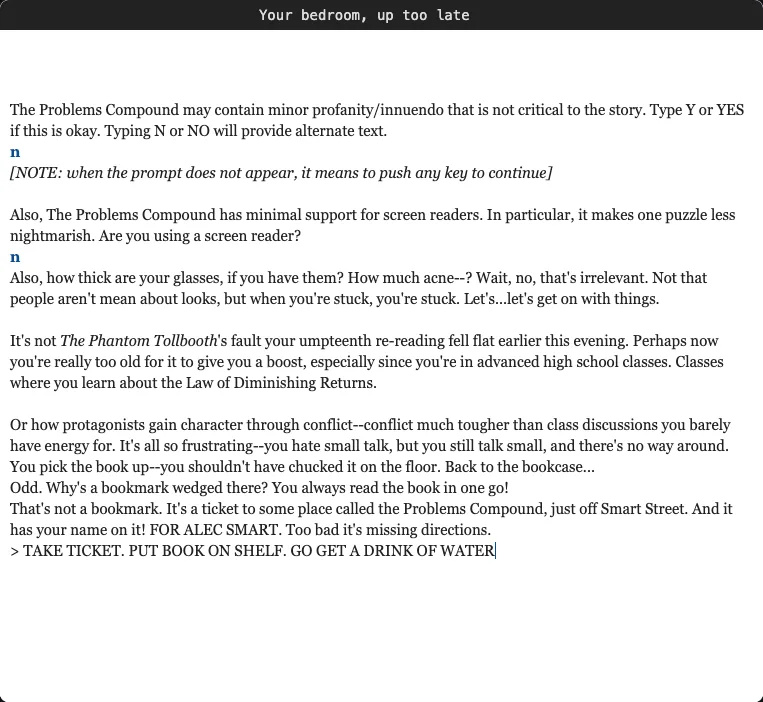
The Problems Compound
A bookmark in The Phantom Tollbooth drops an awkward teenager into a land where every phrase is turned back to front, from Pressure Pier to Idiot Village. Andrew Schultz's comedy of wordplay and social nerves.
-
Text adventures
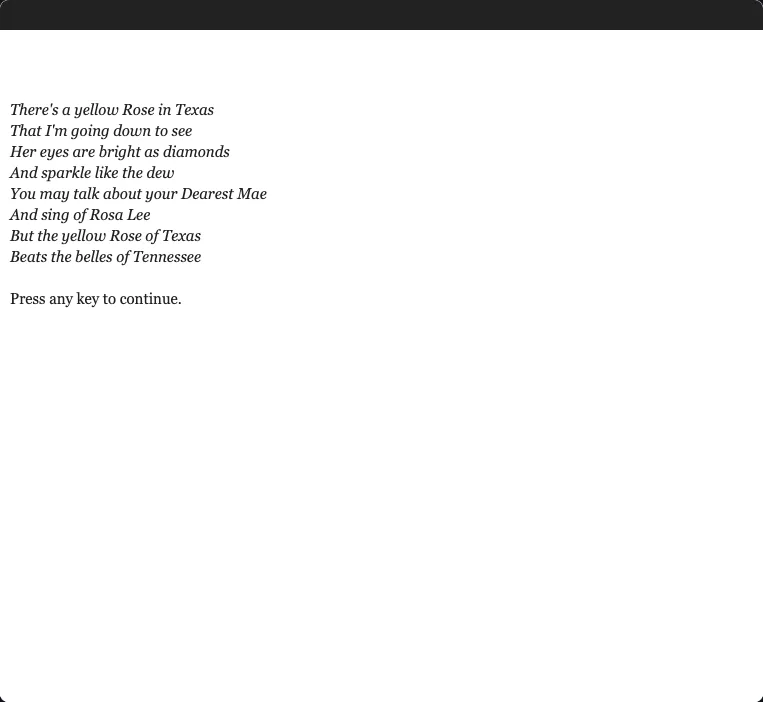
The Song of the Mockingbird
Texas, 1867. An old cowhand known as the Texas Mockingbird wakes up at the mercy of the outlaws he chased alone. A forgiving western text adventure by Mike Carletta.
-
Browser games
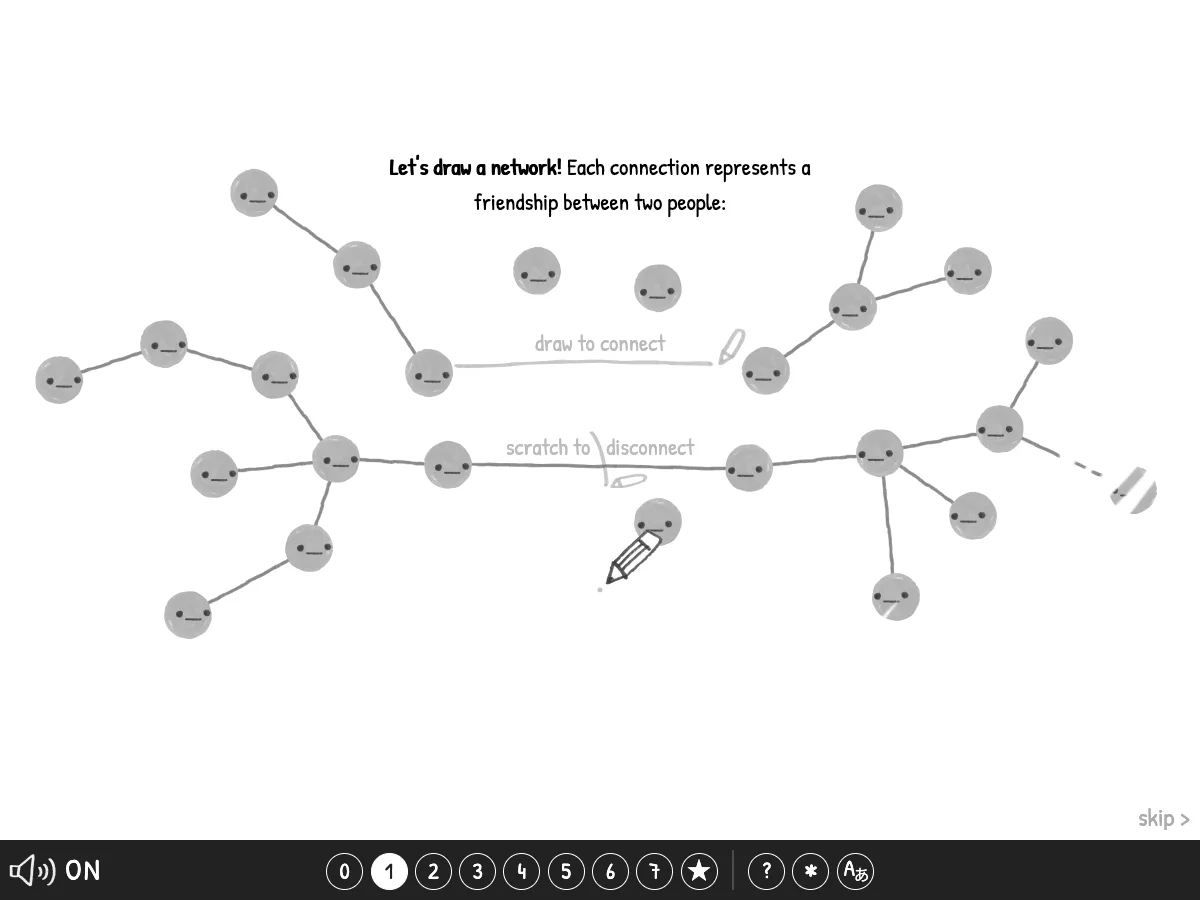
The Wisdom and/or Madness of Crowds
An interactive guide to human networks: draw friendships, watch a rumour or a habit spread, find out why some ideas need more than one friend, and why the world is smaller than it feels. By Nicky Case.
-
Text adventures
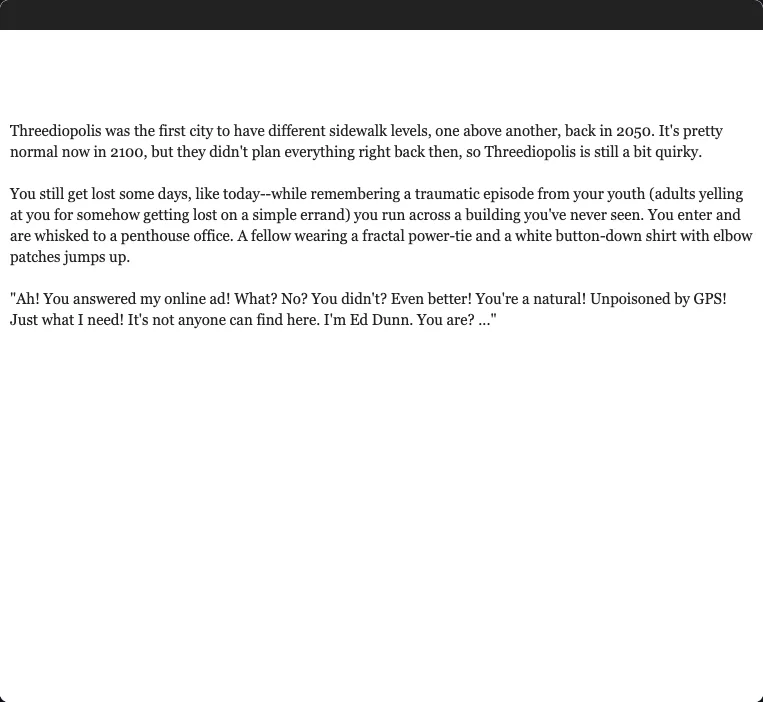
Threediopolis
A city stacked in layers, a list of forty odd errands and a teleporter to get home. Andrew Schultz's word-play puzzle where the route you take matters more than where you end up.
-
Text adventures
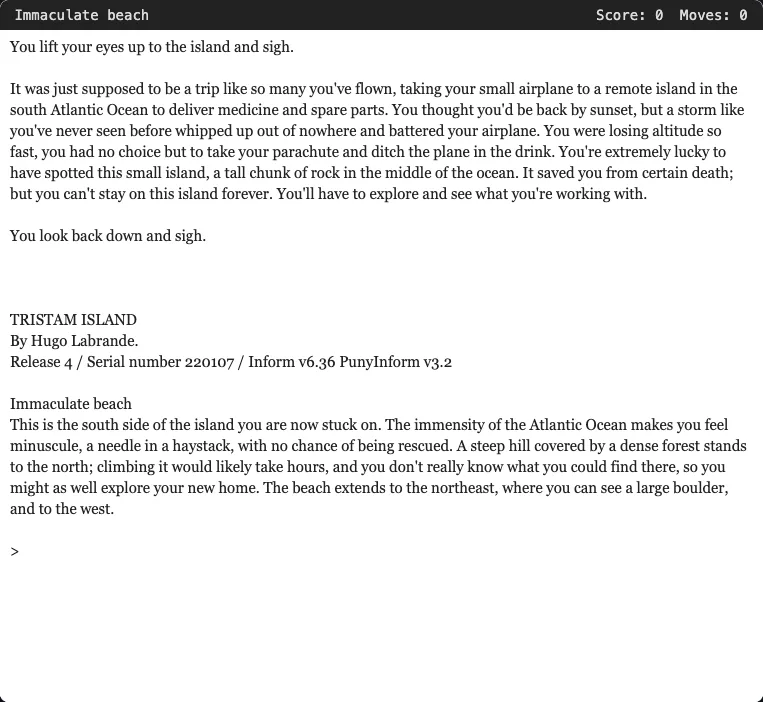
Tristam Island
A storm forced you to bail out of your plane over a tiny island in the south Atlantic. There is an empty village, a fenced building on the hill and no one to answer. A new text adventure written for 1980s machines.
-
Text adventures
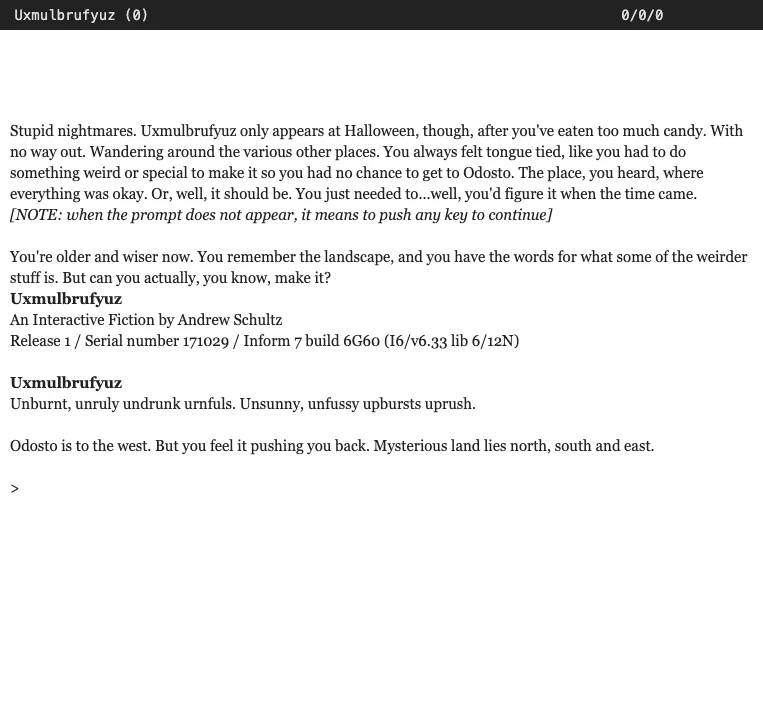
Uxmulbrufyuz
A recurring Halloween nightmare in a land where every word has only one kind of vowel, and the way out is to find the right word for each strange place. A tiny, abstract word puzzle by Andrew Schultz.
-
Text adventures
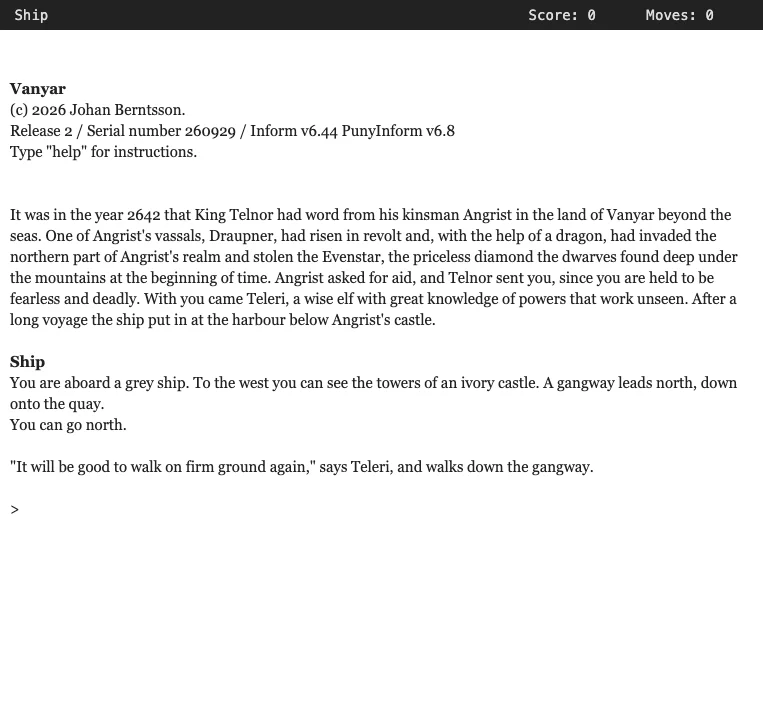
Vanyar
A rebel lord and his dragon have stolen the Evenstar, and the king sends you across the sea with a wise elf at your side. A 1986 Commodore 64 fantasy adventure by Johan Berntsson, rebuilt in 2026 for modern interpreters.
-
Browser games
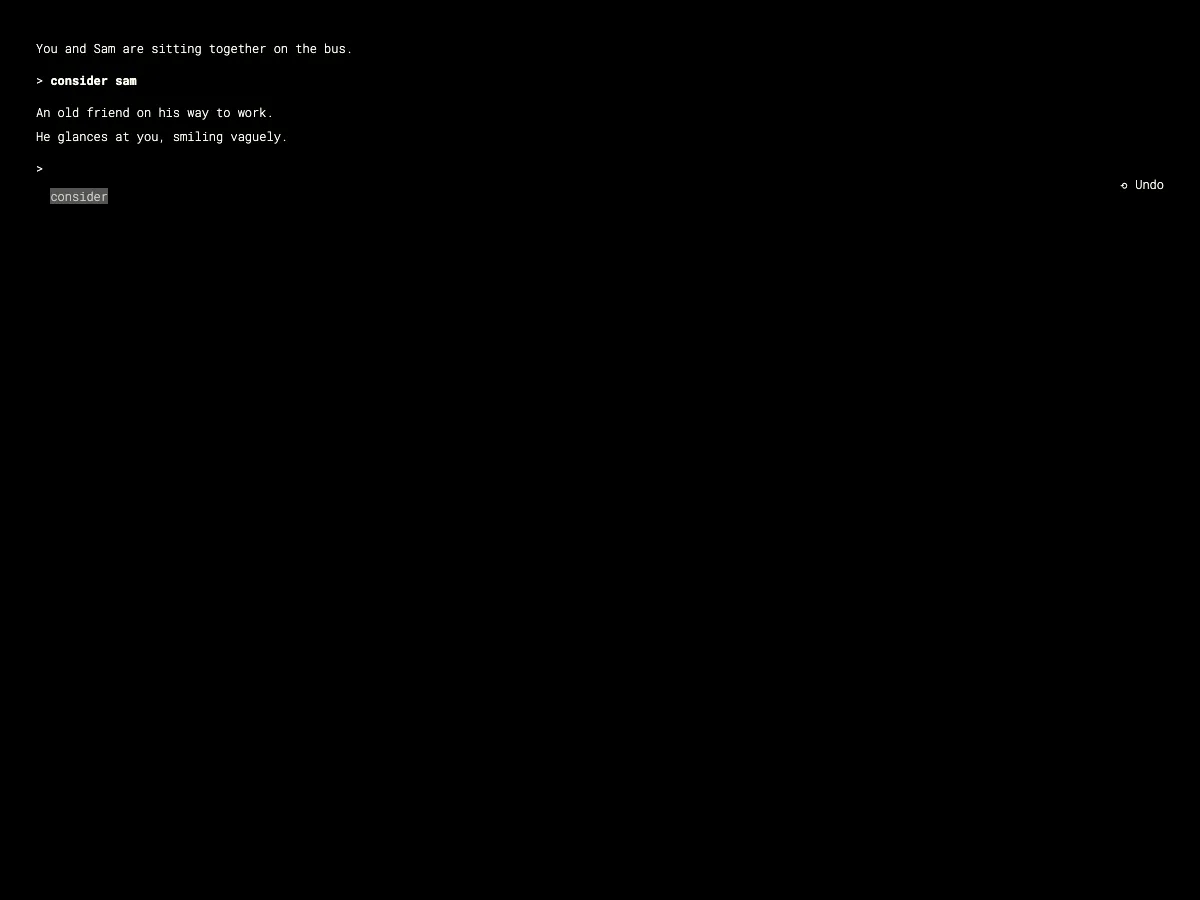
Venience World
A parser game with a different kind of parser: as you type, the game offers the words that could come next, so you can read your way through a bus ride and a conversation with an old friend. An experimental demo by Daniel Spitz.
-
Text adventures
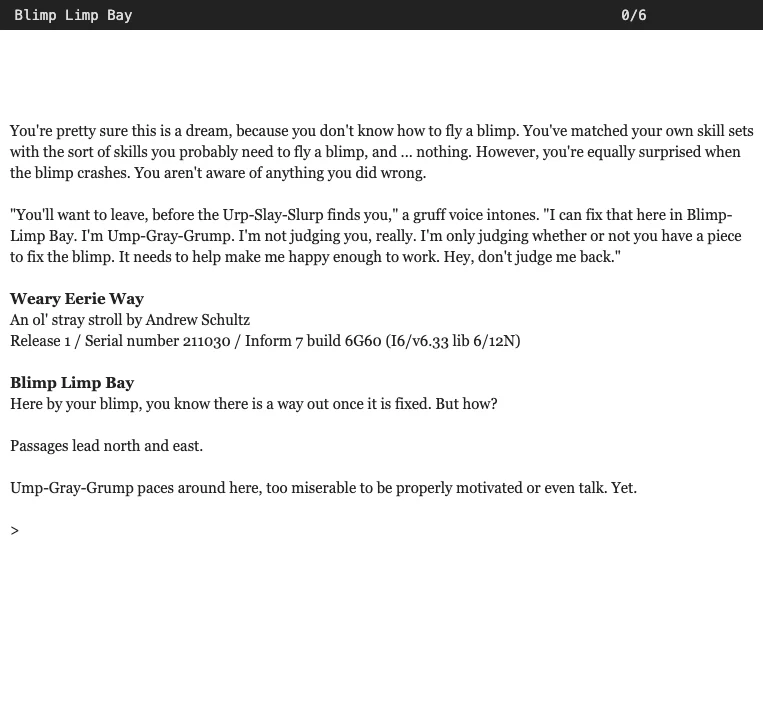
Weary Eerie Way
Your blimp has crashed in a dream, a grumpy mechanic will only fix it if you cheer him up, and something called the Urp-Slay-Slurp is on its way. A tiny rhyming puzzle game for Halloween by Andrew Schultz.
-
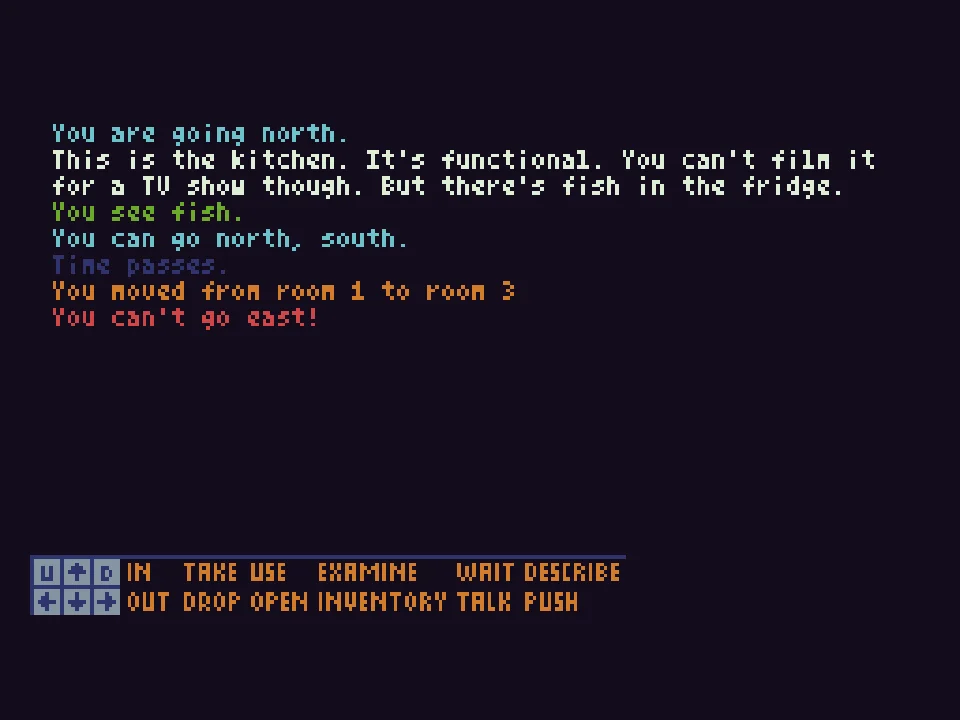
TIC-80
What Remains of Me
A surreal comedy set in the narrator's old neighbourhood: a dog with a ball, a frog nobody can calm down, a man bathing at a public tap and a train you cannot board without a ticket. A point-and-click text adventure by ronynn for the TIC-80.
-
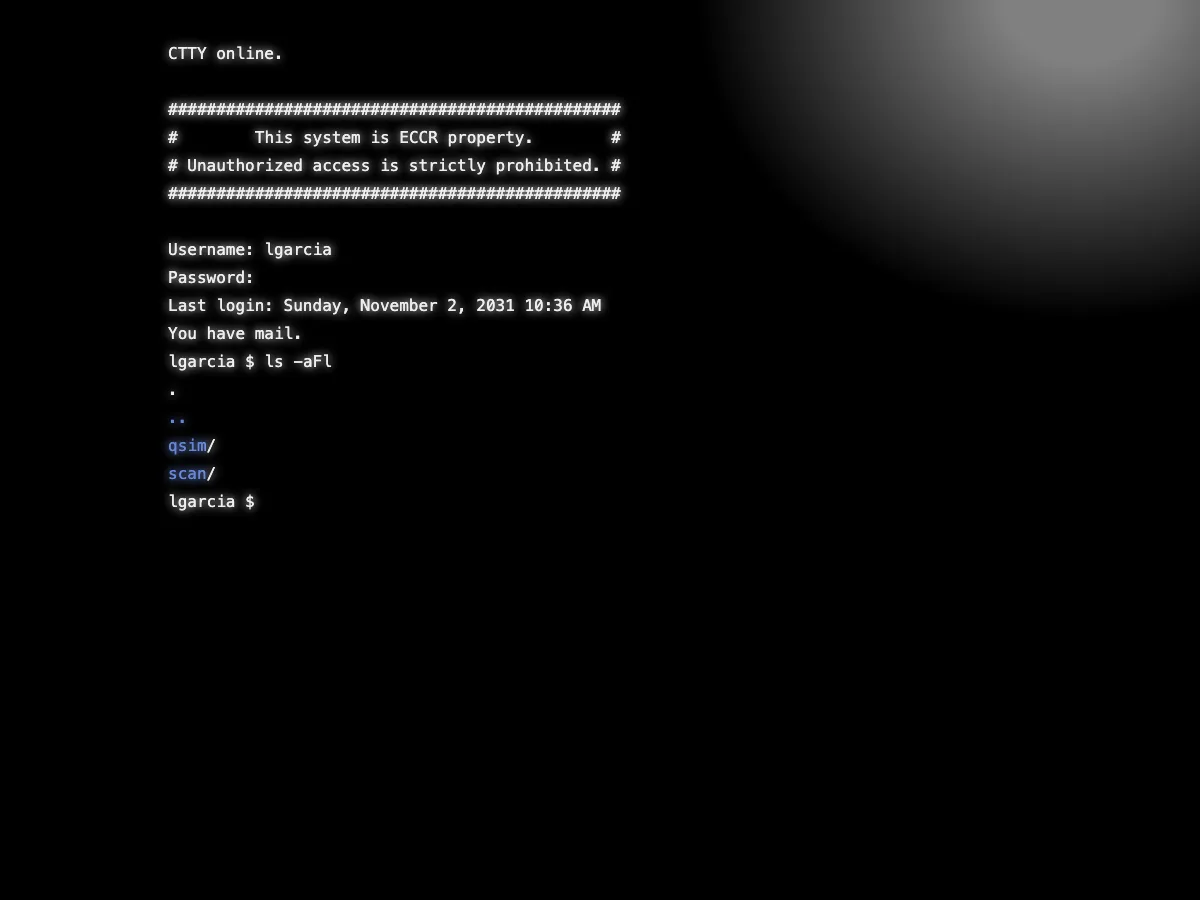
Browser games
whoami
A dying researcher sits at a terminal in an underground lab after a nuclear attack and tries to copy their mind into a simulation. A cyberpunk puzzle story played by clicking through a Unix-style file system. By n-n.
-
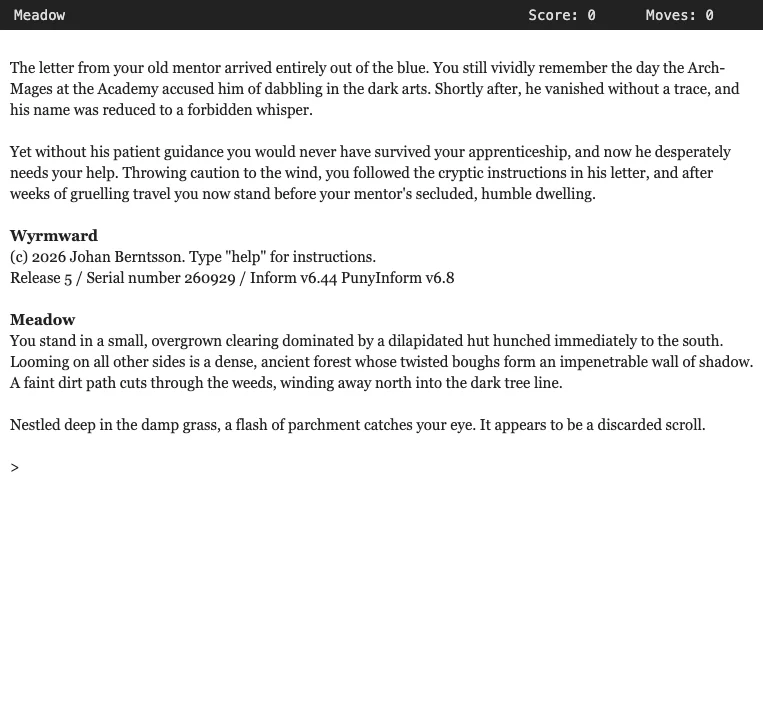
Text adventures
Wyrmward
A letter from your old mentor, accused of the dark arts by the Academy and missing ever since, brings you to his hut at the edge of a dark forest with a spellbook in your pack. A fantasy puzzle adventure built around casting spells, by Johan Berntsson.
-
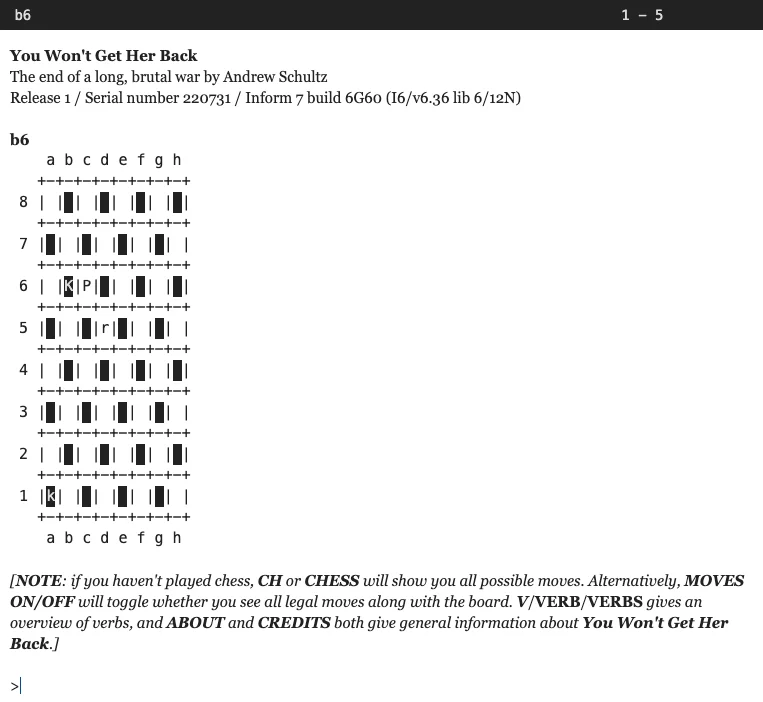
Text adventures
You Won't Get Her Back
The war is nearly over. You are a king with one loyal pawn left, the enemy has a rook, and he is sure you will never get your queen back. A famous chess endgame study turned into a short text adventure by Andrew Schultz; no chess knowledge needed.
-
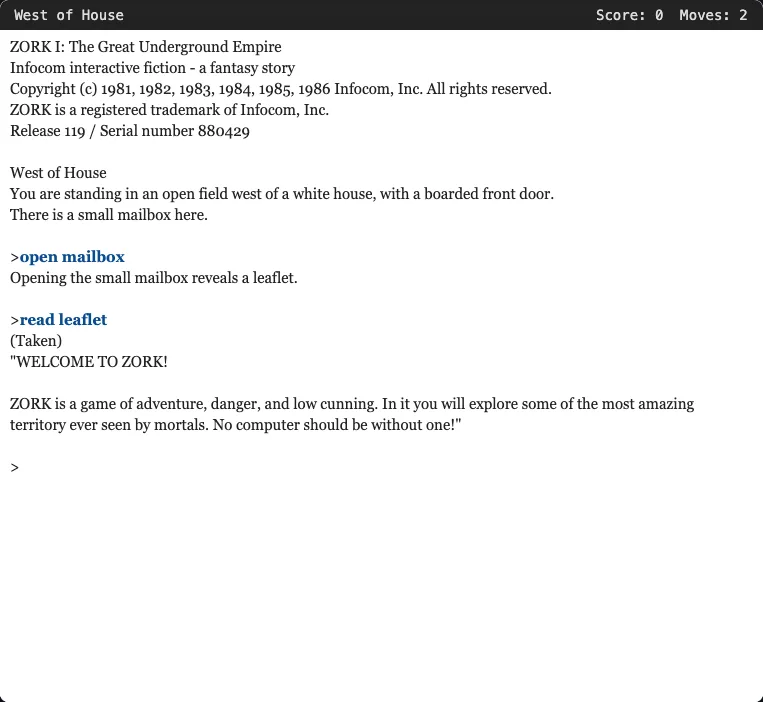
Text adventures
Zork I: The Great Underground Empire
West of a white house, with a mailbox, a leaflet and an empire of caves underneath. The text adventure that taught a generation to type commands, free under the MIT licence.
-
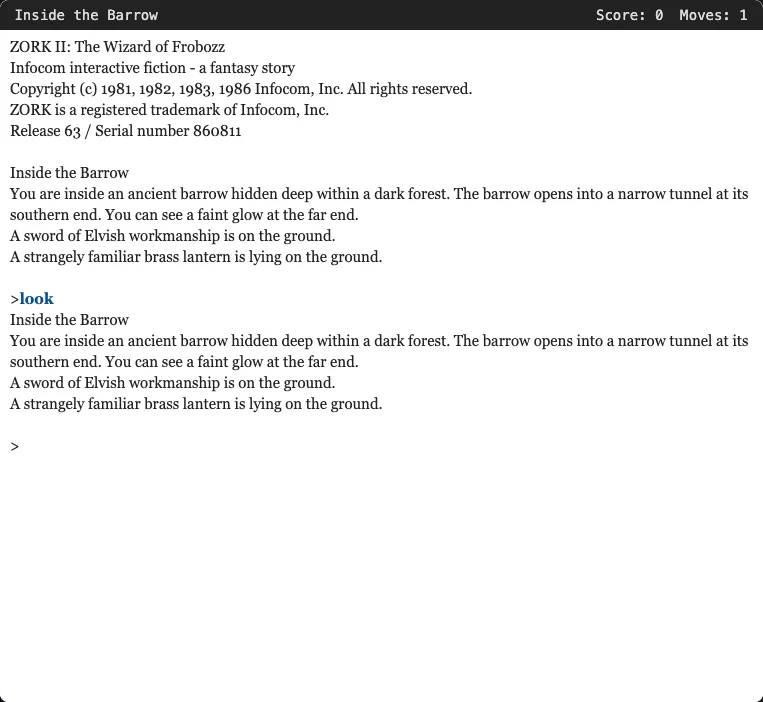
Text adventures
Zork II: The Wizard of Frobozz
Deeper into the Great Underground Empire, with a wizard who keeps casting spells on you. The second Zork, free under the MIT licence.
-
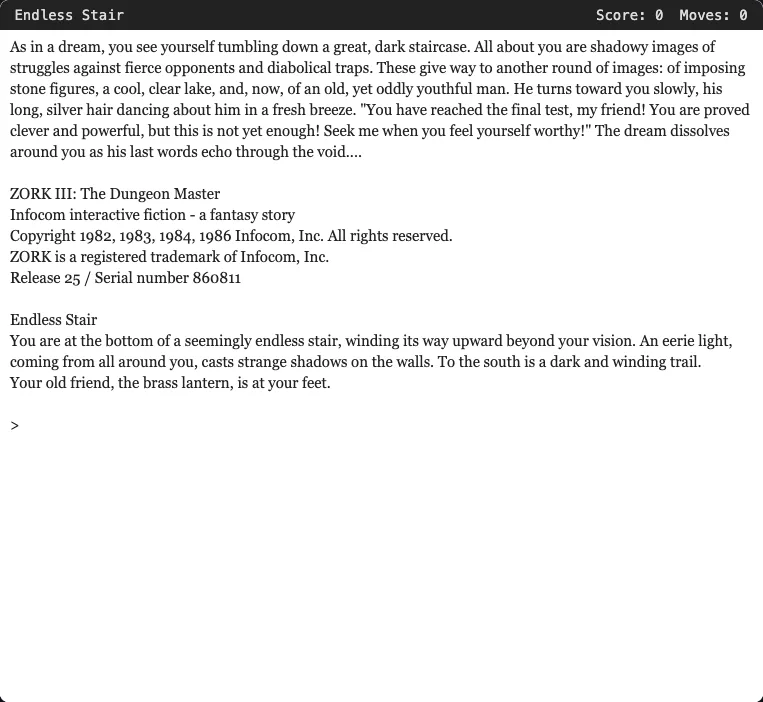
Text adventures
Zork III: The Dungeon Master
The bottom of the Great Underground Empire and a final test set by the Dungeon Master. The last of the original trilogy, free under the MIT licence.
Games made of words
Interactive fiction is a story you take part in by typing. The game describes a place, you write a short command such as open the mailbox or go north, and it answers. There are no graphics to look at, so the writing has to carry everything: the world, the puzzles and the jokes. The form began in 1976–77 with Colossal Cave Adventure, became a commercial hit with Infocom's Zork in the 1980s, and never stopped. Writers still release new games every year, many of them through competitions, and a large share are under free licences, which is why this is one of the biggest sections on the site.
How the games run here
Most of our interactive fiction runs in the Parchment interpreter, which plays Z-machine and Glulx story files, the formats Infocom used and that modern tools such as Inform still produce. You type in the box at the bottom and press Enter. Your progress can be saved with save and restored with restore, and both stay in your browser. A few browser games in this genre use choices and links instead of a parser.
Commands worth knowing
look(orl) describes the room again;examine(orx) looks at a thing closely.inventory(ori) lists what you carry.- Directions:
n,s,e,w,up,down,in,out. take,drop,open,push,talk to,ask aboutcover most puzzles.undotakes back the last move in most modern games.
Our beginner's guide to text adventures explains all of this step by step, with a sample session.
A few to start with
- Colossal Cave Adventure (1977): the first text adventure, a cave of treasure, mazes and magic words.
- Zork I: The Great Underground Empire (1980): Infocom's classic, west of a white house with a mailbox.
- Counterfeit Monkey (2012): Emily Short's wordplay adventure, where removing letters from things changes what they are.
- All Things Devours (2004): a tight puzzle about time, set in a research lab at 4:17 in the morning, where every command moves the clock.
- Founder's Mercy (2019): the last person on a dying space colony decides today is the day to leave.
- The Evolution of Trust (browser): an interactive explanation of game theory, played with coins and simple characters.
- What Remains of Me (TIC-80): a surreal point-and-click text adventure about the narrator's old neighbourhood.