
 Portugues
whoami
Saved games stay in this browser only.
About the game
The world has ended: climate collapse first, then total war. After a nuclear strike, you are one of the last people at a research centre, in a laboratory under the vault, with serious radiation damage and very little time left. The only way out you can see is the work your team was doing on quantum simulation: if a scan of a mind can be made and given a world to live in, a copy of you might go on after you.
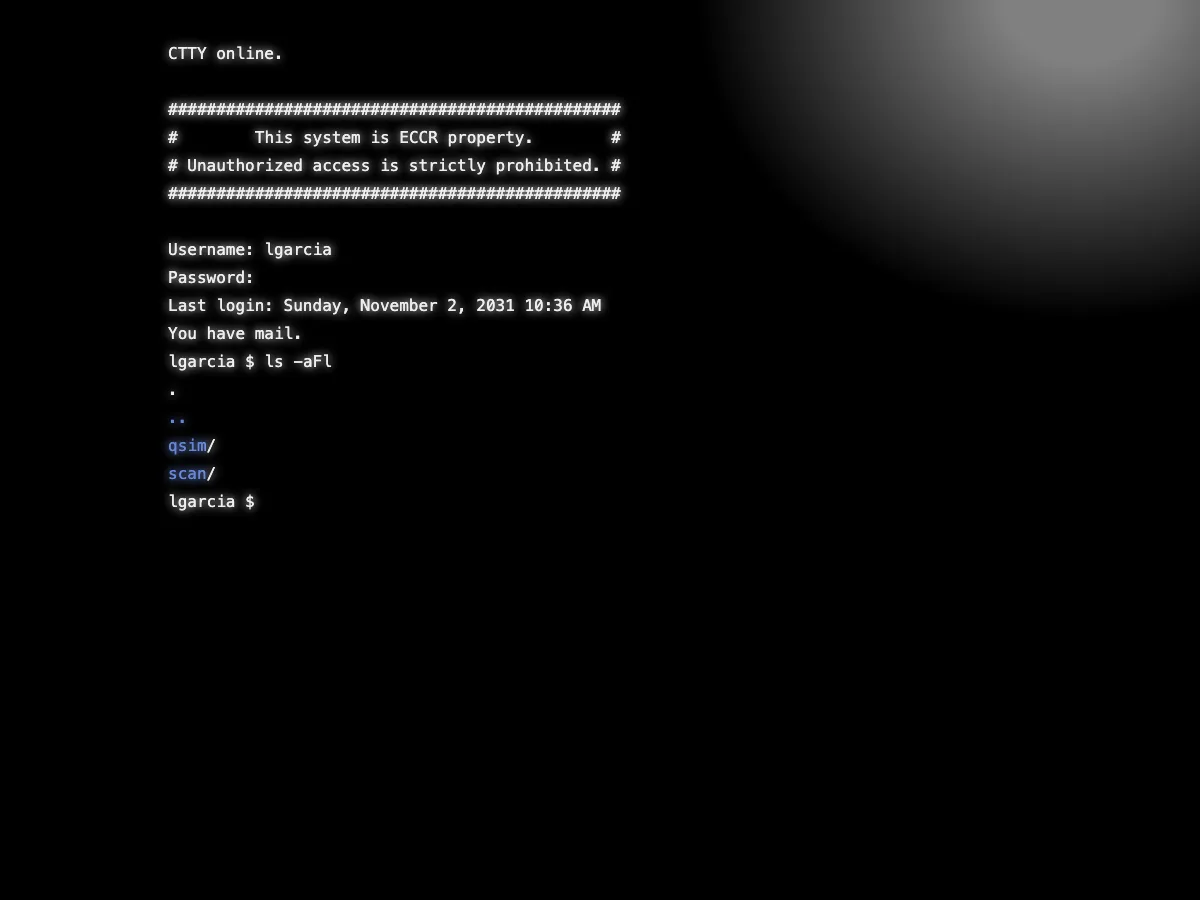
What you do is use a computer terminal. You walk through the file system, read mail and notes, open configuration files and run scripts, and each of these steps is a click on a command or a file. The goal is spelled out by the files themselves: scan the personality, train a model of society, build the simulation and start it. The game cannot be left in a state where it is impossible to finish, so exploring is safe, and the ending depends on what you choose to put into that last run.
whoami was written by n-n in Spanish in 2022 and translated into English for the 2025 Interactive Fiction Competition. It is the English version served here.
Playing it here
Click Play now, then Start. The screen imitates a terminal: lines of text,
and blue words you can click, such as folders and files, which act as commands.
Some settings are drop-down lists inside files. Work through the folders and the
mailbox to learn what you must do. The dump command, under /sbin, manages
saves, and reboot restarts the game.
A few things worth knowing
Read the mail and the notes. They explain the project, the people and the setting, and they point to the next step.
Some choices are heavy. The scan that makes the best copy is dangerous for the person scanned. The game gives you room to think about it.
Content note. War, a nuclear attack, radiation illness and death are central to the story. There is no explicit violence on screen.
Credits and licence
whoami was written by n-n and tested by Comely, dddddd, Tabitha, Josh Grams, Aster Fialla and Stewart C Baker. It is licensed under the Creative Commons Attribution-ShareAlike 4.0 International licence. Its credits also mention a text effect by Elisabéth and a fractal landscape routine ported from a 1985 issue of Amstrad User. The cover photograph, by Taylor Vick, is not part of the version served here. It runs on the Twine story format SugarCube (BSD-2).