
 Portugues
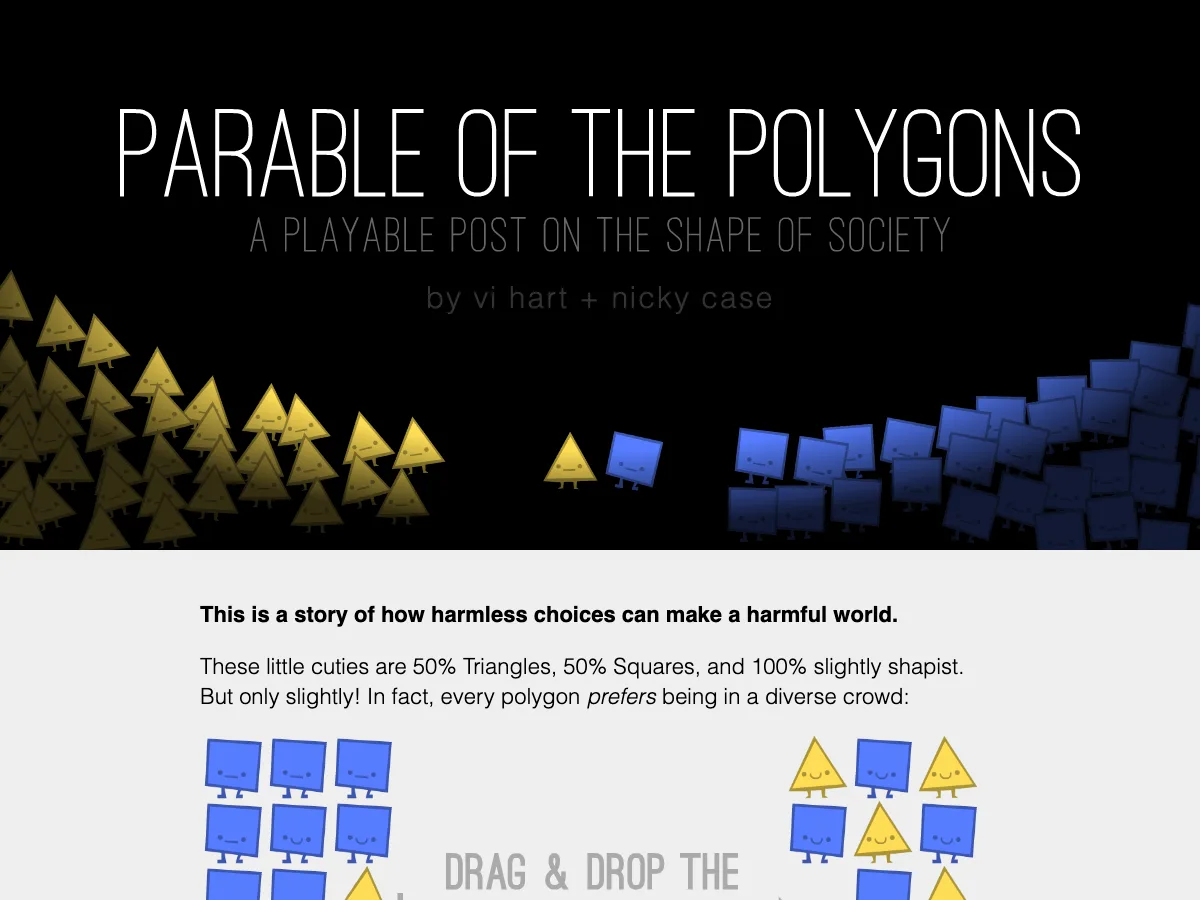
Parable of the Polygons
Saved games stay in this browser only.
About the game
This is not a game with a score, but an interactive essay you play as you read. The cast is a crowd of triangles and squares who are, in the authors' words, only slightly shapist. Every shape would like to be in a mixed crowd, but each one has one simple rule: it wants to move if fewer than a third of its neighbours are like itself.
The page walks you through it in small steps. First you move a few unhappy shapes yourself and watch how the neighbours' feelings change. Then a simulation runs the same rule on a full board, and a neat pattern appears: from a mixed start, the board drifts into separate triangle and square districts, even though nobody wanted that. The next steps ask what happens when the shapes become a little more demanding about diversity instead, and the sliders let you try for yourself, with a hopeful answer.
Parable of the Polygons was made by Vi Hart and Nicky Case in 2014 and builds on Thomas Schelling's 1971 model of segregation. It was an early "explorable explanation", and it still works as a short lesson on how a system can produce an outcome that none of the people in it intended.
Playing it here
Click Play now and scroll down the page. Some boxes can be played right where they are: drag a shape that is upset to an empty square, press the buttons under a board, or move the sliders to change how much the shapes care. The story tells you what to try at each step. Nothing is saved, and you can reload at any time to start again.
A few things worth knowing
It is about segregation. The shapes stand in for real social groups, and the page links to research on segregation and on bias at work. Read it as a model, which the authors say is a simplification.
Try the sliders more than once. The point comes from seeing the same rule give different results when you change a number.
FAQ
Is there a winner? No. You are done when the story ends.
Can I use it in class? The authors dedicate it to the public domain and invite teachers to do so.
Credits and licence
Created by Vi Hart and Nicky Case and dedicated to the public domain under Creative Commons Zero. The version served here is the authors' repository with the links to social networks, donations and translations removed; the licence text is linked from this page.