
 Portugues
Hitotoki
Saved games stay in this browser only.
About the game
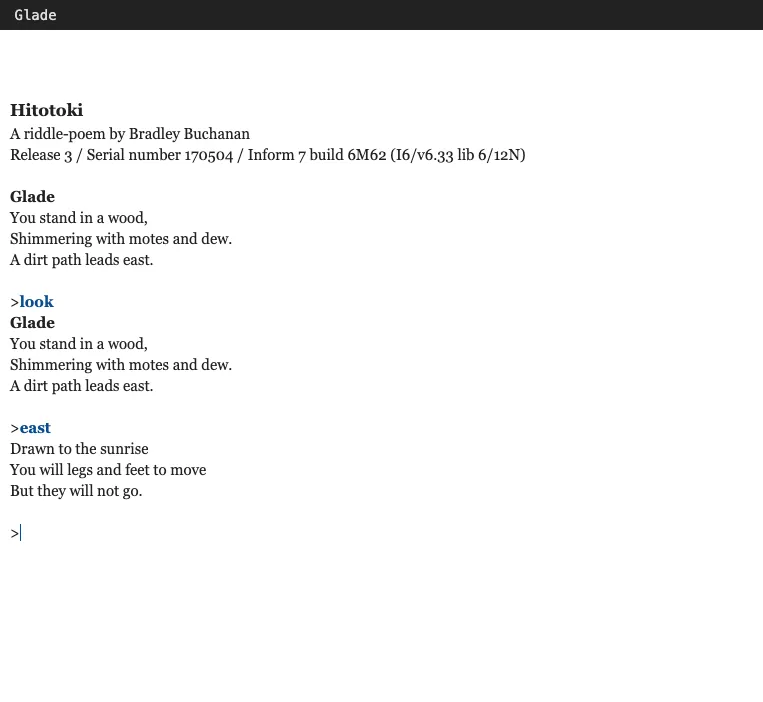
You stand in a wood, shimmering with motes and dew, and a dirt path leads east. Except that you cannot take it. Your legs will not move, the dust in the air hangs still, and nothing in the glade so much as trembles. Time has stopped, and the only thing left to you is to look.
Hitotoki is a Japanese word usually translated as "a moment", and the whole game happens inside one. Everything it says is written as a haiku, three short lines of five, seven and five syllables, even the error messages. Each thing you examine leads to other things: trees and leaves, stones and old snow, a waterfall and a pool, small lives caught mid-motion. Somewhere in the picture is the key to letting the moment end.
Bradley Buchanan wrote it in 2016 as an experiment in interactive poetry rather than prose, with text that adapts to the number of syllables in each word. It takes a few minutes to play and is more riddle than adventure: a small, calm piece to come back to on a busy day.
Playing it here
Click Play now and the poem begins in the player. The game is in English.
Type examine (or just x) and the name of something in the text, then
press Enter, for example x dew or examine path.
Commands
| Command | What it does |
|---|---|
examine (x) something |
look closely; this is almost the only thing you can do |
look (l) |
read the opening verse again |
about |
what the game is and how it began |
postscript |
the author's note, which explains the solution |
undo |
take back the last command |
A few things worth knowing
Follow the words. Each verse names new things to examine. Following those threads is the whole game.
Movement is not the answer. Walking, taking and pushing all fail, on purpose. The game will remind you, in verse, to look instead.
Think about the title. The ending is a riddle, and the word moment is the best clue you have.
Save the postscript for last. It is a lovely explanation of the poem, but it gives the solution away.
Credits and licence
Hitotoki was written by Bradley Buchanan and is released under the MIT licence in the author's repository. The version served here is Release 3, built automatically from that repository; only the story file is served, without the cover image. The licence text is linked from this page, and the source code is in the author's repository.