
 Portugues
Waternet
Saved games stay in this browser only.
About the game
In Waternet, a grid of pipes surrounds a water source, and the goal is always the same: connect every pipe so that water flows through the entire network. How you get there depends on the mode.
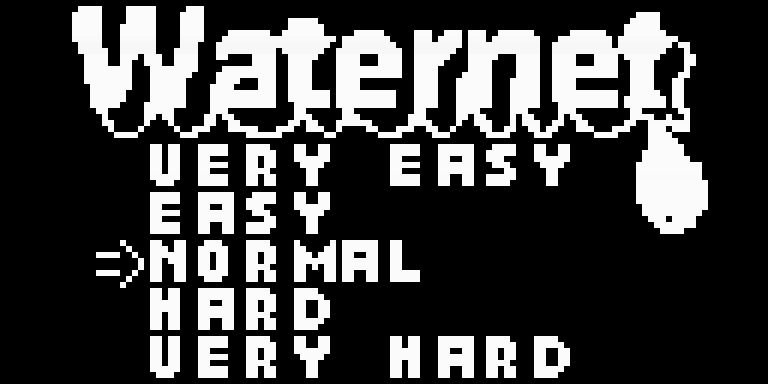
In Rotate, you turn individual pipes until they line up. In Slide, you cannot turn anything; instead you push whole rows and columns by selecting the arrows at their ends, and the pipes wrap around the edges. Roslid combines the two. Each mode has 25 puzzles in each of five difficulties, from Very Easy to Very Hard, plus a Random mode for endless boards, and the game counts your moves.
Playing it here
This is a homebrew game made for the Arduboy, the open, credit-card-sized handheld with a tiny black-and-white screen: a new game by an independent developer, not a commercial release. It runs here in Ardens, an Arduboy emulator compiled to WebAssembly. Click Play now and press Z to get through the title screen.
The game saves your progress through the levels, and it stays in this browser automatically. F2 also saves the full state of the emulator and F4 brings it back. A gamepad works too. The menus are in English, and the Help entry on the main menu explains each mode.
Controls
| Key | Arduboy button | Action |
|---|---|---|
| Arrow keys | D-pad | move the cursor; choose in menus |
| Z | A | confirm; rotate a pipe; slide a row or column from its arrow |
| X | B | back to the previous menu or level select |
| F2 / F4 | — | save / load the emulator state |
A few things worth knowing
Work from the edges in. Pipes on the border have fewer possible directions, so they are the easiest to lock in place first.
Slide mode wraps around. A pipe pushed off one side comes back on the other. Moving a row back and forth is free, so experiment.
Learn the rules once. Help on the main menu shows how each mode works, with pictures.
Credits and licence
Waternet was created by Willems Davy (joyrider3774): code, graphics and music. Its puzzle rules follow the Net and Netslide games from Simon Tatham's Portable Puzzle Collection, in the author's own implementation. It is released under the MIT licence and uses the Arduboy2 (BSD) and ArduboyTones (MIT) libraries by Scott Allen. The licence texts are linked from this page.