
 Portugues
Brogue: Community Edition
Saved games stay in this browser only.
About the game
Brogue is a roguelike in the classic mould: one character, a randomly generated dungeon, turns that pass only when you act, and a death that is permanent. Your goal is simple to state. Somewhere on the 26th level lies the Amulet of Yendor; go down, take it, and climb all the way back up alive.
What sets Brogue apart is how much it does with how little. The controls fit on a single help screen, there is no character creation, and you never pick a class or spend skill points. Everyone starts with the same dagger, darts, leather armour and a ration of food. Your character becomes whatever the dungeon lets it become: a heavy fighter if you find good armour and pour your scrolls of enchanting into it, a mage if a staff of firebolt comes along, a leader of monsters if you free enough captives. Two runs rarely play the same way.
The levels themselves are full of things to use rather than just things to fight. Grass burns, gas spreads, deep water washes items out of your pack, and rope bridges burn and fall into the chasm. Vaults behind locked doors offer a choice of several treasures, of which you may keep only one. Shackled prisoners beg to be released and will fight at your side if you do. A potion that ruins your day when you drink it can be just as deadly when you throw it into a room full of goblins.
Brian Walker created Brogue, first released in 2009, and published it as free software. Brogue: Community Edition, which is what you play here, carries on its development: the community, led by tmewett and with Walker himself taking part, fixes bugs, improves the interface and rebalances the game while keeping it true to the original. It also adds two shorter variants, Rapid Brogue and Bullet Brogue.
Playing it here
This is Brogue: Community Edition 1.15.1, compiled for the browser from the official source code. Click Play now: the download is about 1.3 MB. The game is in English only, has no sound or music, and plays entirely offline.
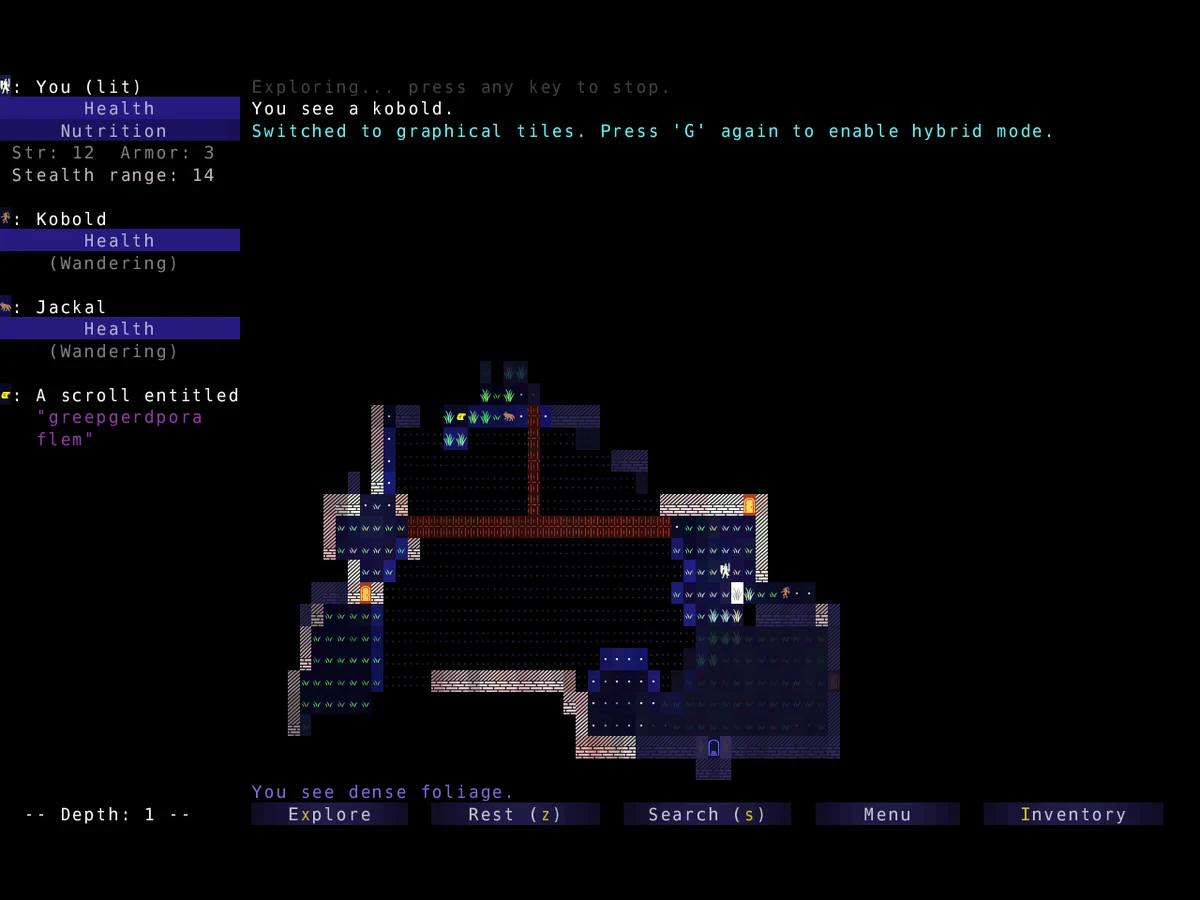
Press Shift+G at any time to cycle between three looks: classic text characters, graphical tiles, and a hybrid of the two. The letters and symbols of this build were redrawn with the free DejaVu fonts, because those in the original image came from commercial fonts; the graphical tiles are the game's own.
Saved games, recordings and high scores stay in this browser. Shift+S saves under a name of your choice and returns to the menu; continue it later with Play, then Load Game (a save is used up when you load it, as in most roguelikes). Even without saving, the game keeps writing a record of the current run as LastGame on every staircase and every few hundred actions, so if the tab closes you can usually pick up again from Load Game, losing only your latest moves. Clearing this site's data in your browser deletes your saves.
The window's own zoom and full-screen keys are switched off here: the game fills the player and grows with it, so use the player's full-screen button for a bigger view. A keyboard is strongly recommended. With a mouse alone you can still travel by clicking and use the buttons along the bottom (Explore, Rest, Search, Menu, Inventory), but many commands only have a key.
Controls
| Key | Action |
|---|---|
| Arrows / numpad / HJKLYUBN | move or attack (hold Shift to run) |
| Click a cell | travel there |
| Mouse over a cell | describe the monster, item or terrain there |
| X | explore automatically and pick up items |
| Z / Shift+Z | rest one turn / rest until healed or disturbed |
| S | search for secrets (five in a row: a detailed search) |
| > / < | travel to the stairs down / up |
| I or right-click | inventory |
| A / E / R / T / D | apply (read, drink, zap) / equip / remove / throw / drop |
| W | swap to your other weapon or armour |
| Shift+T | throw the same item again at the last target |
| C / Shift+D | name an unknown item / list what you have discovered |
| ] | show your stealth range |
| Shift+M | old messages |
| Shift+G | text, graphical tiles or hybrid display |
| Shift+S | save and return to the menu |
| ? | full list of commands |
| Space or Esc | dismiss a message or cancel |
Your first levels
Let the game explore for you. X walks the unexplored parts of the level, picks up everything along the way and stops the moment something interesting appears. On the first few depths, press X, deal with whatever interrupts it, and press X again. When it reports that it sees no path for further exploration, the level is done: press > to walk to the stairs down.
Read everything. Hovering over a monster shows its health and what it does, and the sidebar on the left lists everything in view. The description even says how often a monster hits you, how hard, and in how many hits it could kill you at worst. Take that number seriously.
Fight in corridors. Rats, jackals and kobolds are weak alone and dangerous in groups. Back into a corridor or a doorway so that only one enemy can reach you at a time. Monkeys steal an item and run; kill them before they reach the exit, or throw darts after them.
Use your darts. You start with fifteen. Throwing them (T) at a monster that is walking towards you gets in free damage, and you can pick them up again afterwards.
Rest before you go down. Health comes back over time. Use Shift+Z to rest to full before taking the stairs. Resting uses up food, but the dungeon provides enough for steady play, and the game warns you well before you starve.
Unknown potions and scrolls
Every potion and scroll starts unidentified, with a random colour or title. Using one is the usual way to learn what it is, and Brogue is built so that experimenting pays off, as long as you do it carefully.
Read scrolls freely. Most scrolls are helpful, and the worst ones (aggravate monsters, summon monsters, an unwanted teleport) are rarely fatal. Read them when no monster is in sight.
Drink potions with care. The harmful potions are nasty: caustic gas, confusion, paralysis, darkness, hallucination, incineration and creeping lichen. Drink unknown ones at full health, with no enemies around, and not while standing in grass that can catch fire. If you drink something bad, walk out of the cloud or the fire at once. Once you know a potion is harmful, keep it: thrown at enemies, it works on them.
Watch for detect magic. This potion marks every magic item on the level, and those in your pack, as good or bad. It is one of the most common potions, so a type you keep finding early is worth trying.
Enchanting is the big decision. Scrolls of enchanting are by far the most common scroll. Each one makes a single item permanently stronger, and the best runs usually put most of them into one or two items, such as your armour, a good weapon, a staff, a ring or a charm. You do not need to decide on the first level, so keep the scrolls until you find something worth building around.
Equipment reveals itself. Armour shows its true enchantment after about 1,000 turns of wear, rings after 1,500, and weapons after 20 kills. A scroll of identify does it at once. Heavy armour and weapons need strength: each point you are missing makes them less effective, and heavier armour is also noisier.
Stealth and allies
Monsters do not see you right away. Many are asleep or wandering when you arrive, and they notice you only inside your stealth range, which ] shows on the map. Resting halves it, staying in the dark or in shadow halves it too, and heavy armour widens it. Sneaking past a dangerous sleeping monster, or letting a group walk by, is often the right move.
Free the captives. Sometimes you will find a monster in shackles, guarded by others. Kill the guards, walk into the captive and agree to free it: it becomes your ally and follows you from level to level. Allies can learn new abilities from the monsters they defeat, and a wand of empowerment makes one much stronger. A good ally can carry the early game for you, but keep it alive: a dead ally does not come back.
Vaults are a choice. Some rooms, often behind a locked door, hold several items on altars. Pick one up and cages lower over all the others, so read each description before you choose. The key to a locked room is found elsewhere on the same level, often behind a puzzle or a trap.
A few things worth knowing
The terrain is a weapon. Burning grass, explosive gas, deep water and collapsing bridges hurt monsters as easily as they hurt you. Lure a pack into a meadow and set it alight, and think twice before fighting in one yourself.
Run away early. A scroll of teleportation, a potion of descent or simply the stairs are all ways out. Escaping a bad fight while you still have health to spare is much easier than at the last moment.
Search when stuck. If a level seems to have no way forward, press S five times in a row for a detailed search; secret doors and hidden levers are common.
Try a shorter game. Play, then Change Variant offers Rapid Brogue, a quarter-length dungeon, and Bullet Brogue, even shorter and meant for experienced players. Change Mode offers Easy Mode, where you take only a fifth of the damage but keep only a tenth of your score.
Past the amulet. The dungeon goes on below the 26th level. Climb back out with the amulet and you have escaped; carry it all the way down to the 40th level and through the crystal archway there for a "mastered" victory. The lumenstones found on those deeper levels are worth a great deal of score.
Credits and licence
Brogue was created by Brian Walker. Brogue: Community Edition is maintained by tmewett and a group of co-maintainers and contributors named in the game's changelog. It is free software under the GNU Affero General Public License, version 3 or later. The graphical tiles were drawn by Antony Boucher, based on Oryx Design Lab's tiles for Brogue, and are licensed under CC BY-SA 4.0; in this build their text glyphs were redrawn with the DejaVu fonts, and the modified image keeps the same licence. The licence texts and the complete source code of this build, with our patch, are linked from this page. Official repository: github.com/tmewett/BrogueCE.