
 Portugues
Echo Chamber
Saved games stay in this browser only.
About the game
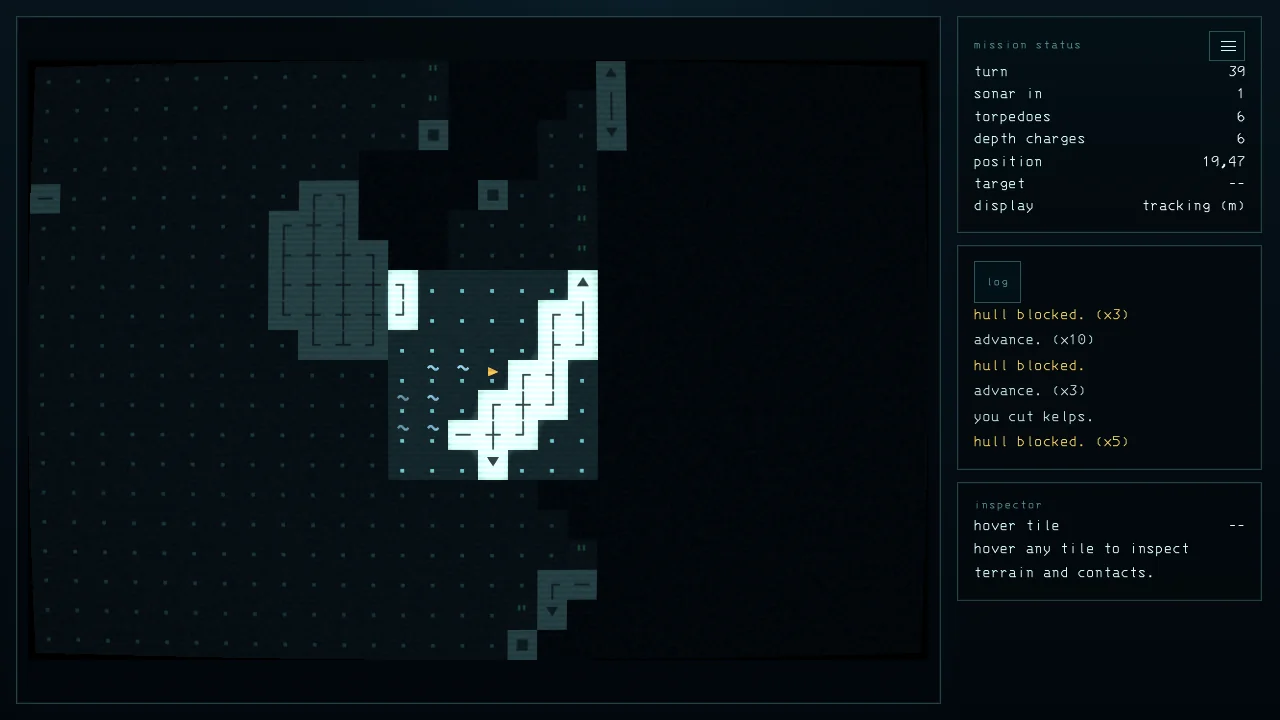
Echo Chamber puts you in a small submarine at the bottom of the sea, inside a cavern that you cannot see. All you have is sonar. Every few turns the boat sends out a wave, and when it hits rock, kelp or another vessel the game remembers a snapshot of that spot on your screen. Close to you, things are clear; a few tiles away you only know that there is something; farther than that it is black. The map you build is a record of where you have already been listening.
You move one tile a turn, and some things in the cavern are faster than you, such as torpedoes and falling rocks. You have six torpedoes and six depth charges, and nothing else. Explosions change the rock around them and make noise, so a shot that opens a way can also tell everyone where you are. The goal, in the words of the author's design notes, is to cross the labyrinth, find the secret document capsule at the end of it and survive.
The game was written in a week for the 7DRL Challenge 2026. It has a retro-terminal look with scanlines and a glow, a haunting soundtrack and a log that tells you what the boat hears. It is a game about caution: listen, move, listen again.
Playing it here
Click Play and the game loads in the page (about 9 MB, downloaded only when you press the button, most of it the music). Sound starts after your first key press. The game keeps its settings in this browser, and the options menu (the button with three lines) lets you restart or start a random run at any time. The page makes no requests outside this site. The game is in English and Korean; it picks Korean only if your browser is set to it, and you can change the language in the options.
Controls
| Key | Action |
|---|---|
| Arrows or WASD | move one tile |
| . | wait a turn |
| z | fire a torpedo |
| c | fire a torpedo upwards |
| x | drop a depth charge |
| m | switch the display mode |
| r | restart once your boat is sunk |
| Mouse over a tile | inspect terrain and contacts in the panel |
| Click a tile, then click again | plot a course to it, then sail it (it stops when something new shows up) |
| Menu button | restart, random run, and other options |
Tips
Wait to hear. The sonar wave comes every three turns, and standing still costs nothing but time.
Torpedoes are loud. Use them to open a route or to answer a threat, not to check what is ahead.
Read the log. It reports blocked hulls, explosions and contacts, with a direction.
Let the boat sail. Plotting a course with the mouse saves keystrokes in the parts of the map that you already know.
Inspect before you commit. Hover a shape on the map to know if it is rock, kelp, an item or an enemy.
FAQ
Is it hard? Yes, by design: you play half-blind and have very little ammunition. Runs are short and every one shows you a new cavern.
Is there sound? Yes: the music and the sonar and explosion effects. Turn your volume down if you play in a quiet place.
Does it work on a phone? No: it needs a keyboard.
Credits and licence
Echo Chamber was made by scarf (scarf005) and is free software under the GNU Affero General Public License v3. The complete source of this build, with the small patch we apply and the script that builds it, is linked from this page. The patch removes the links to the author's pages from the HTML and caps the volume of the explosion sounds, so that they play in the browser.
- Music: "SCP-x2x (Unseen Presence)" by Kevin MacLeod (incompetech.com), licensed under CC BY 4.0.
- Sounds: "Underwater Deep Water Loop" and "Underwater Blub 03" by Department64 (freesound), and "UnderWater_Explosion1", "2", "3" and "ExplosionFar" by Akkaittou (freesound), all CC BY 4.0; "Sonar (tuned to F)" by kwahmah_02 (freesound), CC BY 3.0; "Reload" by gulfstreamav, "Bang/Explosion Metallic" by Werra, "Sonar" by KIZILSUNGUR and "sonar" by digit-al, all CC0. The author converted the sounds to mp3.
- Font: IBM 3270 by Ricardo Banffy and contributors (BSD-3-Clause).
- Libraries: Preact, Preact Signals, rot.js (BSD-3-Clause), Lingui and Deno standard library packages, under MIT and similar licences, all in the licence file linked from this page.