
 Portugues
Orpheus
Saved games stay in this browser only.
About the game
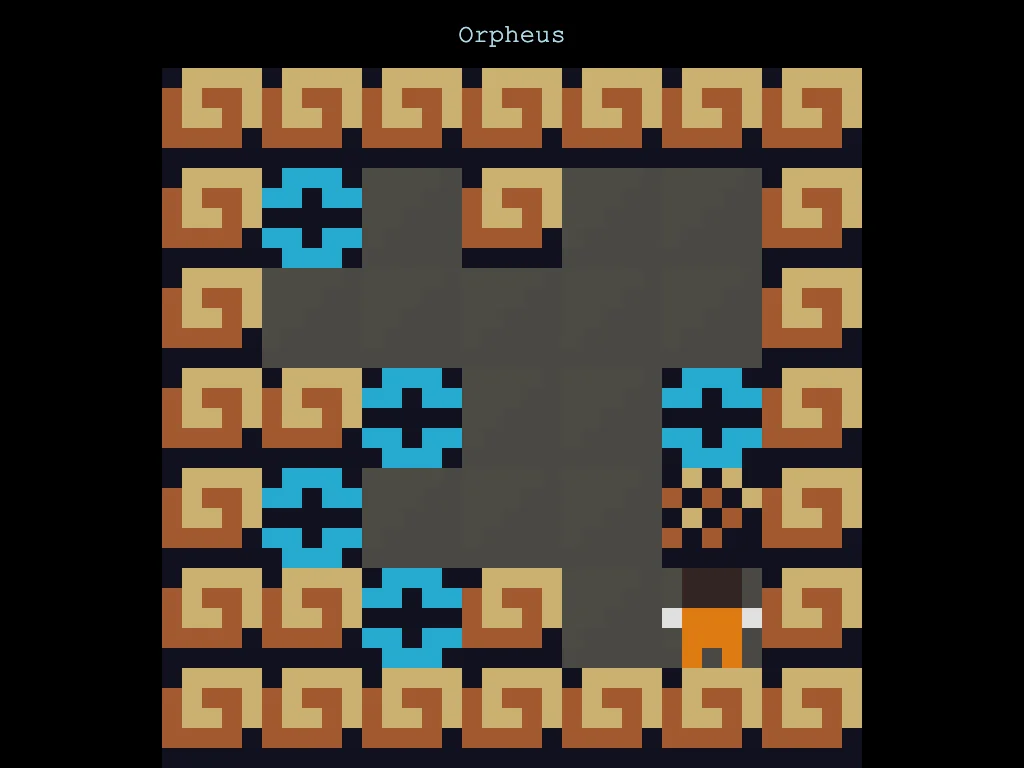
Orpheus is a small puzzle game in which the thing you manage is your own line of sight. You play a figure who slides across a tiled temple floor, and wherever you look you leave a mark: the walls at the end of your gaze count as seen. The goal of each room is to open every eye tile by looking straight at it. The catch, as the author puts it, is that you cannot look at any tile twice, so every slide has to be planned.
Eyes are also switches. An open eye sends power along the blue wires in the floor and opens the gates that block other parts of the room, so the order in which you open them matters as much as where you stand. There are six levels, the first two of them a short tutorial, and the layouts go from a few tiles to long corridors full of gates. The whole game, rules and levels included, is a short text file for the PuzzleScript engine, with the author's own pixel art.
Playing it here
Click Play and press X to start. Your progress is kept in this browser, and the game picks up at the level where you stopped. On a phone or tablet, on-screen buttons appear. Nothing is sent anywhere.
Controls
| Input | Action |
|---|---|
| Arrow keys, W A S D or on-screen pad | slide in that direction |
| Z or U | undo the last move |
| R | restart the level |
| X, C or Space | continue past a message |
A few things worth knowing
Undo is free. There is no move limit, so slide, see what you looked at and take it back.
Every slide ends with a look. The wall you end up facing counts as looked at, so plan where each slide stops, not only where it starts.
Open the gates in order. A gate that blocks the way is usually opened by an eye you can reach first; look for the wire that leads to it.
Credits and licence
Orpheus was made by Henrique Lacreta Alves ("Illusion Fisherman") and published under the MIT licence in the repository henriquelalves/Orpheus. The licence text, together with the licence of the engine, is linked from this page. The page is the standard standalone export of the PuzzleScript engine (MIT, Stephen Lavelle) with the game text inside; we only removed the link to the author's site and the "hack" button, which would send the code to another site, and replaced the one small part of the engine that was under another licence (GPL) with our own code.