
 Portugues
Netslide (Simon Tatham's Puzzles)
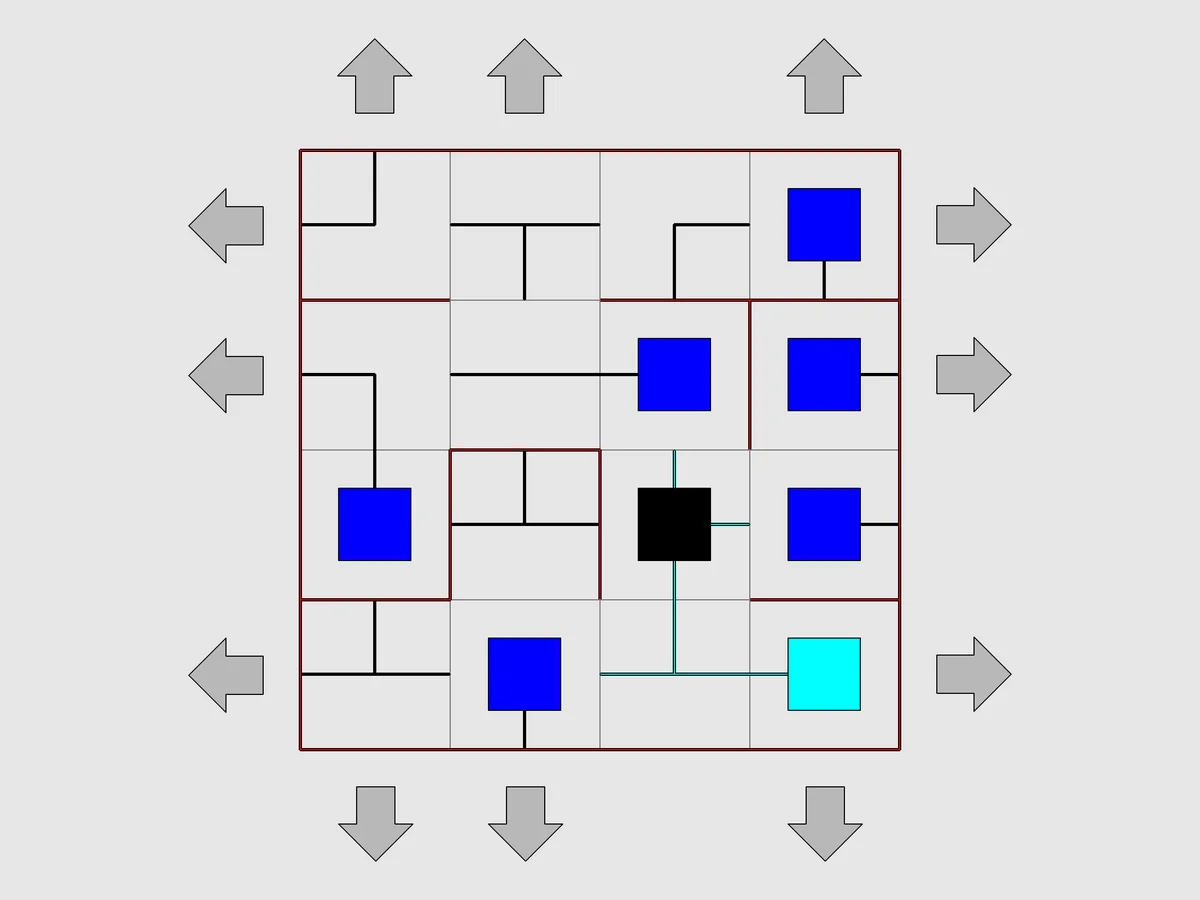
Saved games stay in this browser only.
About the puzzle
Netslide takes the network of Net and the moves of a sliding puzzle. The grid holds a tree of cables running out from a source tile in the middle, but the tiles have been shuffled around. You cannot turn them; instead you slide a whole row left or right, or a whole column up or down, and the tile pushed off one end reappears at the other. Put every tile back where it belongs and the whole network lights up.
Richard Boulton contributed it to the collection in 2004, as a cross between Net and the row-sliding puzzle Sixteen.
Rules
- Each move slides one row or one column by one square, wrapping the end tile round to the other side.
- The row and the column that pass through the centre never move, so the source tile always stays in the middle.
- Tiles keep their orientation; only their positions change.
- Tiles connected to the source are drawn lit. The puzzle is solved when every tile is connected.
- On some levels, fixed barriers lie between squares. They stay put while the tiles slide underneath, and no cable crosses them in the solution.
Controls
| Input | Action |
|---|---|
| Left click on an arrow | slide that row or column in the arrow's direction |
| Right click on an arrow | slide it the opposite way |
| Arrow keys | move the cursor around the arrows on the edge |
| Enter / Space | slide the row or column at the cursor |
| N / U / R | new game / undo / redo |
The status bar shows the number of moves and how many tiles are connected out of the total.
How to solve it
Start from the middle. The source tile never moves, and the four tiles around it can only move along their own rows or columns. Look at which ends leave the source and find tiles that can plug into them.
Read the shapes. There are only a few kinds of tile: dead ends, straight pieces, corners and T-junctions. Every cable from a placed tile must meet a matching cable next door, so the shape needed in each square is often obvious before you go looking for it.
Use the barriers. On the easy levels, a barrier says that no cable crosses that line. A tile next to a barrier can only be one whose cables point the other way.
Swap with three moves. Sliding a row moves everything in it. To change a single square, slide its column to bring a new tile in, slide the row to put the right tile in place, then slide the column back. Only a few tiles end up disturbed, and they are usually in parts you have not solved yet.
Watch the lit count. The number of connected tiles in the status bar is a quick check on whether a slide helped. A move that drops it sharply has pulled a placed tile out of the network.
Sizes and difficulty
The Type menu has 3x3, 4x4 and 5x5 grids at three levels: easy, with barriers everywhere the solution has no cable; medium, with no barriers; and hard, where there are no barriers and the network may also wrap round from one edge of the grid to the opposite one. Custom sets the width and height, wrapping, the barrier probability and, if you like, an exact number of shuffling moves to undo.
Playing here
Click Play to open the puzzle. The menu above the board has New game, Restart, Undo, Redo and Solve (which you can undo to keep going on your own), the Type menu with the sizes, and the Game menu, where you can type in a game ID or a random seed, download the current game as a file, load a saved file and change the preferences. Your game in progress is kept in this browser and comes back with its whole undo history the next time you open the page.
On a touch screen, tap an arrow to slide its row or column; turn on the Mark button above the board to slide the other way.
Credits and licence
Netslide was written by Richard Boulton for Simon Tatham's Portable Puzzle Collection, which Simon Tatham maintains with code contributed by several other authors and distributes with its source code under the MIT licence. This page runs a WebAssembly build made by FredyGames from the author's official source snapshot, with no changes to the puzzle; the source and the build script are hosted with the game, and the licence text is linked from this page.