
 Portugues
Umoria
Saved games stay in this browser only.
About the game
Umoria, whose full name is The Dungeons of Moria, is a single-player dungeon crawl that Robert Alan Koeneke started writing in 1981 and shared in 1983. James E. Wilson later turned it into the portable version that gave the game its name, and it spread through universities and early home computers. It is one of the ancestors of the whole roguelike genre: Angband descends from it, and its influence reaches action games like Diablo.
You start by building a character. There are eight races (from human to
half-troll) and six classes: warrior, mage, priest, rogue, ranger and
paladin. The class decides what you can do. Warriors hit hard, mages and
priests cast spells from books, rogues are good at stealth and disarming
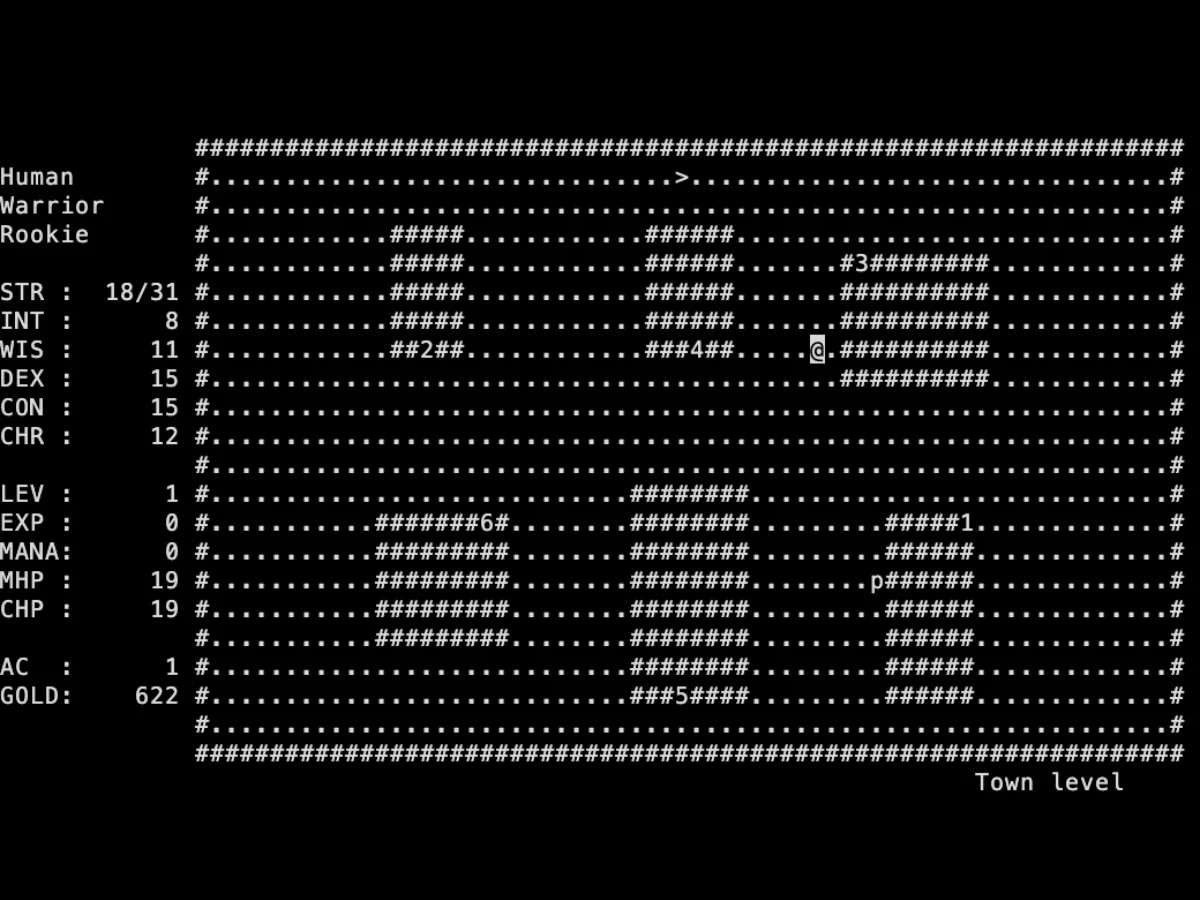
traps. Then you wake up in a small walled town with a little money, six
shops marked 1 to 6 on the map, and a staircase marked with >. Buy a weapon,
armour, a lamp, some food and a few potions, then go down.
Below the town the dungeon is built anew every time you take the stairs. Rooms and corridors are full of monsters, traps, doors, treasure, magic items that you only learn to identify by trying them, and ever tougher enemies as you go deeper. You gain experience by killing things and surviving. Your character is lost if it dies, so the whole game is about balancing greed against caution: when to push on, when to rest, when to read the scroll that takes you back to town.
Playing it here
This is Umoria 5.7, the modern edition that keeps the 1980s rules and adds no new gameplay, compiled for the browser from the project's source code. The download is under 1 MB. The screen is the game's original text screen, drawn in your system's monospaced font. There is no sound or music. Your saved character stays in this browser: press Ctrl+X (or ^ then X) to save and quit, and the game picks it up on your next visit. The game is in English and needs a keyboard.
Controls
| Key | Action |
|---|---|
| Arrow keys or 7 8 9 / 4 6 / 1 2 3 | move or attack in that direction |
| 5 | rest for a turn |
| < and > | take an up or down staircase |
| i / e | inventory / equipment |
| w, t, d | wear or wield, take off, drop |
| q, r, E | quaff a potion, read a scroll, eat food |
| m, p, b | cast a spell, pray, browse a book |
| . then a direction | run |
| R then * | rest until healed |
| L, M | look around the map, view the whole level |
| Ctrl+X, Ctrl+K | save and quit, give up (kill your character) |
| ? | the full list of commands |
Control commands can also be typed in two keystrokes: ^ and then the letter.
Tips
Shop before you dive. The general store (1) sells food, torches, oil and arrows; the alchemist (5) sells cure-light potions. Do not leave town without a source of light and a healing potion.
Do not stay and fight to the death. Few things are as final as a low-level character facing a pack. Retreat upstairs, rest to full health with R and then *, and come back.
Try unknown items when it is safe. Potions and scrolls are only identified by use. Do it near the stairs and at full health.
Read the help. The ? key lists every command, and the game's menus accept a capital letter to show a description of the choice before you pick it.