
 Portugues
Bisby's Escape
Saved games stay in this browser only.
About the game
Bisby is a robot who works in a mine and is perfectly content with it, until one day a strange urge to see the surface takes hold. The shaft to the top is in Zone 7-R, seven levels up, and every level is a block of packed dirt full of crates, energy and other robots that would rather you stayed.
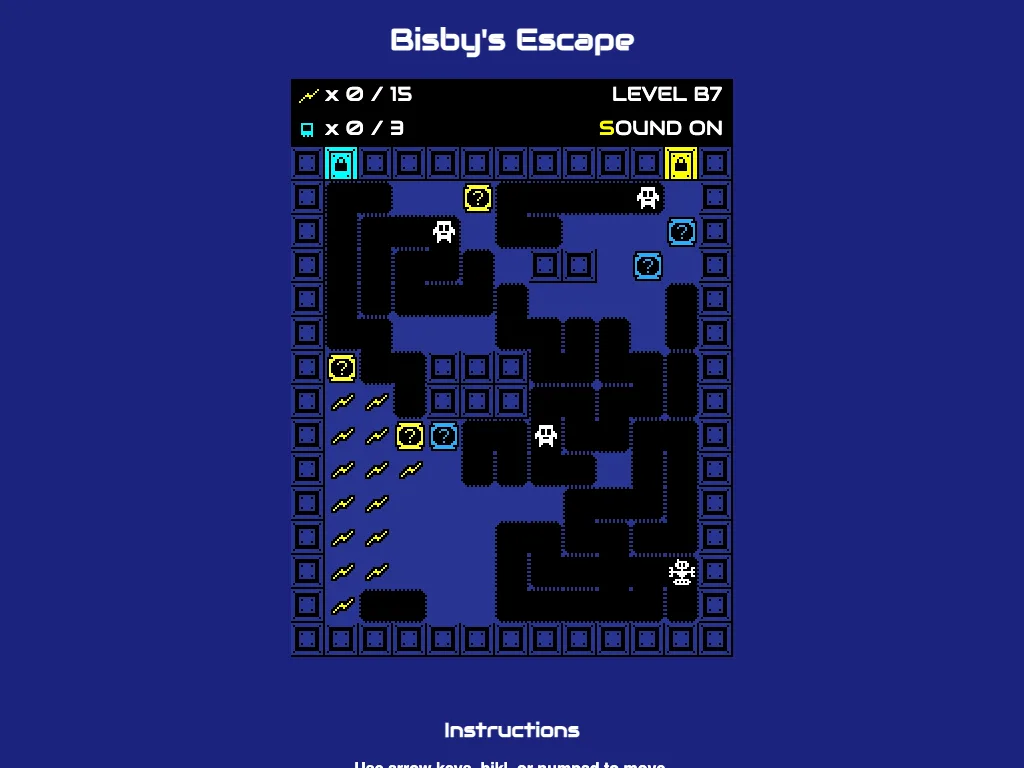
You dig your own tunnels as you move, which is the Dig Dug part, and you push crates around, which is where the puzzle comes in. A crate pushed over an enemy crushes it, and the crates have question marks on them for a reason: each kind does something different when it lands, and finding out what is half the game. Some are useful and some are dangerous, and the author's hint is that even the dangerous ones have their uses.
Each level can be finished in two ways. You can pick up every yellow energy unit scattered through the level (the counter at the top shows how many are left) and open the yellow gate, or you can crush enemies, collect the blue datachips they leave behind and open the blue gate. Both gates are on the top row.
The game is turn-based: the robots only move after you do, and crates follow after them, so you can stop and think as long as you like.
Playing it here
Click Play and the game starts at once, on the lowest level (B7). A game over asks for Space to try again. Nothing is saved between visits.
Controls
| Key | Action |
|---|---|
| Arrow keys, H J K L or numpad | move and dig |
| walking into a crate | push it |
| S | sound on or off |
| Space | try again after a game over |
A few things worth knowing
You can push a crate from the side, even through dirt. Digging a path first is often what makes a plan work.
Learn the crates. Try each new kind somewhere safe once, so that you know what it does when you need it.
Pick the cheaper gate. If the energy is all in one corner, collecting it can be simpler than hunting robots, and the other way round.
Credits and licence
Bisby's Escape was made by Matt Walsh for the 2016 7-Day Roguelike Challenge, and this is its version 1.3.0, with the later fixes and two extra crate types. The game is released under the MIT licence. It uses PixiJS and Howler.js (MIT) and rot.js (BSD 3-clause), and the title font is Audiowide (SIL Open Font License 1.1), now served from here instead of from Google Fonts. The licence texts are linked from this page.