
 Portugues
Monk Tower
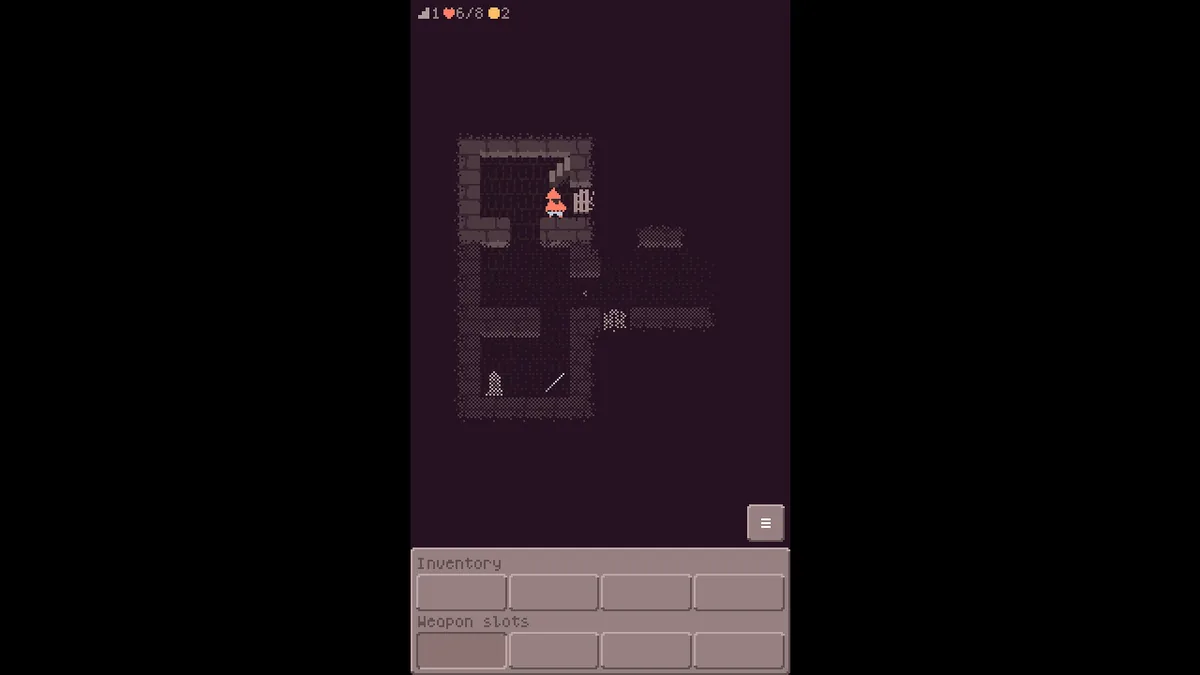
Saved games stay in this browser only.
About the game
Monk Tower is a short turn-based dungeon crawler built for quick sessions, which is why the author calls it a coffee-break roguelike. You are a monk climbing a tower of twenty floors, and somewhere on the last one lies the Second Book of Poetics, the object of the whole trip. Every floor is a handful of rooms joined by corridors, drawn in the dark and lit only around you, and nothing moves until you do: each step, each attack and each turn spent waiting is one tick of the world.
The monsters begin with rats and snakes and work their way up through vipers, basilisks, gargoyles, golems, ghosts and exorcists, and some of them attack from a distance. Fighting is done with whatever you find lying around: swords of three grades, an axe, a spear, a poisoned dagger, a warhammer, and wands that stun or push enemies away. The catch is that weapons wear out. Each has a durability that drops with use, so the right sword at the right moment matters more than a big pile of them, and a forge on some floors will repair one for a price.
Gold buys what the tower offers: a herbalist raises your health, and the forge repairs a weapon. Potions are the gamble. A healing potion, regeneration, immunity, a poison cure, teleportation and plain poison all look alike until you drink one, so the first sip of a new bottle is always a risk worth thinking about. The game saves after every turn, so you can close the page in the middle of a floor and pick the climb up where you left it.
Monk Tower was written in Rust by Maciej Główka, on top of his own small 2D engine called rogalik. The art is tiny pixel art in a muted palette, and the interface is designed for phones first, with big buttons at the bottom of the screen.
Playing it here
Click Play, then click once on the "Click to play" button inside the game. The game is made for a tall, phone-shaped screen, so on a wide window it appears as a centred column with black bars on both sides. On a phone it fills the screen, and you move by swiping on the board. Your climb is saved in this browser after every turn, and the title screen offers Resume when there is a saved run. The sound effects in this version were generated for this site.
Controls
| Input | Action |
|---|---|
| W A S D or arrow keys | move one step, or attack the enemy in that direction |
| Space | wait one turn |
| 1, 2, 3, 4 | pick one of the four weapon slots |
| Z, X, C, V | use the item in slot 1 to 4 |
| Q / E | when you stand on an item: Q takes it (PICK, WIELD or USE), E shows the next item (MORE) |
| Touch | swipe on the board to move, tap the buttons below the board |
A few things worth knowing
Wait for them. Moving next to a monster hands it the first hit; stepping back and waiting a turn (Space) lets it come to you and gives you the first strike. The game's own hints say the same.
Check the durability. A weapon at one use from breaking is a bad thing to trust in the middle of a fight; swap early.
Ranged enemies cannot hit you next door. A shooter that stands right beside you is harmless, so close the distance instead of running.
Test unknown potions in safe places. Drink them when you are at full health and no monster is near, and the poisonous ones will cost you little.
Credits and licence
Monk Tower and its engine rogalik were made by Maciej Główka and are released under the MIT licence; the sprites, the bitmap font and the title picture are his. The nine sound effects in the original repository do not say who made them, so this site replaces them with simple tones generated for it, in the public domain. The licence texts, the exact source, the patch and the build script, and the licences of the Rust libraries inside the program, are linked from this page.