Portugues
Freeware adventure classics: point-and-click games you can play free
In the late 1980s and the 1990s, the point-and-click adventure was one of the great genres of computer gaming. You guided a character through painted scenes, collected odd objects, talked your way past suspicious guards and solved puzzles that ranged from elegant to completely absurd. Most of those games are still sold or simply unavailable, and their rights holders have never allowed anyone to give them away. A few are different: their owners decided, years after release, to make them freeware, with written terms that let anyone share them. FredyGames hosts four of those, and this guide introduces them, explains the software that runs them, and offers some advice for anyone new to the genre.
Four games, four studios
Beneath a Steel Sky (1994)
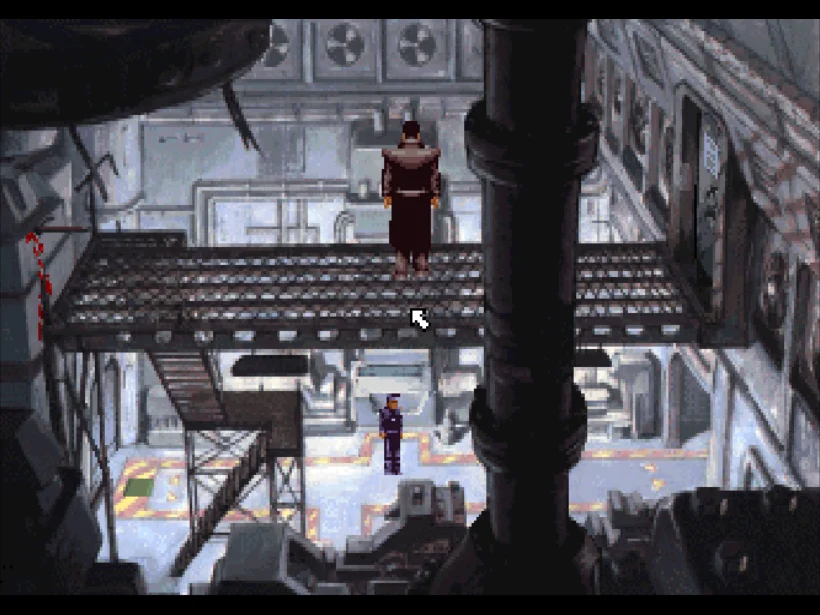
Beneath a Steel Sky is a cyberpunk adventure by Revolution Software, first published by Virgin Interactive for DOS and the Amiga. You play Robert Foster, taken from the wasteland where he grew up and stranded in Union City, a vertical metropolis where the poor work at the top of the towers and the comfortable live below. His only companion is Joey, a sarcastic robot whose personality lives on a circuit board and who can move into whatever machine body you find for him.
The comic artist Dave Gibbons, best known for Watchmen, designed its backgrounds and characters. The tone mixes a serious story with a steady stream of dry jokes. Revolution released the CD version, with full speech, as freeware in 2003, together with the ScummVM project, and that is the version you play here.
Flight of the Amazon Queen (1995)
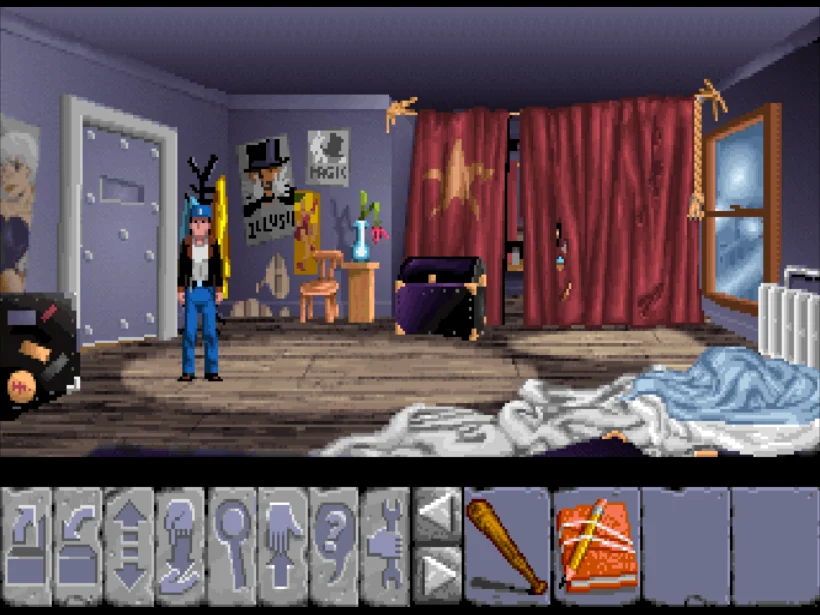
Flight of the Amazon Queen is a comedy in the style of old adventure serials, made in Australia by John Passfield and Steven Stamatiadis of Interactive Binary Illusions and published by Renegade Software. Joe King, a pilot for hire with one battered seaplane, is supposed to fly a film star into the Amazon for a photo shoot. Naturally, the trip goes wrong, and he ends up in a jungle full of Amazon warriors, unexpectedly tall pygmies, hapless explorers and a much bigger plot.
Its humour is broad and fast, and its puzzles often reward the silliest idea available. The authors released the CD "talkie" version as freeware in 2004, again through ScummVM.
Lure of the Temptress (1992)
Lure of the Temptress was Revolution Software's first game, published by Virgin Games. Diermot, an ordinary man caught up in a lost battle, wakes in a cell in a town now ruled by a sorceress and her brutish servants. Its big idea was what Revolution called Virtual Theatre: the townspeople walk their own routes, go to work and talk to each other, and part of the game is learning who can help you and where to find them.
It is shorter and plainer than the studio's later games, but its living town still feels unusual. Revolution released it as freeware with permission to distribute it. On FredyGames it runs as the original DOS program in DOSBox. One practical note: the original starts with a copy protection screen, and you skip it by opening the menu at the top of the screen and choosing Restart.
Sfinx (1997)
Sfinx comes from Poland, from the studio Laboratorium Komputerowe Avalon (L.K. Avalon). Two children, Vincent and Anna, live in the same apartment block when every electric device in the building dies. An absent-minded professor explains that a tiny alien fell through a black hole and landed nearby, and the two set out to help it get home, trading favours with a gallery of eccentric neighbours.
You control both children and switch between them at any time, and many puzzles depend on choosing who does what. L.K. Avalon released the game as freeware, and the English translation by Arnaud Boutonné and Thierry Crozat is the version hosted here. The voices remain in Polish, with English text in speech bubbles.
How ScummVM works
Three of the four games run in ScummVM, so it is worth knowing what it is.
ScummVM began in 2001 as a way to play the LucasArts adventures on modern computers. Its name comes from SCUMM, the Script Creation Utility for Maniac Mansion, the system LucasArts used to build those games. Over the years it grew far beyond that one engine: today it supports hundreds of games built on dozens of different engines, from many studios.
The key idea is that ScummVM is not an emulator. It does not imitate a 1990s PC and run the original program. Instead, its developers re-implement each game engine, the program that reads a game's scripts, pictures and sounds and turns them into something playable. They do this by studying how the original behaves or, sometimes, by working from source code the studio provided. ScummVM then reads the original game data files unchanged. That approach has some welcome consequences: the games run on systems their makers never imagined, bugs from the original releases can be fixed, and features such as saving at any moment work the same way across games.
It also explains why ScummVM itself never includes the games. It is free software under the GNU GPL, and the data files remain the property of their owners. For a handful of titles, including the three here, the owners agreed to release the data as freeware, and the ScummVM project distributes those packages on its website with the original licence texts.
On FredyGames, we compile ScummVM for the browser with Emscripten, a toolchain that turns C++ into WebAssembly, and include only the engines our games need. The game files are served exactly as the freeware packages contain them, with their readme next to them. The first load is large, roughly 40 to 80 MB depending on the game, engine included, because everything downloads before the first scene; after that your browser usually keeps a cached copy. The complete source code of our ScummVM build is linked from the licences page, as the GPL requires.
Freeware is not abandonware
Old commercial games are often described as "abandonware" when nobody seems to sell them any more. That word has no legal meaning: a game is still protected by copyright whether or not anyone is selling it, and only the rights holder can allow copies. FredyGames does not host abandonware.
These four games are different because each rights holder published a licence that explicitly allows free redistribution. The terms vary a little, but they share the same core: the game may be copied and shared for free, on any medium, as long as the readme or licence file and the copyright notices stay intact, and nobody charges for the game itself. We keep those files alongside the game, link the original text from each page, and never charge for playing. A freeware label without terms that allow redistribution would not be enough. Our guide to how we check every licence explains these rules in detail.
How to play a point-and-click adventure
If you have never played one, a few habits make the genre much more enjoyable.
Examine everything. Look at every object, door and person. The descriptions are often funny, and they are where most hints hide. In Sfinx, the name of whatever is under the pointer appears on the panel, which tells you what is worth clicking.
Pick up anything that is not nailed down. Adventure heroes have bottomless pockets (except in Sfinx, where each child has only four). An item that looks useless now is almost always needed later.
Combine and use items on things. Many puzzles are solved by using one item on another, or on a person or object in the scene. Select it in the inventory, then click where you want to use it. If you are stuck, try each item on the thing blocking your way.
Talk to everyone, and come back. Go through every dialogue option. People often say something useful only after small talk, and what they say can change after events in the story. In Lure of the Temptress, people also move around town, so the person you need may simply be somewhere else for now.
Think like the game. Beneath a Steel Sky is mostly logical; Flight of the Amazon Queen often prefers the joke. If the sensible solution fails, try the silly one.
Save often, and keep several saves. Some of these games, notably Beneath a Steel Sky, have moments where you can die. Save before trying anything risky.
Saving and controls in our player
Each game saves from its own menus, and those saves stay in your browser:
| Game | Save and load | Other useful keys |
|---|---|---|
| Beneath a Steel Sky | F5 opens the control panel (save, load, options) | Esc skips a cutscene, . (period) skips a line |
| Flight of the Amazon Queen | F5 opens Joe's journal; F11 / F12 quick save and load | Space skips a line, Esc skips a scene |
| Sfinx | F5 saves, F7 loads | Esc closes a speech bubble and skips the intro |
| Lure of the Temptress | Menu at the top of the screen (save, restore, restart) | Right click opens the list of actions |
In the three ScummVM games, Ctrl+F5 opens the ScummVM menu, which has its own options. A mouse is the best way to play: on a touch screen a tap works as a left click, which is enough for Sfinx and for most of Flight of the Amazon Queen, but Beneath a Steel Sky needs the right button for many actions. Our guide to playing in your browser covers where saves are stored and what clearing site data does to them.
Where to go next
If you enjoy stories you solve rather than fight through, two other corners of the catalogue are worth a visit. Soyuz 404 is a short point-and-click adventure made for the web in only 13 kilobytes; our guide to browser games and js13kGames has more like it. And before point-and-click, adventures were typed: the text adventures on FredyGames, from Zork I to modern works, are the genre's roots, and our beginner's guide to text adventures explains how to play them.