Portugues
Quick games for a five-minute break
This guide is about games where a round fits into a short break, the rules take a few seconds to explain, and losing costs nothing because starting again is one key press away. All of them run in your browser on FredyGames, with nothing to install, and they come from many platforms: fantasy consoles, tiny handhelds, a 1970s virtual machine and plain web pages.
We sorted them by the break you have, not by genre.
What makes a game good for a short break
A few traits mark the games that suit a quick session:
- A round ends on its own. Either you lose within a minute or so, or the game has a built-in limit, such as a fixed number of moves or a countdown.
- Restarting is instant. No menu, no loading screen, no long intro to sit through. One key and you are playing again.
- The rules fit in a sentence. If you need a tutorial, you are no longer taking a break.
- There is a number to beat. A score, a distance or a time turns "one more try" into the natural way to use the leftover minute.
About a minute: one idea, one key, instant restarts
These games throw you into the action and end on the first mistake. A run lasts from a few seconds to a minute or two.
Falldown
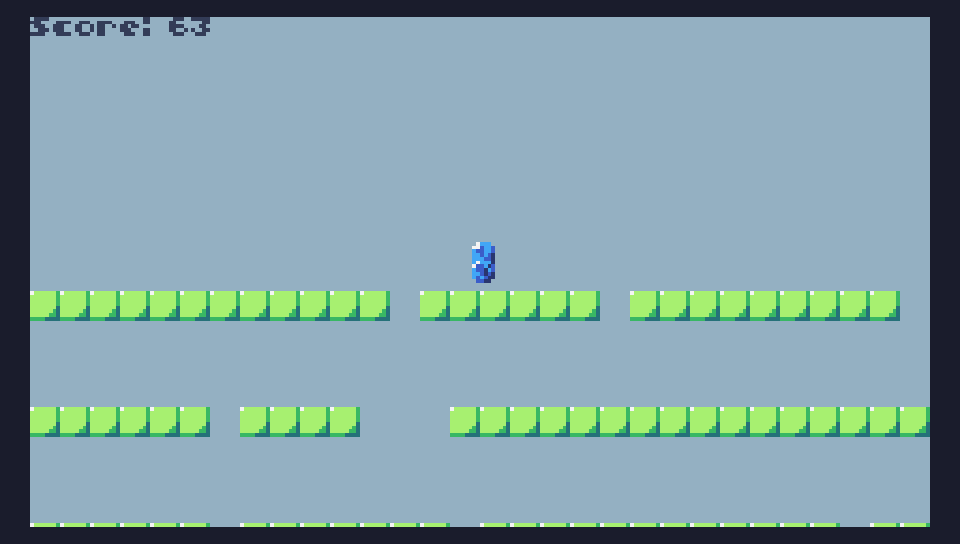
Falldown is a game for the TIC-80, a fantasy console (our guide to fantasy consoles explains what that is). You are a ball at the top of the screen, and rows of blocks with a gap in each one rise from below. Slide left and right so that the ball drops through the gaps. When the rows push you against the top of the screen, it is over, and your score is how far you went.
Why it fits a break: runs last seconds, and the author, Colin Woodbury, built it as a remake of an old graphing-calculator game, so the idea is as small as it gets. On the title screen you choose Fast or Slow, and the slow mode is where to learn how the gaps are laid out. Your high score is kept in this browser. You need a keyboard, because Space starts and restarts the game.
Dino Run
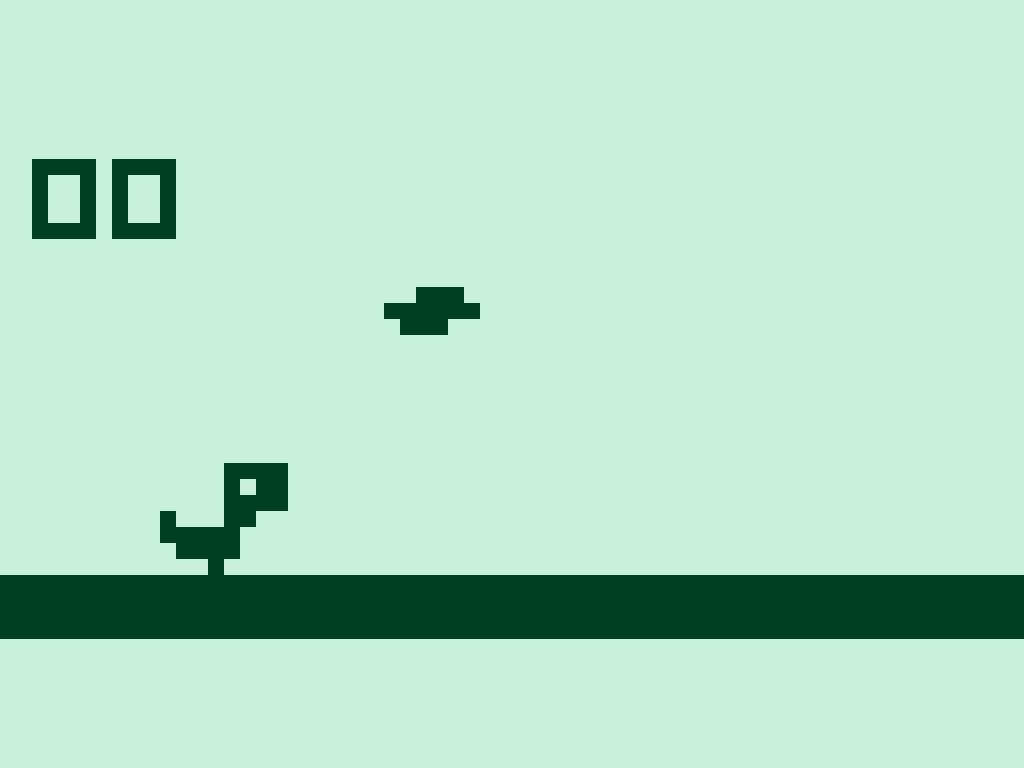
Dino Run is an endless runner with a single button, written for CHIP-8, a small virtual machine from 1977 that hobbyists still write games for. A dinosaur runs across the desert, cacti arrive from the right, and the only thing you do is jump. Each cactus you clear is a point.
Why it fits a break: press W or Up to start, press it again to try again. The cacti speed up at 3 and 6 points and keep getting faster until 40, and since the jump is always the same, timing is the whole game. Take off sooner than feels natural once the pace picks up. Every ten points the screen flips between light and dark with a beep, which gives a run a small sense of progress.
Dodgeball
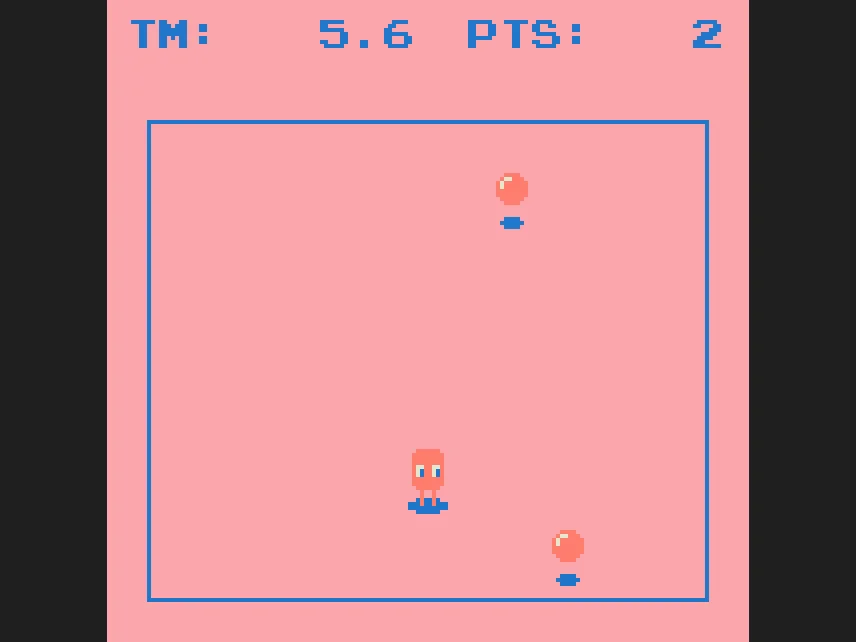
Dodgeball is for WASM-4, a console with a four-colour screen. Sander in 't Veld has said he built it in a single day. You run around a small court while balls fly in from the edges, and a round ends the moment one touches you. The game then shows how long you survived and how many balls went by.
Why it fits a break: it is 23 KB and starts instantly, and every ball is announced by a warning mark at the edge before it appears, so you can decide where to go in advance. Balls come more often as time passes, and after about a minute the fast ones appear. A word of warning: you can only run in one direction at a time, so there is no diagonal escape, and the walls are deadly too, so stay near the middle. Holding Z makes the walls harmless, which is good for practice. This one does not save anything.
down8
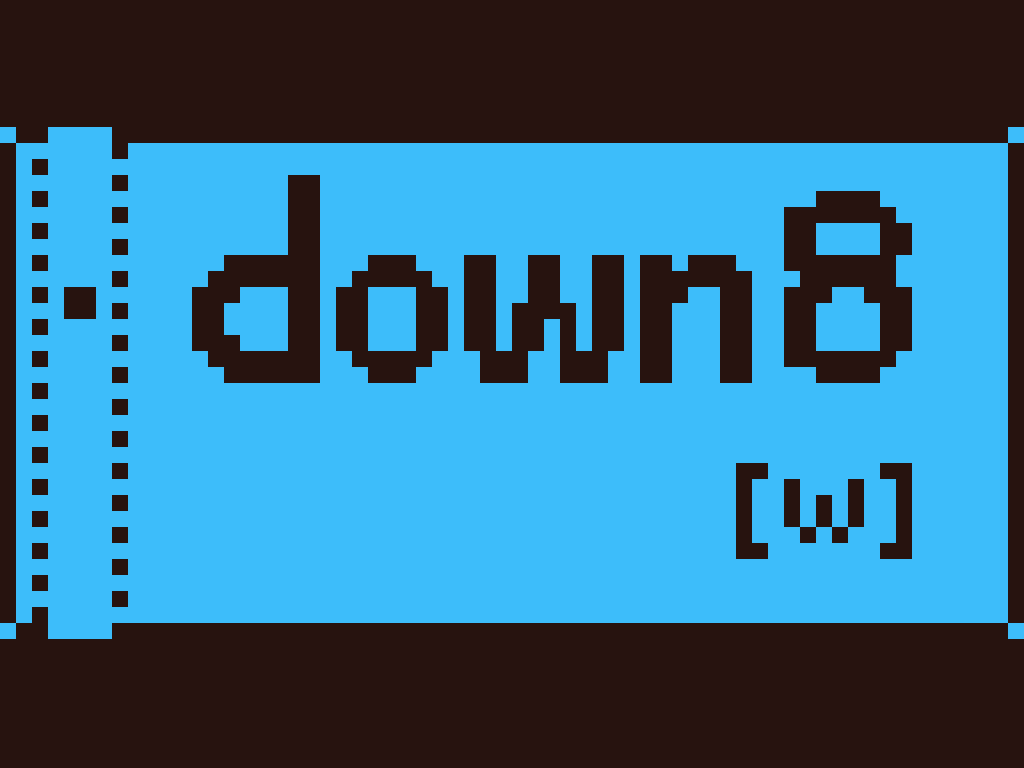
down8 is another CHIP-8 game, made for Octojam 2 in 2015. You fall down an endless shaft and steer left and right to land on platforms, which break and add to your combo. Miss a platform and you lose a point of health. Reach the bottom of a screen and the next one begins. After ten levels the platforms narrow, and after twenty they are one pixel wide.
Why it fits a break: a run ends when your health does, with the level you reached and your best combo on the screen. One thing to know before you start: do not hold W during the fall, because that stops you from bouncing. Press it only on the menus.
Up to five minutes: a little more to think about
Here the rounds are longer or the decisions are heavier, but the game still has a clear finish line.
Evasion
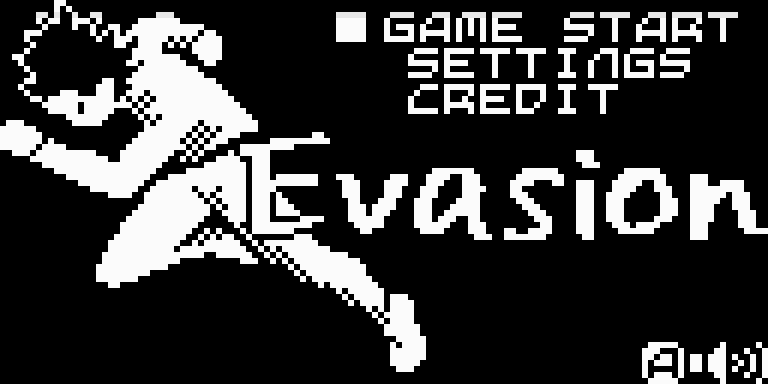
Evasion is a game for the Arduboy, a credit-card-sized handheld with a black-and-white screen. A runner sprints forward through a field of pillars that rush at the screen in 3D, and you dodge left and right. Distance is your score, and the first pillar you hit ends the run.
Why it fits a break: it is as simple as an arcade game gets, but the settings screen lets you change the starting speed, whether the run accelerates, and how dense and thick the pillars are. That means you can choose a relaxed warm-up or a frantic test of reflexes. Tap in short bursts rather than holding a direction, and watch the small pillars in the distance, since they tell you where the next gap will be. The records are kept in this browser.
ARDUBULLETs
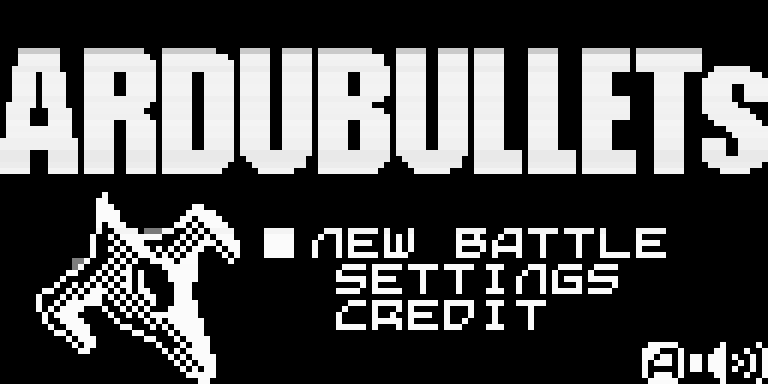
ARDUBULLETs comes from the same author, OBONO, and is a bullet-hell shooter that lasts exactly one minute. Twelve waves of enemies arrive, one every five seconds, each spraying bullet patterns. One hit loses the battle, and surviving the minute wins it.
Why it fits a break: the length is fixed, so you always know what you are signing up for. Holding the fire button (X) shoots and slows your ship down at the same time, which gives you the tiny movements that dense patterns need. Release it to cross the screen fast. Every battle is generated from a code: NEW BATTLE rolls a fresh one, and RETRY replays the same one, so a hard battle can be learned wave by wave.
Flooder
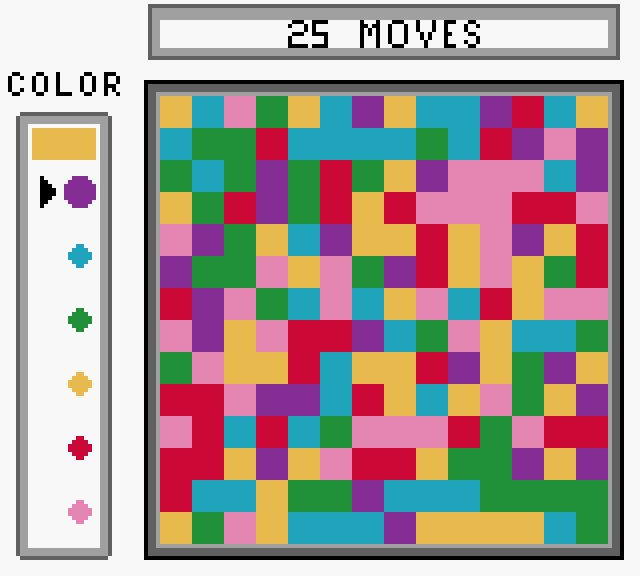
Flooder is a puzzle for the Game Boy Color (for more homebrew on that console, see our guide to Game Boy homebrew). A 14 by 14 board of squares in six colours is scattered at random, and the top-left square is yours. Each turn you pick a colour, your area turns that colour and swallows the neighbouring squares of the same colour. Fill the board with a single colour in 25 moves or fewer to win.
Why it fits a break: the 25-move limit gives a game a natural end, a loss is quick, and a fresh random board is one press of Start away. Choosing the colour you already have costs no move. For better results, pick the colour that touches your area along the longest border instead of the one that appears most on the board, and open a path to the far corner early.
EntroPipes
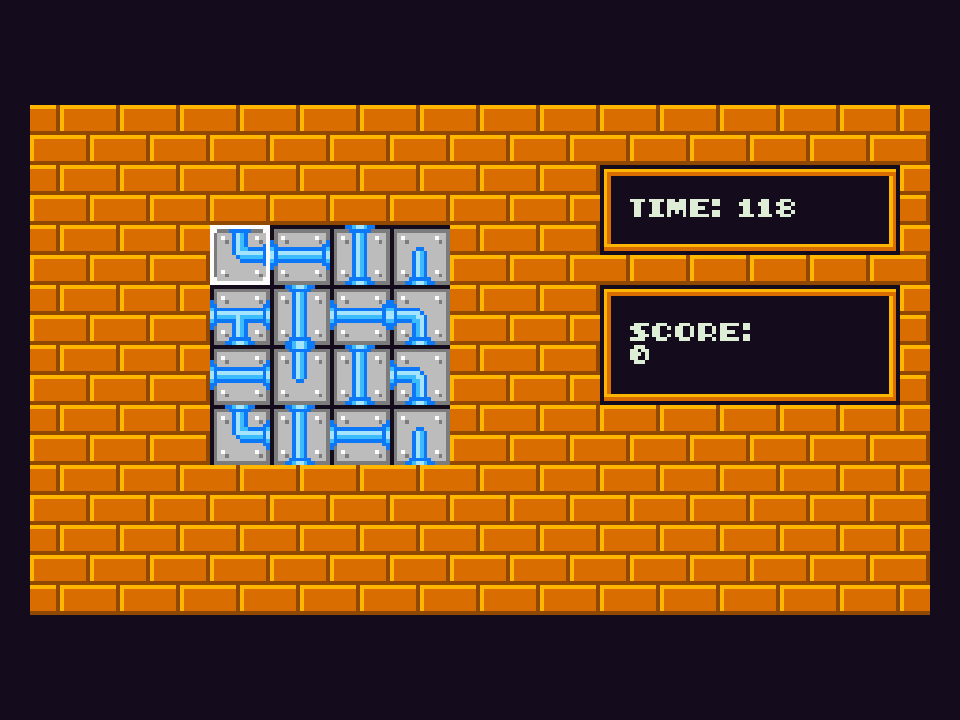
EntroPipes is a pipe puzzle for TIC-80 by Alfonso Saavedra, known as Son Link. Each grid is full of pipe pieces, straight, bent, T-shaped, crossed and dead ends, turned in random directions. Rotate them until every open end meets another and nothing leaks. There are four grid sizes, 4 by 4 up to 8 by 6, with 20 puzzles each.
Why it fits a break: it is a race against the clock that starts at two minutes. Every solved grid adds 30 seconds and scores ten points per second left, so finishing small grids quickly builds a cushion for the harder ones. Begin with the pieces on the edges and in the corners, since they can only sit in one or two ways, and the middle falls into place after that. The best score for each size is saved in this browser.
Mouse or a single button
Not every break comes with a keyboard in reach. These four need only a mouse or one button. All four are browser games, and you can find more of them on the browser games platform page; our guide to browser games and js13kGames tells the story of the competition behind many of them.
1x111
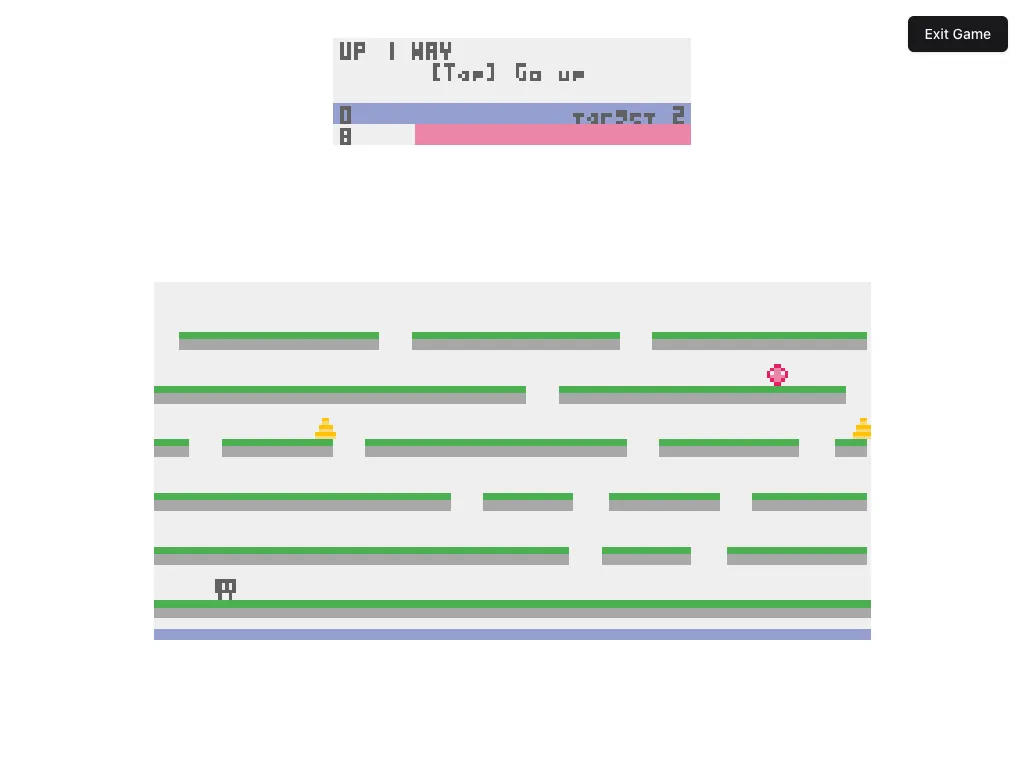
1x111 is a collection by Kenta Cho (ABA Games) of 111 mini-games that all use the same single button. Start a round and five of the unlocked games are picked at random, each lasting eleven seconds with its own target score. Reach the target and you earn a star. Miss it and the next game starts at once.
Why it fits a break: a full round is about a minute, and nothing needs explaining. Each game states in a couple of words what the button does, such as tap to jump, hold to charge or release to throw, and the best way to learn is to press and see. You start with eleven games, and every five stars unlock one more. Progress is kept in your browser, and Endless mode keeps picking games until your stars run out.
Box Snake
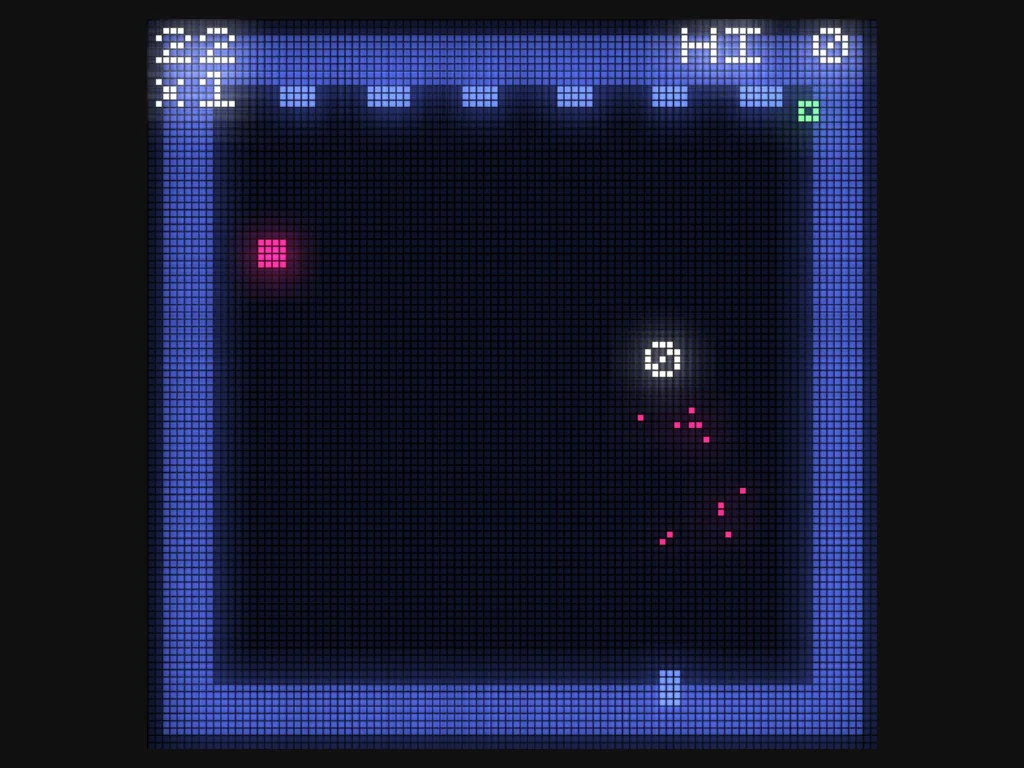
Box Snake is another single-button game by the same author. A snake lives on the inside wall of a glowing box, and red balls bounce around inside. Hold the button and the head crawls along the wall, making the snake longer. Release and the tail catches up. A turret travels along the body firing into the box, so a long snake is a long firing line, and a bigger target.
Why it fits a break: the whole game is one decision, how long to be. Going all the way round the box raises your multiplier. The best score is only remembered while the page stays open, so play for the number, not the record.
Coil
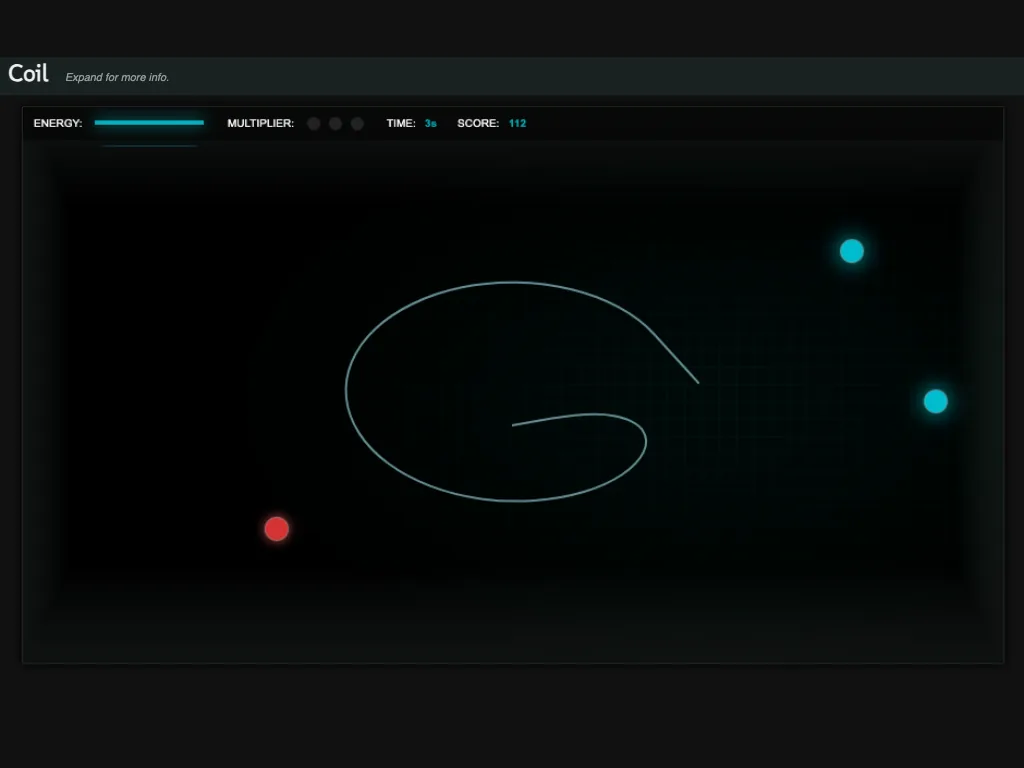
Coil is played with the mouse alone, and it is a game from 2011 by Hakim El Hattab. A glowing line follows your pointer. Draw a loop around the blue orbs to capture them before they burst. Red orbs are the opposite: leave them alone. Orbs that burst, and red ones you catch, drain the energy bar, and the game ends when it runs out.
Why it fits a break: a game usually lasts a minute or two. Catching several orbs in one loop raises a multiplier up to four, so it pays to wait until a few have gathered. Small, quick circles are safer than huge sweeps. It also works by dragging a finger on a touch screen. Scores are not saved.
Bubble Popper
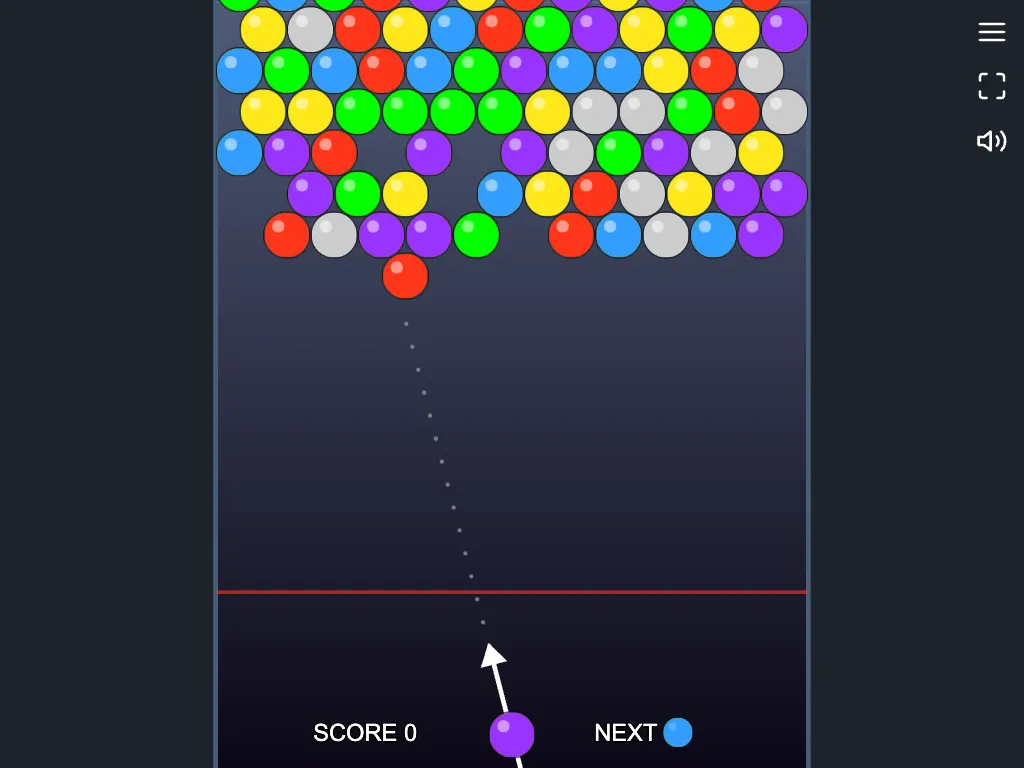
Bubble Popper is a bubble shooter by Frank Force. Aim with the mouse, click to fire, and pop groups of two or more bubbles of the same colour next to your shot. Bubbles left hanging in the air fall for bonus points, and the ceiling lowers slowly. If the bubbles reach the red line, you lose.
Why it fits a break: you can stop at any time, and the rules are the familiar ones of a bubble shooter. Bounce shots off the side walls to reach awkward spots, and aim for the bubbles that hold a group to the ceiling to drop it all at once. Looking at the next bubble lets you plan two shots in advance.
Scores and saving
Know before you chase a record: Falldown, Evasion, ARDUBULLETs and EntroPipes keep their records in your browser, while Dodgeball, Box Snake and Coil do not keep a score between visits. Our guide to playing retro games in your browser explains the saving options in more detail, and the tiny handhelds are in Arduboy and Uzebox.
Where to start
If you have a minute: Falldown. If you have two, Dino Run, which you will understand before the page finishes loading. For a break of about five minutes with a keyboard, try ARDUBULLETs for a fixed minute of bullet-dodging, or Flooder for a puzzle with a clear end. If you only have a mouse and a free hand, Coil is the most unusual of the lot, and 1x111 is the one to try if you cannot decide, since it picks for you.